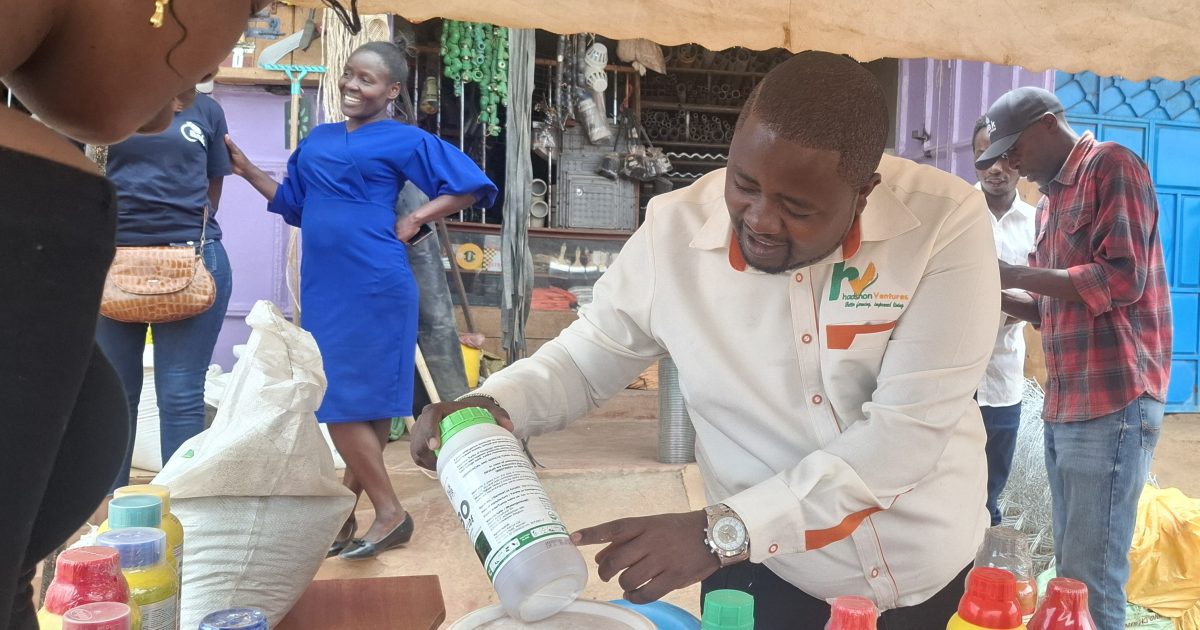
As the morning sun rises over the sprawling Mwea Irrigation Scheme, farmers begin streaming into Hadshon Ventures carrying wilted rice leaves, photographs of diseased crops, and empty pesticide containers.
Others simply want advice before the planting season gathers momentum.
By the end of the day, nearly 100 farmers will have passed through the agrovet shop seeking help.
For Alex Munene, CEO of Hadshon Ventures, every customer represents more than a sale. “We are the closest contact with the farmer,” he says. “That means we are very key.”
It is a role that has transformed the modern agrovet from a pesticide retailer into an agricultural adviser, educator, and environmental steward.
Some farmers walk into his shop knowing exactly what they need. Many do not.
Instead of reaching for the shelves, Munene and his team of two trained agronomists first seek to understand the problem. They regularly visit farms to inspect crops, diagnose pest and disease outbreaks, and recommend the most appropriate solution.
“Our responsibility is not just to sell products,” he says. “We have to make sure the farmer understands what they are buying, why they need it, and how to use it correctly.”
Every product stocked at Hardshon Ventures is sourced from authorized distributors such as Mazao Afya Ltd. and must be registered by the Pest Control Products Board (PCPB).
Before accepting any delivery, the products are checked to ensure they meet regulatory requirements and have sufficient shelf life.
The stock is then arranged using the “first in, first out” system, ensuring older products are sold before newly delivered ones to minimize the risk of expiry.
Munene, who spoke to KNA during a media tour in Mwea organized by the aak-Grow CropLife and Pest Control Product Board (PCPB), says the relationship between distributors and stockists has evolved beyond business.
“Continuous training equips agro-dealers with the technical knowledge to guide farmers on product selection, safe handling, emergency response, and proper disposal of pesticide containers,” he says.
The training is delivered jointly by aak-GROW/CropLife Kenya and the PCPB.
aak-GROW Chief Executive Officer Joel Mutai says the program recognizes that agrovet shops are often the first place farmers turn to for both products and advice.
“The agrovet is the main source of two things for the farmer, the products and the information,” says Mutai, adding that aak-GROW and PCPB work together to continuously train stockists so they have the knowledge to protect human health, the environment, and the farmer’s produce.
The training is ongoing, not a one-off exercise, ensuring stockists remain updated on new products, regulations, and emerging challenges in pesticide stewardship, adding that the industry is also strengthening traceability systems to ensure pesticides can be tracked from manufacturers to distributors and eventually to farmers.
“We already have mechanisms to trace products from manufacturers to distributors. We are now developing systems that will enable us to trace products all the way to the end user. This helps us know where products go, prevents diversion into illegal markets and reduces cases of products expiring within the supply chain, “Mutai said.
That partnership is reinforced through strict government oversight, and according to PCPB compliance and enforcement officer Cynthia Irungu, AgroVet outlets across the country undergo routine, unannounced inspections to ensure compliance with pesticide laws.
“Our inspections are random. We do not announce our visits,” she says. Inspectors examine whether premises are suitable for storing pesticides, verify that every product bears a valid PCPB registration number, and remove illegal products from the market.
Those include counterfeit, unregistered, smuggled, and expired pesticides, as well as products repackaged into unapproved containers.
“When inspectors find those products, they remove them from the market,” Irungu says, adding that offenders risk prosecution while minor first-time offenders may receive administrative warnings.
The board also scrutinizes the qualifications of agrovet attendants.
“It is a requirement that whoever dispenses pesticides must have technical knowledge; the attendant must be qualified in an agriculture-related course so they can advise farmers correctly,” she explains.
PCPB General Manager for Compliance and Enforcement Lawrence Kalawa say the law requires every agrovet to have a qualified agricultural professional whose credentials are displayed in the shop.
“The farmer should not just be given a product,” Kalawa says. “The attendant must understand the problem and advise on the right product and how it should be used.”
He says agro-dealers are only allowed to source pesticides from authorized and physically identifiable distributors, a measure aimed at choking the supply of counterfeit and illegal products.
“We discourage buying pesticides from unknown people moving around on foot or motorcycles because that is one of the channels through which illegal products enter the market,” he says.
Kalawa adds that stockists also play a crucial role in preventing expired products from reaching farmers by ensuring deliveries have adequate shelf life and applying proper stock rotation.
For Munene, those standards have changed how agrovet businesses operate.
Instead of simply selling products across the counter, his team spends time explaining dosage rates, correct mixing procedures, pre-harvest intervals, and the importance of using clean water when preparing pesticide sprays.
He also encourages farmers to wear protective clothing and never reuse empty pesticide containers.
Instead, farmers are advised to triple-rinse the containers, puncture them, and return them to designated collection centres for safe disposal.
Mutai says aak-GROW and PCPB have intensified awareness campaigns to reinforce those messages, and that in Mwea alone, the two organizations recently spent a week visiting all seven irrigation sub-schemes, reaching more than 1,000 farmers with information on the safe purchase, transportation, storage, mixing, and application of pesticides.
They have also trained more than 90 spray service providers in Kirinyaga County and continue to conduct nationwide anti-counterfeit, herbicide stewardship, and poison information campaigns.
Beyond protecting farmers, the initiative seeks to protect the environment.
Mutai says they have established more than 15 pesticide container collection centres across farming schemes and continue to expand the network in partnership with regulators and industry players.
“These products have been scientifically evaluated and, when used correctly, have minimal impact on the environment,” he says. “Our responsibility is to ensure those standards are maintained all the way to the farmer.”
Munene says years of training have produced noticeable changes. “Five years ago, many farmers did not take safety seriously. Today I would say about 95 percent understand the importance of protective clothing and proper handling.”
Challenges, however, still exist, and some farmers occasionally mix pesticides with dirty water, ignore dosage instructions, or fail to observe recommended waiting periods before harvesting, but Munene believes continuous education is making a difference.
Although his business earns its income from selling agricultural inputs, he says long-term success depends entirely on the farmer’s success. “I can sell a product today because I want to make money, but if it doesn’t help the farmer, that farmer will make losses and will not come back.”
For Munene, the real measure of success is not the number of bottles sold, but the harvests that follow.
As farmers leave his shop carrying carefully selected products and freshly acquired knowledge, Munene knows each one is taking home more than a pesticide. They are carrying the combined efforts of regulators, industry, and agro-dealers working together to keep Kenya’s food production safe, productive, and sustainable.
“More than 60 percent of Kenyans depend on agriculture for their livelihoods,” says aak-Grow CEO Mutai. “If we all play our part, from manufacturers and regulators to stockists and farmers, we will continue producing safe food, protecting the environment and securing livelihoods for generations to come.”
Government laws on pesticides in Kenya are primarily anchored by the Pest Control Products Act, which regulates the import, export, manufacture, distribution, and use of pest control products through the Pest Control Products Board (PCPB).
In recent regulatory actions, the government withdrew and banned 77 highly hazardous pesticide products to protect public health and the environment.
By Wangari Ndirangu