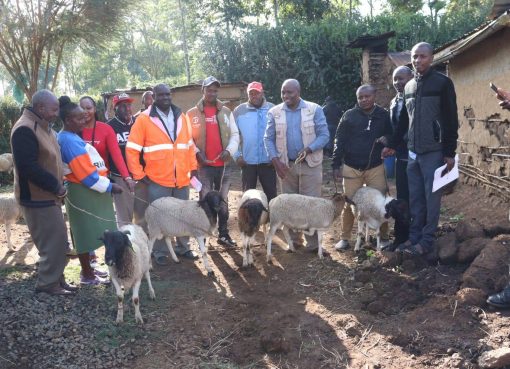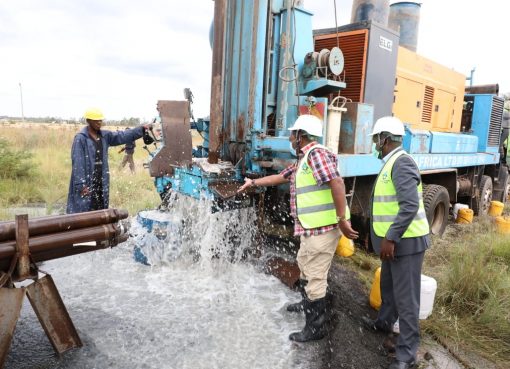
Farmers in Nakuru County are exploring improved irrigation management practices to increase agricultural production, strengthen household incomes and make irrigation schemes more sustainable.
Consequently, farmers from Lari Wendani Irrigation Scheme in Subukia and Kabugi Irrigation Scheme in Gilgil participated in a peer-to-peer exchange visit to Mitoini Phases 1 and 2 and Kibirigwi Irrigation Schemes in Kirinyaga County.
The visit exposed the farmers to practical approaches used by established irrigation schemes to manage water, operate infrastructure and maintain facilities for reliable agricultural production.
Nakuru County Agriculture Chief Officer Engineer Margaret Kinyanjui said effective irrigation requires proper management, collective responsibility and efficient use of available resources.
She said the exchange would help farmers develop the capacity needed to manage irrigation infrastructure and maximise its contribution to food production and livelihoods.
“Peer-to-peer learning gives our farmers an opportunity to see what other farmers are doing, learn from their experiences and identify practices that can be adapted to our own irrigation schemes,” Eng. Kinyanjui said.
She added that the approach would strengthen farmer ownership and capacity, even as the county moves towards completing and fully utilising its irrigation investments.
The initiative is being implemented under the Farmer-Led Irrigation Development (FLID) approach through the National Agricultural Value Chain Development Project (NAVCDP).
FLID shifts greater responsibility for irrigation development and management to farmers, either individually or through organised groups.
The approach allows farmers to invest, operate and manage irrigation systems, while accessing technical support, finance, technologies and markets.
The World Bank identifies financing, knowledge and market access among the major constraints limiting smallholder irrigation development in Kenya.
It says farmer-led irrigation can improve productivity and incomes, while strengthening resilience to climate shocks and market volatility.
NAVCDP has therefore incorporated irrigation into wider climate-smart value-chain investments, while its FLID component supports water harvesting, efficient irrigation technologies, affordable financing and improved water management.
The project targets 20,000 hectares of new or improved irrigation services by the end of its implementation period.
It also seeks to improve farmers’ capacity to manage water resources sustainably and increase the reliability of agricultural production.
The programme is particularly important as Kenya seeks to reduce the vulnerability of agriculture to unreliable rainfall.
According to the Kenya National Bureau of Statistics, agriculture gross value added increased by 2.8 percent in 2025 to Sh1.75 trillion.
However, the sector recorded slower real growth amid adverse weather conditions.
Consequently, irrigation remains central to Kenya’s strategy for increasing agricultural productivity while reducing dependence on rainfall.
The National Irrigation Sector Investment Plan records about 711,933 acres equipped for irrigation in 2023, representing about 21 percent of the country’s estimated irrigation potential.
The plan targets 1.5 million acres of developed irrigation by 2030. The State Department for Irrigation says Kenya currently has more than 3,000 irrigation schemes.
It identifies FLID as one of the major pathways for expanding irrigation, particularly among individuals and small groups managing farms between 0.5 and two hectares.
Beyond infrastructure, the sustainability of irrigation depends on farmers’ ability to manage water efficiently, maintain facilities and coordinate production.
This makes farmer-to-farmer exchanges important because they allow irrigation users to observe operational practices in functioning schemes and assess approaches that can be adapted to local conditions.
The Kirinyaga exchange also comes as the county seeks to strengthen farmer ownership of irrigation investments under NAVCDP.
The programme links irrigation with other interventions, including access to credit through agricultural SACCOs, farmer producer organisations, market infrastructure, digital services and climate-smart agricultural technologies.
At the national level, the approach is intended to move smallholder agriculture from reliance on subsistence production towards more commercial and market-orientated farming.
For Nakuru farmers, improved irrigation management could support more predictable production, allow greater use of high-value crops and strengthen links between farm production and markets.
The county’s irrigation schemes therefore represent more than water infrastructure. Their long-term contribution to food security and rural incomes will depend on effective management, farmer participation and continued investment in water-efficient agricultural production.
by Jane Ngugi and Jefther Simeon Afuyo