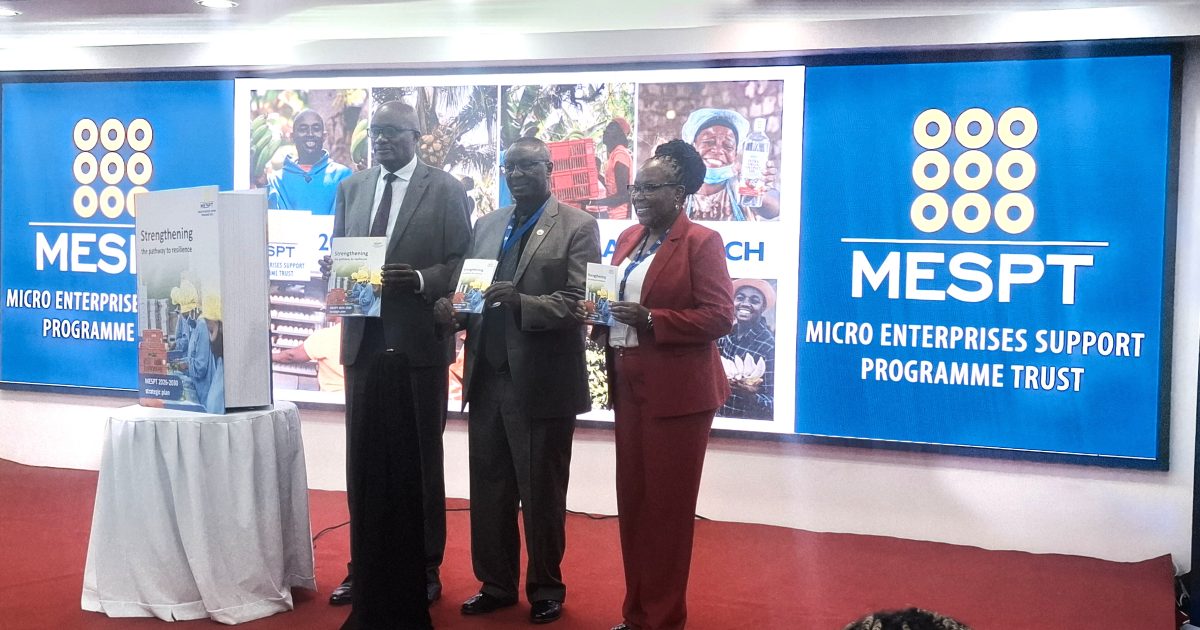
The Micro Enterprises Support Programme Trust (MESPT) has officially launched its 2026–2030 Strategic Plan, marking a new phase in its efforts to support farmers, Agri-MSMEs, and job creation across Kenya.
The new strategy, themed “Strengthening the Pathway to Resilience,” focuses on helping over 500,000 smallholder farmers and Agri-MSMEs improve their incomes, access financing, and adapt to climate change.
Cabinet Secretary (CS) for Cooperatives and MSMEs Development, Wycliffe Oparanya, said that farmers and MSMEs still struggle to access affordable and appropriate finance, and many SACCOs and financial institutions lack the capacity to effectively serve the agricultural sector.
In a speech read on his behalf by Henry Rithaa, Director General of the Micro and Small Enterprises Authority Kenya, the CS congratulated MESPT for demonstrating that development is not just about funding but about building systems that work.
“For over two decades, MESPT has linked farmers, cooperatives, MSMEs, and financial institutions, helping to unlock opportunities where they matter most — at the grassroots level,” Oparanya added.
He commended the organization’s focus on combining financial solutions with capacity building, market access, climate resilience, and sustainability.
“If we want to grow our economy, create jobs, and improve livelihoods, we must get agriculture and MSMEs right,” he said.
He noted that the targets outlined in the MESPT Strategic Plan are clear and provide the measurable outcomes required to transform the economy.
The Ministry of Cooperatives and MSMEs Development, he said, is focusing on strengthening SACCOs and cooperative institutions, expanding access to affordable credit for MSMEs, supporting value addition and market access, and ensuring that young people and women are fully integrated into the economy.
“Economic transformation will require the deliberate removal of barriers to finance, supporting entrepreneurship, and creating opportunities for young people,” he noted.
Oparanya further commended MESPT for its strategic shift toward becoming a system-level enabler, saying this is the right direction.
“We cannot transform agriculture through isolated projects. We must build strong systems, financial, market, and institutional, that continue to deliver impact long after individual programs end,” he said.
The strategy also focuses on climate resilience and green finance, which Oparanya said are necessary to support farmers and MSMEs in adopting climate-smart practices and accessing green financing.
MESPT Chief Executive Officer, Rebecca Amukhoye, said that by 2030, MESPT aims to scale access to responsive agri- and green financial services and facilitate Kenya’s transition to an inclusive, climate-resilient agri-food system.
Over the next five years, she added, MESPT will work to increase access to affordable financing for farmers and agri-MSMEs, support business growth, improve market access, and promote sustainable farming practices.
“MESPT aims to mobilize Ksh 7.2 billion in inclusive financing, strengthen over 100 local financial institutions such as SACCOs, and support 500 SMEs and cooperatives. These efforts are expected to contribute to the creation of 100,000 jobs and income opportunities, especially for women and youth,” Amukhoye said.
The CEO added that these goals will be achieved through four strategic pillars: scaling inclusive Agri- and green finance, strengthening business development services, climate adaptation, and strengthening systems, partnerships, and policy.
The new strategy builds on strong results achieved between 2021 and 2025. During this period, MESPT connected over 112,000 farmers to markets, provided more than Sh 2 billion in financing to farmers and Agri-MSMEs, and supported businesses to generate sales worth Sh 6.8 billion.
MESPT also helped create over 1,600 jobs, improve productivity, and promote environmental conservation through the planting of over 2 million trees and the adoption of sustainable farming technologies.
MESPT is a development organization with a purpose to grow smallholder farmers and Agri SMEs-SMEs to increase productivity, income,-SMEs and enhanced competitiveness for job creation, especially for youth and women. This is achieved through capacity building, which includes skills development, technical support, business advisory, and financial and market linkages.
By Wangari Ndirangu