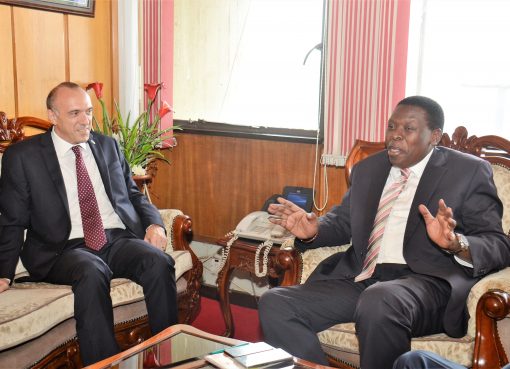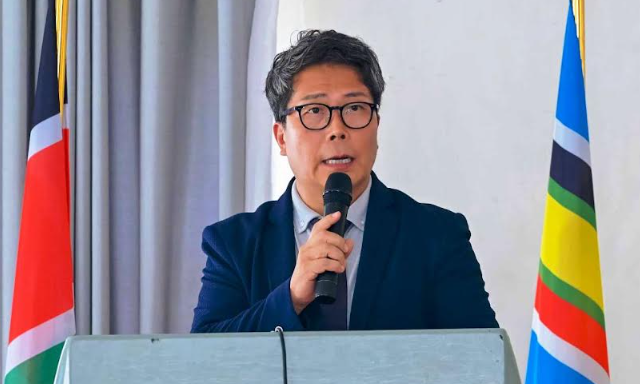
Kisumu Governor Prof. Anyang’ Nyong’o and the President of the World Smart Cities Forum (WSCF) Jaewon Peter Chun have challenged African governments and international partners to move beyond smart-city plans and translate their vision into projects that directly improve people’s lives.
Speaking during the 2026 Africa Smart Cities Alliance (ASCA) Summit in Kisumu on Tuesday, Nyong’o, who is also the ASCA chairman, said the success of the alliance should not be measured by conferences or memoranda of understanding but by tangible improvements in healthcare, water, sanitation, agriculture, infrastructure, and livelihoods.
“Smart City development, therefore, means better healthcare, reliable water and sanitation, modern agriculture and food security, better mobility and infrastructure, cleaner energy, environmental protection, digital public services, and wider economic opportunities for our young people and not just. A Smart City is not smart because it has more sensors, more computers, or more artificial intelligence,” stressed Nyong’o.
He said a city becomes smart when it uses its resources, technology, and partnerships to improve the quality of life of its people.
For Kisumu, Nyong’o said this means better healthcare, reliable water and sanitation, modern agriculture and food security, improved mobility and infrastructure, cleaner energy, environmental protection, digital public services, and wider economic opportunities for young people.
“Technology is just the instrument; human development has to remain the objective,” he said.
Nyong’o said Kisumu was prepared to become a “living laboratory” for a new African smart-city model, urging international partners to work with local communities, universities, entrepreneurs, farmers, hospitals, and the county government.
“We are not asking our international partners simply to come here and sell technologies; we are inviting you to come here and solve problems with us,” he said.
Nyong’o further said that there is a need to explore the local production and compounding of medicines needed by cancer patients and other critically ill patients.
“Africa cannot remain permanently dependent on importing virtually everything required to care for our people, and we must progressively build our own medical, pharmaceutical, and technological capacity, and Kisumu is prepared to be part of that transformation,” Nyong’o added.
He, however, lamented that despite Kisumu’s geographical location sitting on the shores of Lake Victoria connecting communities and economies across East Africa there are still many challenges faced which includes healthcare, water pollution, food security, climate change, mobility and economic development which he said were regional challenges
The governor added that solutions developed in Kisumu could be tested locally and later replicated across the Lake Victoria region and other parts of Africa.
The governor identified healthcare as one of the areas where such international cooperation is already producing tangible results, citing the Chun Jeong-eun Nyong’o Cancer Center at Victoria Sub-County Hospital as one such example.
The center, which was unveiled in March, is expected to form part of an integrated cancer-care ecosystem covering prevention, early detection, diagnosis, treatment, research, training, and long-term patient care.
Nyong’o said the county also plans to explore local production and compounding of medicines needed by cancer patients and other critically ill patients.
He disclosed that a pharmaceutical facility near Kibos is expected to break ground soon after the completion of the remaining administrative formalities, with funding already secured.
“Africa cannot remain permanently dependent on importing virtually everything required to care for our people,” he said, calling for greater local medical, pharmaceutical, and technological capacity.
Nyong’o said he did not want ASCA to become “simply another organisation that holds conferences every year,” but rather a platform for implementation.
He said the real measure of success would be whether pilot projects begin, investors return, university partnerships produce research, young people receive training and employment, communities gain access to better services, and patients receive improved healthcare.
Chun, the President and Chairman of the World Smart Cities Forum (WSCF), on his part said Kisumu’s position on the shores of Lake Victoria makes it strategically important to Africa’s smart-city ambitions.
He said the city’s location brings issues such as water, waste management, and environmental protection into sharp focus, making it an ideal place to demonstrate how technology and partnerships can address urban challenges.
“Kisumu is where the African dream is becoming real. How can Africa build smart cities differently? We are moving from the vision to implementing it, and that is why Kisumu is important,” Chun said.
He defined a smart city as one “where technology improves people’s lives,” saying the approach being promoted through ASCA is anchored on real and implementable projects.
“That is why ASCA’s approach is based on real projects. Here in Kisumu it is becoming tangible,” he said.
Chun said ASCA could not implement smart-city projects alone and called for stronger cooperation between governments, communities, and international partners.
“ASCA cannot implement it alone. Even with technology, we need government, communities, and international systems,” he said.
He urged delegates attending the summit to identify areas where they could contribute while encouraging Kisumu to remain open to partnerships.
“Let Kisumu be evidence that this project works. Let’s move together from vision to projects,” he said.
Chun cautioned against allowing feasibility studies and development plans to remain unused, saying they should translate into practical interventions that improve people’s livelihoods.
“Documents should not sit in drawers. Feasibility studies should be used to improve livelihoods,” he said.
Chun similarly called for a shift from plans to projects that can demonstrate the practical value of smart-city solutions.
Kisumu, which serves as the chair city of ASCA, is positioning itself as a testing ground for solutions that can eventually be scaled across the Lake Victoria region and the wider continent.
The county’s location, Nyong’o said, gives it an opportunity to address challenges that extend beyond its borders, including healthcare, water pollution, food security, climate change, mobility, and economic development.
The 2026 ASCA Week is being held under the theme “Together for a Smarter, Healthier Africa,” with the speakers stressing that achieving that vision will require governments, businesses, communities, universities, and international partners to work together.
The summit brought together a business delegation from the international community alongside officials representing ASCA member sub-sovereigns on opportunities for collaborations, investments, innovation, and sustainable urban development in Africa.
The summit also saw the establishment of the ASCA Regional Specialized Diagnostic Hub for Cancer and Sickle Cell Screening at Victoria Sub-County Hospital.
The Africa Smart Cities and Townships Alliance (ASCA) is a public-private partnership network initiative proposed by the World Smart Cities Forum (WSCF) to drive inclusive, technology-powered, and sustainable development across African cities, townships, and rural regions.
Chaired by Kisumu County Governor Prof. Peter Anyang’ Nyong’o, ASCA acts as a continental hub, promoting urban cooperation and uniting over 20 African municipal and regional authorities (with pioneering members including Kisumu, Mombasa, Casablanca, Dakar, and Konza Technopolis) to share a smart development framework.
The organisation is also tasked with mobilizing investment and fostering sector-specific innovation and prioritizing implementation in critical fields like smart healthcare, water and waste management, digital governance, renewable energy, affordable housing, and climate resilience.
By Mabel Keya–Shikuku and Dorothy Pamela