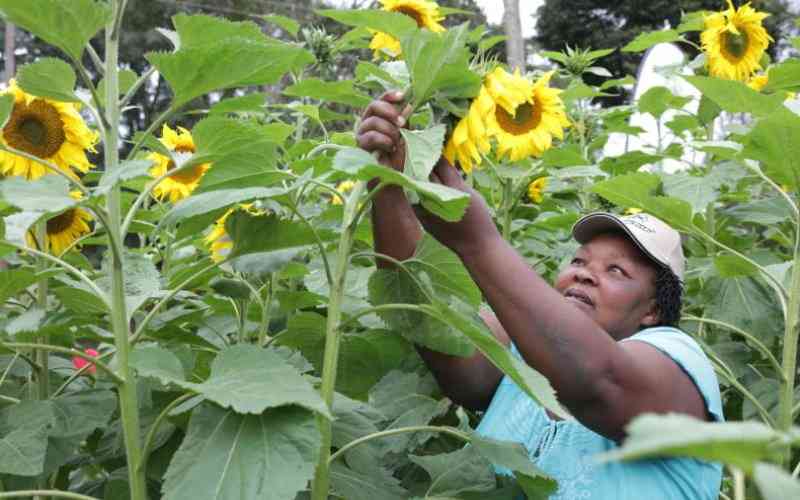
The County Government of Nakuru has distributed 7,000 kilograms of certified sunflower seeds to 2,500 farmers in a move aimed at promoting sunflower farming in the region towards increasing edible oil products and reducing cooking oil imports in the country.
The initiative, which is a partnership between the devolved unit’s administration and the Agriculture and Food Authority (AFA) through the Nuts and Oil Crops Directorate, targets to increase the acreage under the crop from the current 2,300 acres to more than 30,000 acres within the next three years across the eleven sub-counties.
Agriculture Chief Officer Engineer Margaret Kinyanjui said the seeds were distributed to registered farmers under Governor Susan Kihika’s initiative to empower the farmers and create employment, adding that the sunflower crop was critical in building climate-resilient agricultural systems, particularly due to erratic rainfall patterns.
She explained that since the inception of the county’s sunflower promotion program in 2024, Nakuru had received a cumulative total of 59,000 kilograms of certified seeds and added that local farmers had to date cultivated over 9,000 hectares, generating an estimated output of 9,500 metric tonnes valued at more than Sh 475 million.
“We are championing sunflower farming as a key commercial and rotational crop to economically empower farmers upon harvest,” the chief officer added.
Under the initiative, the county government is coordinating the distribution of certified planting material to farmers, subsidized fertilizer, providing market linkages, and enhancing value addition to boost farmers’ earnings.
The Chief Officer emphasized the importance of partnerships to enhance sunflower production and improve market access for farmers and assured that county extension officers will train farmers on proper agronomic practices to maximize production cost.
Additionally, she noted that sunflower by-products serve as a key ingredient for high-protein livestock feed formulation.
Engineer Kinyanjui voiced the county government’s commitment to ensuring that farmers access quality and certified sunflower seeds and enhanced agriculture extension services for farmers towards increasing edible oil products.
The county government, the official said, had acknowledged that the best way to create jobs for the citizens was through agriculture and that they were promoting sunflower production to put money in the hands of the people.
She stated that the distribution was part of Nakuru County’s vision of transforming smallholder sunflower farming into an organized, commercially viable, and climate-smart value chain.
The Chief Officer noted that the county was focusing on strengthening access to quality seed, extension services, aggregation, processing, value addition, and reliable markets, enabling farmers to earn better returns from their produce.
To further support sunflower processing and value addition, Engineer Kinyanjui disclosed that the county is advancing the Common User Facility at Agriculture Training Center (ATC)-Soilo to support aggregation while creating opportunities for employment, particularly for young people and women.
Two main categories of sunflower, hybrid variety (HV) and open-pollinated variety (OPV), are grown in the county.
Several hybrid varieties, which include Sunbeam, Mammoth, Autumn Beauty, Teddy Bear, and Kenya Fedha, are grown in different parts of the devolved unit. They mature in three to four months.
The chief officer announced that the sunflower farmers will sell edible oil in the local market if they harvest desirable quantities, adding that through public-private partnerships, Governor Kihika’s administration was enabling the farmers access services such as tilling their land, supervision, and extension services during propagation.
She said they were supporting the farmers to ensure they grow the sunflower satisfactorily with a vision to support them with machines to enable them to produce their cooking oil for sale in local markets.
The official told the farmers to take the initiative seriously to ensure they harvest the targeted quantity of sunflowers and was optimistic that production of edible oil will help to eradicate poverty in the region.
“We urge farmers to take up the crop since there is low production despite the county having great potential. They have been organized into three clusters for more streamlined support and training,” she added.
The official said the county government was promoting oil crop farming to reduce the import bill for edible oils and lower the prices of cooking oil in the country, noting that sunflower, which has a huge unmet demand, guarantees a ready local and international market.
She stated that although sunflowers are drought resistant and adaptable to many ecological zones, Kenya is currently producing less than 50 percent of her needs.
Engineer Kariuki said Kenya spends at least Shs 160 billion annually to import edible oils from other countries, mainly South-East Asian countries, adding that Governor Kihika’s administration had embarked on a sunflower promotion project that aims to boost local production of the oil crops and address the cost of edible oils in the country.
Kenyan manufacturers have been grappling with huge deficits in the production of sunflower oil. Key players, who manufacture edible oils locally, have resorted to importing sunflower from Tanzania and Uganda to sustain processing demand.
The chief officer observed that the oil crop industries had the potential to create over 200,000 jobs in the devolved unit directly and indirectly through the establishment of cottage industries and the production of livestock feed.
According to data from the Nuts and Oil Crops Directorate under the Agriculture and Food Authority (AFA), Kenya produces only 34 percent of its edible oils and fat requirements, with the deficit being imported mainly from South Asian countries.
Statistics from AFA state that the country remains a net importer of vegetable oils as local production has not grown to meet local demand, yet many oilseeds such as canola, sunflower, simsim, coconut, and groundnuts can be grown and processed locally.
AFA has further indicated that the country’s import bill of edible oils has been increasing at an annual rate of 15 percent due to skyrocketing demand locally.
AFA records indicate that Kenya consumes 900 metric tonnes of edible oils annually, of which only six percent is sourced locally.
Sunflowers grow well in areas with sparse rainfall, and the soil should be slightly acidic with a pH of between 6.0 and 7.5. Agricultural experts indicate that the hybrid varieties have higher oil content and better yields per acre, averaging 25 bags, while open-pollinated varieties have an advantage in that their seed can be recycled four times.
Sunflower by-products such as sunflower cake have a ready market in the animal feed manufacturers’ industries. Farmers can make more profits, he added, if they incorporate value addition in the enterprise as compared to selling the raw seed.
Oil crops have been found to reduce erosion, improve soil water retention, and lead to fewer weeds, pests, and diseases. Oil crop yields, he says, are 25 percent more compared to other crops.
The Agriculture and Food Authority (AFA), through the Nuts and Oil Crops Directorate, has been conducting a series of Barazas at the ward level in collaboration across 15 county governments, namely Nakuru, Nyeri, Meru, Makueni, Taita Taveta, Machakos, Kwale, Kilifi, Lamu, Uasin Gishu, Trans Nzoia, Homabay, Migori, Kakamega, Siaya, and Bungoma.
These forums are aimed at building the capacity of farmers by equipping them with the necessary knowledge and skills for successful sunflower farming.
As part of this initiative, farmers are also being issued with free sunflower seeds, providing them with both the tools and expertise needed to contribute to the national edible oil promotion program.
According to AFA, the project aligns with the Bottom-Up Economic Transformation Agenda, with the goal of reducing Kenya’s dependency on edible oil imports.
This move is intended to ease the pressure on the country’s foreign reserves, support employment creation, and promote agro-processing industries. Over 50,000 farmers are set to benefit from the free sunflower seeds, with up to 60,000 acres expected to be planted across the nation.
By Esther Mwangi