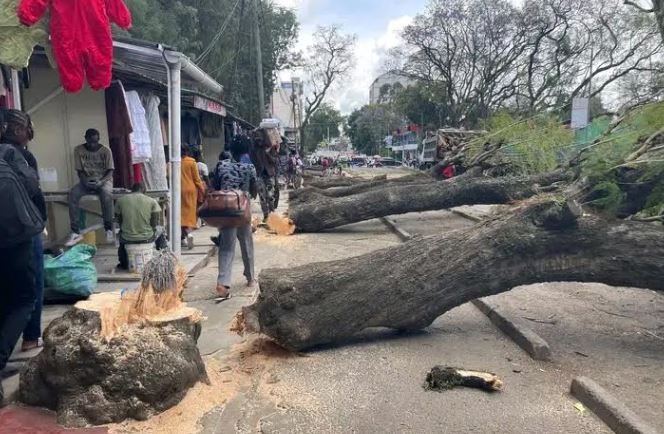
A section of Nakuru residents has expressed anger over the falling of trees along Oginga Odinga Road and raised concerns about urban environmental conservation.
The outcry comes after images of the wanton destruction of the tree cover along the stretch were leaked as tangled branches and debris littered the road, causing inconvenience to pedestrians and other road users.
The residents took to social media platforms to vent their anger and called out Nakuru leaders for remaining silent as the exercise continued.
Nakuru Governor Susan Kihika used her X handle to answer the residents, saying that her administration was not to blame for the felling of the trees.
She added that she had since engaged with the agencies concerned to ensure that no more trees would be cut unless it was extremely necessary.
“They initially didn’t seek the approvals as required before felling the trees, but once we stepped in, we stopped it, and now it can only happen with the county’s approval where it’s absolutely necessary for the expansion of the road,” the governor tweeted.
The Kenya Urban Roads Authority (KURA) indicates that the trees are being felled to pave the way for an expansion of the road into a dual carriageway.
Kihika argued that tree cutting should not be encouraged as the country faces the effects of climate change.
The dispute has sparked debate over how urban road improvements can provide safer pedestrian infrastructure without unnecessarily destroying established green spaces.
Kihika said the Kenya Urban Roads Authority (KURA), which is undertaking the road works, had cut trees without first obtaining the required county approval.
She said the county intervened and stopped the exercise, adding that any further felling would require county clearance.
The governor maintained that the county would only approve tree removal where it was necessary for road expansion.
Her intervention followed criticism from residents who questioned why mature trees had to be removed to create space for walkways.
The controversy has also raised questions about coordination between national agencies responsible for roads and county governments responsible for local planning and environmental management.
KURA’s project documents show that the works involve upgrading approximately 4.7 kilometres of Oginga Odinga Road in Nakuru City.
The planned works include carriageway improvements, coloured paving-block footpaths, drainage, road furniture, signage and road markings.
The tender also provides for site clearance and relocation of services where necessary.
The planned improvements are intended to strengthen road infrastructure and pedestrian access.
However, the removal of mature trees has prompted residents to question whether planners adequately considered alternatives that could preserve existing greenery.
Some residents have criticised the loss of the jacarandas, which provide shade and contribute to Nakuru’s urban character.
Their concerns centre on whether modern walkways could be delivered while retaining at least some of the established trees.
KURA’s position on the Governor’s latest directive was not included in the reports reviewed for this story.
The authority has also not publicly explained, in the available reports, whether it assessed options to retain the trees or what restoration measures may accompany the works.
The controversy therefore leaves important questions about the project’s environmental safeguards, the basis for selecting trees for removal and whether replacement planting will adequately compensate for the loss of mature vegetation.
Kihika nevertheless noted that road construction and environmental conservation are both important to Nakuru’s long-term development.
She added that better footpaths can improve pedestrian movement and accessibility, while drainage improvements can help manage runoff and reduce hazards along busy urban roads.
Article 69 of the Kenyan Constitution obliges the State to protect the environment, conserve natural resources and work towards maintaining tree cover of at least 10 per cent of the country’s land area. These constitutional obligations make environmental protection a consideration in public infrastructure planning.
The governor said that Nakuru County’s own planning framework recognises the importance of sustainable land use and environmental management as the city grows.
The county’s physical planning department identifies coordinated development control and spatial planning as essential to orderly urban growth.
“The immediate challenge is to establish a clear process through which KURA and the county can resolve their differences without leaving residents uncertain about the future of the affected streets. A transparent account of the approvals obtained, the reasons for removing individual trees and the environmental safeguards attached to the works would help address public concerns,” she stated.
Kihika indicated that the agencies could also clarify whether the road design allows for retaining some trees, what replanting programme will follow and how the survival of replacement trees will be monitored.
Such measures would help ensure that road improvements deliver lasting public benefits rather than simply shifting the cost of development onto the urban environment.
The dispute is not unique to Nakuru. Similar public concerns have emerged over mature trees removed during road works in other parts of the country, renewing debate over how Kenyan cities and towns should manage infrastructure expansion while protecting urban greenery.
Nakuru has previously taken action against tree felling in environmentally sensitive areas.
In 2022, the county announced a ban on illegal tree felling around Lake Naivasha to protect riparian zones and habitats, requiring relevant approvals for logging activity.
The latest dispute presents another test of environmental governance as Nakuru City expands. Cooperation between the county, KURA and environmental regulators will be important in ensuring that public infrastructure meets community needs while safeguarding the city’s natural assets.
The outcome will depend not only on how road works proceed but also on whether the responsible agencies demonstrate that environmental considerations informed their decisions and that appropriate safeguards will be enforced.
One thing that remains clear is that in this era of social media reawakening, citizens will continue using the available social spaces to hold their leaders to account.
They are becoming more aware of the power of social media and are using platforms such as Facebook, X, TikTok and WhatsApp to question their leaders, demand transparency and ensure that leaders fulfil their responsibilities.
Social media is a powerful tool to demand better governance by raising awareness, questioning public officials, exposing service delivery gaps and demanding transparency and accountability.
Tech-savvy citizens have perfected the art of engaging leaders directly by tagging governors, Members of Parliament, Members of County Assembly and relevant government agencies through their social media handles when raising concerns, requesting explanations, or seeking updates.
They also monitor development projects and can share photographs, videos and verified updates on public projects to encourage proper implementation and responsible use of resources.
By Jane Ngugi and Jefther Afuyo