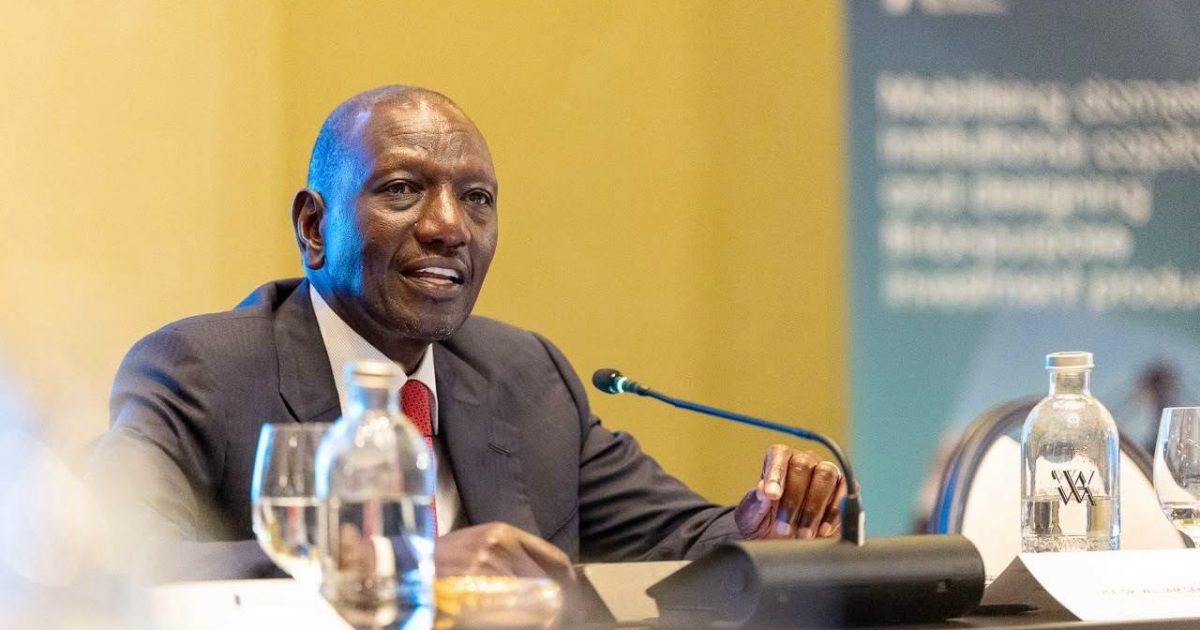
President Dr William Ruto has urged African countries to take a more active role in developing and governing Artificial Intelligence (AI), warning that technological dependence could undermine national sovereignty.
Ruto said Africa must move beyond consuming AI technologies to developing, owning and shaping systems that reflect its languages, economies and social realities.
“We must not reproduce the old extractive economy in digital form. Africa cannot provide the minerals, energy, data, content and talent of the AI revolution, only to import the resulting intelligence at a premium,” he said.
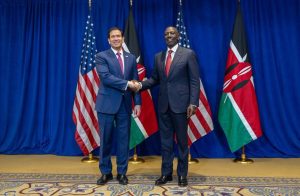
The president spoke Monday during the high-level AI Middle Powers (AIM) Coalition meeting on Shared Sovereignty in the AI era, held on the margins of the 81st Session of the United Nations General Assembly at the United Nations Headquarters in New York.
Ruto noted that AI was rapidly changing the distribution of economic and technological power, with countries increasingly depending on computing power, advanced chips, data systems, AI models and technological standards that they may not own or control.
“Political sovereignty without technological agency risks becoming sovereignty in law but dependency in practice,” he said.
The president called for greater cooperation among middle powers in areas where individual countries cannot efficiently develop the entire AI value chain while retaining national control over matters requiring accountability.
“No nation can efficiently secure every critical mineral, fabricate every advanced chip, build every data centre, train every frontier model, and determine every global standard,” Ruto said.
The President described this approach as shared sovereignty, saying cooperation should strengthen rather than diminish the ability of countries to make independent decisions.
“Shared sovereignty is not sovereignty surrendered. It is agency enlarged through organised cooperation,” he said.
Ruto placed Africa’s role at the centre of the discussion, noting that the continent has significant natural resources, a growing digital economy, a young population and a pool of skilled professionals that can contribute to the development of AI.
He, however, expressed concern that African languages, contexts and institutions remain under-represented in technologies increasingly influencing education, healthcare, commerce and public discourse.
“A model that cannot understand millions of people in their own language cannot claim to be truly global,” Ruto said.
The President pointed to Kenya’s National Artificial Intelligence Strategy as part of the country’s efforts to build capacity in the sector. The strategy focuses on digital infrastructure, data and AI governance, research, innovation and commercialization.
Ruto said Kenya intends to harness AI to improve agricultural productivity, strengthen healthcare, expand access to education, improve public services, advance financial inclusion and create enterprises and jobs.
He stressed that meaningful participation in the AI economy requires more than access to applications, noting the importance of computing capacity, data, energy and skilled human resources.
“There is no Artificial Intelligence without electricity,” Ruto said, calling on countries with abundant renewable energy to host computing infrastructure, support research and develop businesses around the technology.
He also identified compute infrastructure, trusted data ecosystems, research, skills development, multilingual AI models and public-sector capacity as areas where middle powers could work together.
According to Ruto, the AI Middle Powers Initiative will provide a voluntary framework for countries to mobilise financing, expand trusted infrastructure and develop the human and institutional capacity required to build, adapt, evaluate and govern AI.
He stressed that technological advancement must also be accompanied by safeguards against misinformation, deepfakes, cyber threats and harmful AI-generated content.
“Values without capability can leave nations dependent. Capability without values can make power dangerous. We require both,” Ruto said.
The President further called for the United Nations to remain central to global AI governance, arguing that countries affected by the technology should have a meaningful role in determining the rules that guide its development and use.
“Those affected by these technologies must have a meaningful hand in shaping them,” he said.
Ruto maintained that Africa was seeking partnerships rather than charity, while middle powers should cooperate without isolating themselves from the wider global system.
He warned that the foundations of the AI era were being established now and urged countries to ensure they did not become dependent on technologies built from their data and resources but governed by rules they had no role in shaping.
“The architecture of the intelligence era is being built now,” Ruto said.
“We must not become tenants in a future built from our data, powered by our resources, shaped by technologies we cannot influence and governed by rules we did not write.”
He called for collective action among middle powers to build technological capacity, expand national choices and ensure countries become active participants in shaping the future of AI.
“Together, we can become co-authors of the age of intelligence,” Ruto said.
by Nancy Omondi