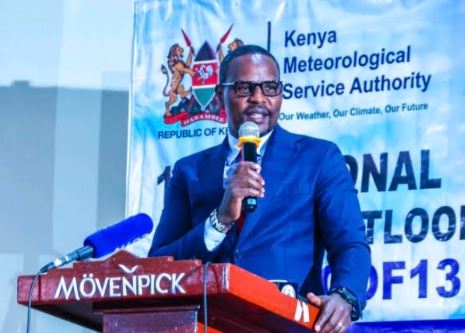
Principal Secretary (PS), State Department for Environment and Climate Change, Dr. Festus Ng’eno, has called for stronger collaboration and early action to ensure that climate information is translated into practical interventions that protect lives, livelihoods, and the economy.
Speaking during the closing of the 13th National Climate Outlook Forum (NCOF13) in Nairobi, Ng’eno emphasised that climate forecasts must go beyond providing information and instead guide timely decisions and preparedness across all sectors.
The three-day forum brought together scientists, policymakers, development partners, the private sector, and county governments, among other stakeholders.
It emphasised the need for enhanced collaborations, noting that effective climate action requires stronger mechanisms that connect forecasts to decisions to action and action to impact.
As Kenya anticipates the October–November–December (OND) 2026 rainfall season, the PS said the rains present both opportunities and risks.
“We must move from climate information to early action,” Ng’eno said, noting that favourable rainfall could enhance agricultural production, improve water availability, support pasture regeneration, and contribute to the recharge of water resources.
He underscored the importance of preparedness, drawing lessons from previous extreme weather events, including El Niño, stressing that acting before disasters occur is more effective and less costly than responding after impacts have already been felt.
The PS called for climate information to be translated into practical, sector-specific action, noting that climate variability should not only be viewed through the lens of risk but also as an opportunity to maximise gains.
He observed that farmers require timely information to guide planting, crop management, and harvesting, while pastoralists need climate information to support decisions on water, pasture, and livestock management.
Fishing communities, he added, require timely updates on weather and lake conditions, while urban areas must strengthen preparedness for flooding, drainage challenges, and other weather-related risks.
He reaffirmed the government’s commitment, through the State Department for Environment and Climate Change and the Kenya Meteorological Department, to strengthening climate services, early warning systems, and climate action for the benefit of all Kenyans.
The Director of the Kenya Meteorological Service Authority (KMSA), Edward Muriuki, emphasised that the success of the OND 2026 forecast will ultimately depend not only on its accuracy but also on how effectively it informs early action and timely decisions before impacts occur.
“Climate information must be understandable, relevant, and actionable,” he said, adding that preparedness must be strengthened under evolving El Niño conditions.
However, he noted that El Niño does not automatically mean heavy rainfall everywhere and that other atmospheric and oceanic factors must continue to be monitored.
Muriuki officially announced the October–December 2026 ‘short rains’ season forecast. The forecast indicates enhanced rainfall in Kenya during the season, with high temperatures expected in the coastal region.
“Expect enhanced rainfall in most parts of Kenya during the October to December 2026 short rains season,” he said.
According to the climate outlook for the October–December 2026 short rains season, above-average rainfall is expected over 80 per cent of the country.
Mean temperatures are predicted to be warmer than average during the season, with higher probabilities over Kwale, Mombasa, Kilifi, Lamu, and parts of Tana River, Taita/Taveta, and Garissa counties.
Rainfall will continue in western parts of Kenya and begin during the second and third weeks of October in other parts of the country.
The season will be marked by prolonged wet spells and occasional isolated storms over several parts of the country.
Near-average to above-average rainfall is expected in Turkana County and parts of West Pokot, Samburu, and Marsabit.
During the season, the distribution of rainfall across many areas of the country is expected to be average to good, except in areas of Turkana and Samburu counties, where the distribution is expected to range from poor to average. The onset and cessation of the rainfall will also vary spatially.
The forecast indicates that above-average rainfall is expected in the counties of Baringo, Bomet, Bungoma, Busia, Elgeyo/Marakwet, Embu, Garissa, Homa Bay, Isiolo, Kajiado, Kakamega, Kericho, Kiambu, Kilifi, Kirinyaga, Kisii, Kisumu, Kitui, Kwale, Laikipia, Lamu, Machakos, Makueni, Mandera, Meru, Migori, Mombasa, Murang’a, Nairobi, Nakuru, Nandi, Narok, Nyamira, Nyandarua, Nyeri, Siaya, Taita/Taveta, Tana River, Tharaka-Nithi, Trans Nzoia, Uasin Gishu, Vihiga, and Wajir, as well as large parts of West Pokot, Samburu, and Marsabit counties.
By Anita Omwenga