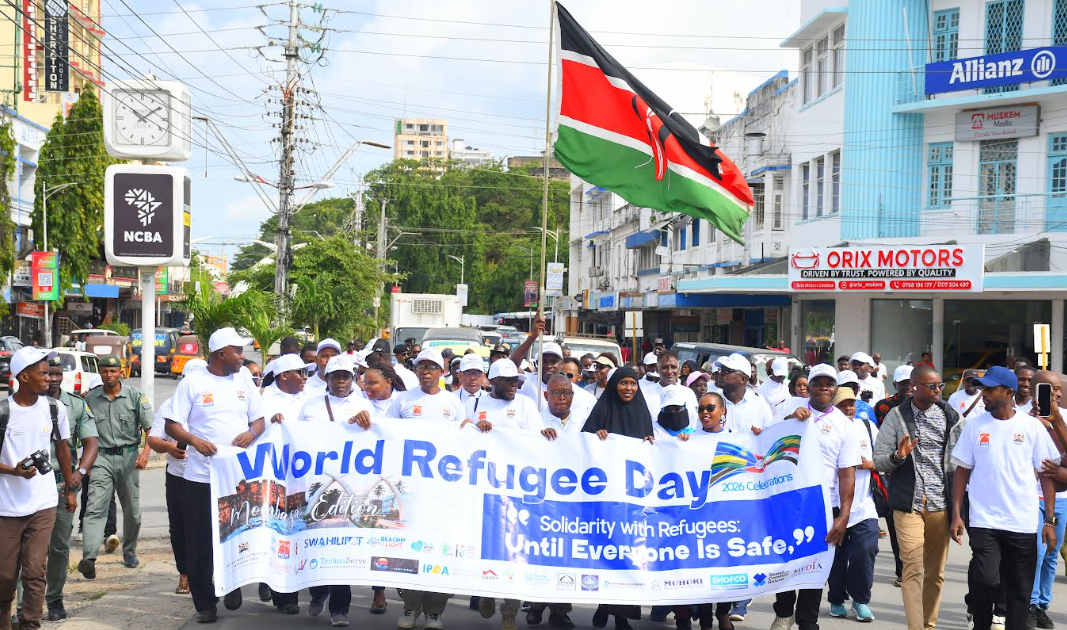
Kenya has joined the rest of the world in marking the 75th World Refugee Day, with officials in Mombasa renewing the country’s commitment to protecting internally and externally displaced persons even as refugees appealed for greater livelihood support to rebuild their lives.
The commemoration, held along Moi Avenue before culminating in a procession to Swahili Port, brought together the Kenya National Commission on Human Rights (KNCHR), the Department of Refugee Services, Mombasa County leadership, and members of the refugee community for a day of reflection, cultural exhibition, and advocacy.
KNCHR Coast Regional Coordinator Brenda Dosio said Kenya, as a UN member state, takes seriously its duty to host people fleeing danger.
“It’s all about our hospitality to our brothers and sisters. Everyone has human rights, and as a commission we participate in commemorating this day,” she said, noting that refugees should never be penalised for arriving irregularly since they are escaping threats to their safety.
Assistant Commissioner for Refugee Affairs and Officer in Charge of the Mombasa Regional Office, Patrick Gatobu, said this year’s event was the first such celebration held in Mombasa.
He clarified that refugees differ from immigrants in that they have fled direct threats to their safety, and once recognised by government, are issued documents allowing them to live, work and trade within host communities rather than being confined to camps, though rights such as voting remain reserved for citizens.
He put the national refugee and asylum-seeker population at more than 800,000, citing UNHCR and government figures, though Mombasa-specific data was not yet available.
Mombasa County Executive Committee Member for Public Administration, Wepukhulu Jonathan, speaking on behalf of Governor Abdulswamad Sharif Nassir, said refugees deserved to be seen as more than numbers.
“Within them there is a mother looking for life to raise her kids, and a child seeking education. They deserve rights just like any other,” he said, calling on Kenyans to make refugees feel at home.
Refugees who have built lives on the coast for years shared their own stories. Saidi Abdulkarim, who fled Rwanda in January 2005 after his life was threatened over a dispute involving his late father’s land, said integration has not been easy but has steadily improved.
“When I arrived, I faced many challenges, but the refugee community here, together with our Kenyan neighbours, helped me settle. These days we are good neighbours,” Abdulkarim said.
Now 49 and unable to continue his former trade of baking and selling tea due to illness, Abdulkarim said he currently relies on support from a relative based in Kampala.
“I’m grateful to the Government of Kenya for the laws put in place to protect us. We are now very good friends, and refugees and Kenyans live well together,” he added.
Nawal Abdulkadir Ali, who arrived from Somalia in 2007 as a young girl and has since married and raised children in Mombasa, said she has no intention of returning home despite economic struggles.
“We have settled here in Kenya, and we are safe. Life is just hard for us economically, but apart from that we don’t have other problems. We thank God for that,” she said.
She appealed for government and organisational support to ease the cost of living for refugee households.
“Our means are limited, and it’s difficult to sustain ourselves. We are asking the government to help us to look into our situation,” Ali said, citing the high cost of basic goods, rent, and lack of stable employment among refugees in the coastal city.
By Ramadhan Nassib