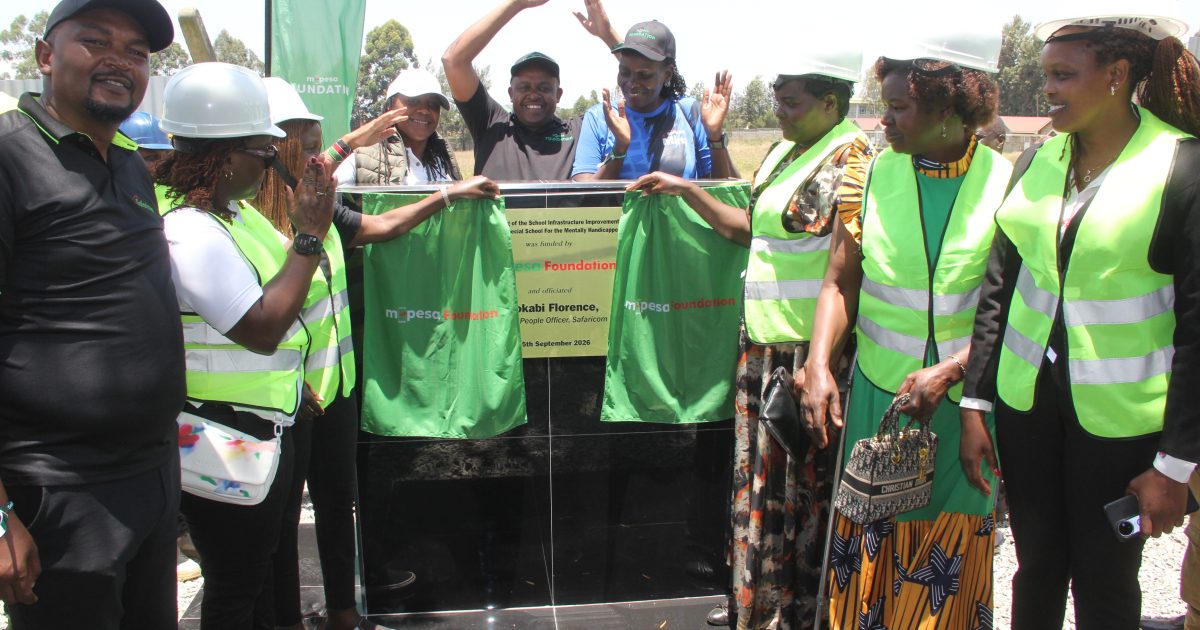
Safaricom has committed Sh51 million towards the construction of additional facilities at Eldoret Special School for the Intellectually Challenged in Uasin Gishu County, in a move expected to improve learning and accommodation for learners with special needs.
The project, which was launched during a groundbreaking ceremony at the school on Saturday, comprises two dormitories, three vocational classrooms and a borehole fitted with solar-powered water-heating fittings.
Speaking to the media during the groundbreaking ceremony, Safaricom Chief People Officer Florence Nyokabi said the investment was part of the company’s long-standing partnership with Uasin Gishu County aimed at transforming lives through investments in education, healthcare and economic empowerment.
“The reason behind this physical infrastructure is the empowerment that learning will bring to children and people with special needs, so that we lift their capabilities to thrive and have equal opportunities to succeed in the external world,” Nyokabi emphasized.
Nyokabi said Safaricom had so far supported 106 projects in the county at a cost of more than Sh600 million, with education receiving the largest share of the investment.
She said the latest project was a fulfilment of a commitment made by Safaricom Chief Executive Officer Dr Peter Ndegwa during a previous visit to the school, where he pledged to strengthen the company’s partnership with the institution.
Nyokabi said the company had previously supported vocational training at the school by providing equipment, including hairdressing equipment, to enable learners to put into practice the skills they acquire.
She added the new infrastructure would go beyond providing physical facilities, noting that the ultimate goal was to empower learners with special needs to develop their abilities and enjoy equal opportunities to succeed.
“When I look at infrastructure projects, I see on one hand that, yes indeed, we are building physical infrastructure. Importantly, the reason behind that physical infrastructure is the empowerment that that learning will have to children and people with special needs,” Nyokabi said.
Nyokabi said the borehole would help the institution become self-sufficient in water and potentially benefit neighbouring institutions.
She stated construction was expected to take 45 weeks, with the completed facilities scheduled to be opened in June 2027.
The school’s Head of Institution, Dina Chebaskony, welcomed the investment, saying the facilities would provide learners with a safer and more conducive environment for learning and developing practical skills.
Chebaskony noted the two dormitories would provide secure and comfortable accommodation for learners, while the three vocational classrooms would create more opportunities for them to acquire practical skills.
She said many learners with intellectual challenges possessed talents and abilities that could be nurtured into careers and enable them to become more self-reliant.
“Talent learned today will be a career tomorrow, while a skill learned today will bring about a better livelihood for learners with special needs tomorrow,” Chebaskony said.
She noted that although some learners faced difficulties in reading and writing, they were capable of acquiring various practical skills and contributing meaningfully to society.
Chebaskony also called for the development of the school’s swampy sports field into a proper sporting facility, saying some learners had demonstrated exceptional sporting abilities and had competed at national and international levels.
She thanked Safaricom for recognising the potential of learners with intellectual challenges and looking beyond their disabilities.
“Thank you for thinking about our learners with intellectual challenges, who have for a long time been left behind by society, and for looking beyond their disabilities to see the abilities and talents that can transform their lives,” she said.
By Fredrick Maritim and Ekuwam Sylvester