Stakeholders in Kenya’s meat industry are calling for stronger coordination across the meat value chain if the country hopes to reap maximum benefits from the multi-million meat export sector.
They have cited fragmented investments and weak linkages between the farmers, traders, processors and the government as some of the key reasons that have continued to deny the country billions of shillings in potential earnings from meat exports. They said that the country must now focus on commercialisation of the industry by embracing value addition and export competitiveness.
The stakeholders spoke in Nyeri during the National Meat Conference 2026.The two-day event is taking place under the theme Transforming Kenya’s meat Sector for Global Competitiveness and Sustainable Growth and it has brought together more than 300 stakeholders from across the meat value chain.
According to Livestock Development Principal Secretary, Jonathan Mueke, the conference will provide a forum for players in the sector to identify practical interventions that will transform livestock into a major source of wealth for farmers. He said that the deliberations will also address gaps along the entire value chain and facilitate revitalization of Kenya’s meat export sector.
“We want to know what producers need in to be in place order to produce what the market demands; what the traders require to move products to the market with the quality, consistency and quantity that the consumer demands; what processors need and how to finance the entire value chain at affordable interest rates. At the end of the conference we hope we will come up with a blueprint that will endure that we grow the livestock sector three-fold in the next three years,” said the PS.
Data from the government reveals the country’s livestock sector contributes approximately 12 per cent of the National Gross Domestic Product (GDP) and over 40 per cent of the Agricultural GDP. Currently revenues from meat exports to the middle East and North Africa stand at Sh 18.7 billion with the Ministry targeting to increase the amount to over Sh 28 billion by the year 2030.
Nyeri Governor, Dr Mutahi Kahiga, noted that despite the country possessing enormous livestock resources the sector continues to underperform due to weak commercial systems.
He said that only seven out of nearly 1,000 slaughter houses in the country meet international export standards further limiting the country’s access to the premium meat market.
To address this, he called for collaboration between the national and county governments in implementing livestock reforms including upgrading aggregation centres of smallholder farmers’ enterprises into commercially viable businesses.
“As County Governments across we believe, that the transformation of our livestock and meat sector is not a national conversation alone. It is a devolved one, built county by county, farmer by farmer,” he said.
“As county governments, we sit closest to the herder, the feedlot operator, and the local abattoir. The deliberations from this conference cannot succeed as a national programme running parallel to counties. They must be built through counties and with the counties”, said Dr Kahiga.
His sentiments were echoed by his Garissa counterpart, Nathif Jama, who is also the chair of the Arid and Semi-Arid Counties Forum. Governor Jama said that the sector was yet to unlock its full potential because investment remains concentrated on production with little focus going towards value addition, processing and export.
He also cited inadequate funding, policy fragmentation among stakeholders especially when drafting policies for the sector as the other major growth impediments.
“While Kenya possess significant livestock resources and enormous potential for growth, the number of structural constraints continue to limit the sector’s potential and competitiveness,” he said.
To address these, Jama called for stronger partnership between National and County government as well as other stakeholders in building stronger value chains that are capable of creating job increasing farmers ‘earnings and boosting export Additionally, he called on the Ministry of Agriculture to borrow lessons from countries like Botswana and Namibia by investing in disease control, traceability and export-oriented processing if it hopes to compete in international markets.
“Global competitiveness in the meat industry is no longer determined solely by livestock numbers. It is increasingly determined by productivity, traceability, quality assurance, animal health compliance, value addition and efficient marketing systems, “said Governor Jama.
“Consequently the transformation of the livestock and meat industry must be anchored on effective collaboration between the National and County governments, “he added.
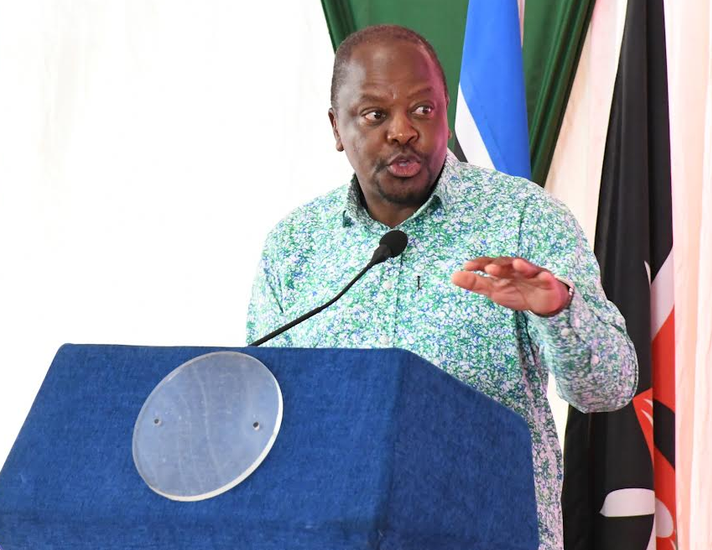
Kagwe said the Government has embarked on a series of comprehensive livestock sector reforms that will unlock the sectors economic potential.
He said his ministry is hoping to increase livestock’s contribution to the country’s GDP from the current 12 percent to 20 percent, while nearly doubling annual meat production from 527,200 metric tonnes recorded in 2022 to almost 990,000 metric tonnes by 2028.
This he said, will in turn generate an estimated Sh450 billion annually for the economy. He said that the reforms will focus on building stronger veterinary regulations and enhancing compliance systems aimed at guaranteeing international standards.
The CS observed that global meat buyers no longer purchase meat alone but increasingly demand confidence, traceability, food safety, disease-free production systems and consistency.
On value addition, the Cabinet Secretary acknowledged that the time was ripe for the country to move beyond exporting raw livestock and instead maximize value from every animal through modern processing, branding and certification.
He said the Government is working with county governments and private investors to modernize meat processing infrastructure, targeting slaughter facilities capable of handling approximately 384,000 livestock annually for domestic consumption and export markets.
According to CS Kagwe, modern abattoirs will function as industrial production hubs creating employment for veterinarians, laboratory technologists, engineers, refrigeration technicians, food scientists, leather processors, logistics firms and exporters.
He also called for stronger collaboration among government, county administrations, researchers, financial institutions, development partners and private investors to transform Kenya into Africa’s leading supplier of premium meat products.
“Our ambition is not simply to export more meat. It is to export confidence, quality and integrity. When buyers anywhere in the world see the words ‘Product of Kenya,’ they should immediately associate them with safe, traceable, high-quality products that meet the highest international standards,” he said.
By Wangari Mwangi