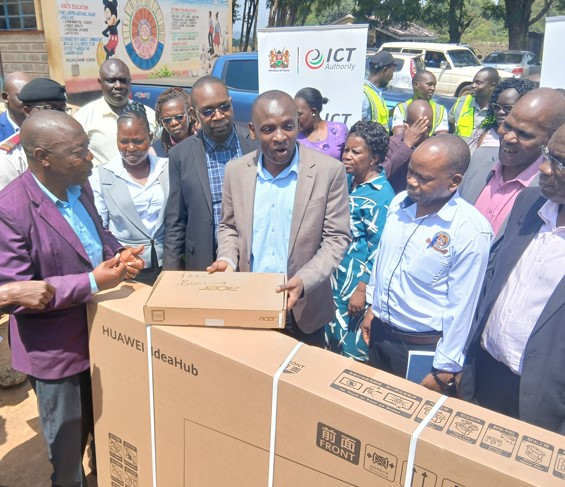
The government has intensified efforts to digitize learning in public schools with the rollout of smart boards and laptops under the Kenya Digital Economy Acceleration Project (KDEAP), a programme expected to transform the delivery of Competency-Based Education (CBE) across the country.
ICT Authority Chief Executive Officer Jessy Maruti said the World Bank-funded initiative seeks to improve the quality of education and equip learners with digital skills required to compete globally.
Speaking during the launch of the distribution exercise at Webuye ACK Junior School in Webuye East Sub-County, Bungoma County, Maruti said the government plans to distribute10,332 smart boards and laptops to junior secondary schools across the country in the first phase of the programme, with an additional devices earmarked for the second phase.
He said the launch follows the national rollout that was flagged off by Deputy President Kithure Kindiki in Elgeyo Marakwet County last week.
“The objective is to strengthen education and improve the quality of learning by creating inclusive and digitally enabled classrooms,” said Maruti.
He noted that the initiative forms part of the government’s broader Digital Superhighway Programme aimed at building a digitally connected economy through expansion of broadband infrastructure and digital public services.
Under the programme, the government is rolling out 100,000 kilometers of fibre optic cable across the country in partnership with Kenya Power to ensure schools gain access to reliable internet connectivity.
Maruti said schools located in remote areas where fibre connectivity is not available will be connected through satellite technology to ensure no learner is left behind.
“We want our students to compete globally by integrating ICT into education and facilitating collaboration among schools and teachers across the country,” he said.
According to the ICTA boss, Western Kenya will receive about 1,300 smart boards and laptops, while 393 devices have been earmarked for schools in Bungoma County.
He added that more than 62,000 teachers have already been trained countrywide to support implementation of digital learning and ensure the devices deliver the intended impact in classrooms.
The smart boards, which operate like computers, will enable learners to access digital content, interact with peers in other schools and participate in virtual learning sessions.
The government, he said, also plans to establish four digital hubs in every constituency and equip modern markets with digital centres containing at least 50 computers each as part of efforts to expand digital inclusion.
Additionally, 25,000 public Wi-Fi hotspots will be installed across the country.
Maruti said all the devices will be monitored centrally to enhance security and ensure proper utilisation.
“These devices have been mapped and we can monitor them online, know where they are and how they are being used,” he said.
Webuye ACK Junior School principal Wycliffe Oduori welcomed the initiative, saying it would revolutionize research and learning among students by exposing them to global knowledge resources.
He said the institution had previously struggled with internet connectivity and unreliable power supply, challenges that had hindered effective integration of ICT in learning.
However, he said the internet challenge had been addressed through government support while a partnership involving the Ministry of Education and KCB Bank had enabled the school to install solar power.
“The introduction of smart boards is going to enhance interaction with other institutions and improve research among learners, enabling them to become more hands-on in their studies,” he said.
He added that the digital infrastructure would also help address teacher shortages by enabling virtual lessons and resource sharing among schools.
“Even in the absence of a teacher physically present in class, learners can still be taught remotely through connections with teachers from other schools,” he added.
The principal said the programme will directly benefit the school’s 1,575 learners.
Webuye East Teachers Service Commission Sub-County Director Kennedy Mekenye said the commission had fully embraced the programme and would continue training teachers to support implementation of CBE.
He revealed that 174 teachers in the sub-county had already undergone training on the use of the digital devices, with more expected to be trained in the coming months.
Mekenye urged teachers to safeguard the equipment and ensure it is used to improve learning outcomes.
Webuye East Sub-County Director of Education Linda Serete described the initiative as the beginning of a new era in teaching and learning.
She said digital literacy had become a critical foundation for education and future employment opportunities.
“Even a child in a rural setting will now be exposed to simulations, demonstrations and other digital learning experiences that were previously inaccessible,” she said.
Serete challenged teachers to utilize the equipment fully instead of locking it away in offices and stores for fear of theft.
At the same time, she raised concern over rising cases of theft of digital devices in schools and appealed to the Ministry of Interior and security agencies to help recover stolen equipment and protect government investments.
She also called for increased funding to schools to facilitate safe custody and maintenance of the devices.
Kenya Primary School Heads Association (KEPSHA) Webuye East chairman Patrick Musinai lauded the initiative, saying it would significantly strengthen implementation of CBE and improve learning outcomes.
Musiani expressed optimism that all the 61 schools in the sub-county would eventually benefit from the programme.
By Chris Mahandara