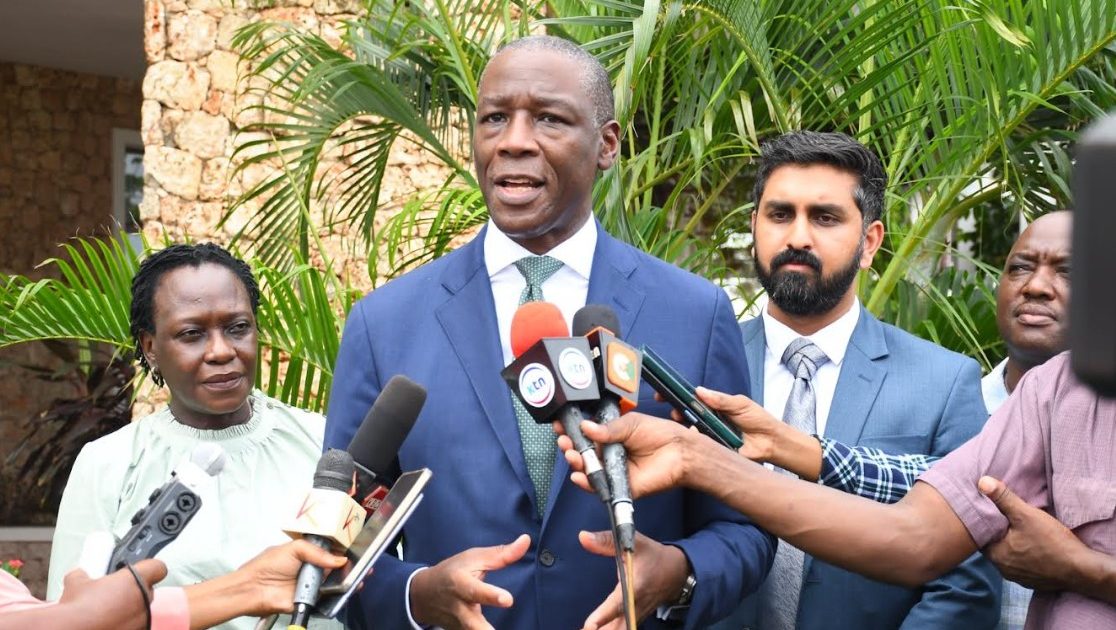
The Government, through the Ministry of National Treasury and Economic Planning, in collaboration with the United Nations Development Programme (UNDP) and Africatalyst, is ramping up efforts to strengthen institutional coordination and technical capacity in managing Kenya’s sovereign credit ratings.
The UNDP, National Treasury and Africatalyst have convened an inaugural three-day inter-agency retreat, bringing together senior government officials, development partners, and technical experts in Mombasa.
It aims to deepen collaboration across key institutions, strengthen engagement with international credit rating agencies, and enhance Kenya’s institutional frameworks for managing sovereign credit ratings.
UNDP Chief Economist and Head of Strategy for the Africa Regional Bureau, Raymond Gilpin, affirmed that Kenya remains on an upward trajectory compared to many countries on the continent, noting that the retreat will further cement the country’s position.
He said an action plan will be developed to ensure Kenya invests in its future development through affordable and accessible financing. Gilpin attributed Kenya’s progress to improved currency and political stability, which he said has boosted confidence among foreign and multinational investors across the world.
He noted that in 2023, UNDP conducted a study examining development financing across Africa, which found that many countries struggle to attract investors due to perceived risks.
“One of these reasons is the fact that when an investor looks at a country like Kenya, they see risk. How is risk measured? There are many indicators, but in a data-scarce environment like Kenya, the primary signal the market sees is the credit rating,” stated Gilpin.
However, he explained that the study revealed that in many African countries, credit ratings often fail to accurately reflect a country’s future capacity to repay debt. This, he said, is not necessarily due to weak methodologies but because nations are often unprepared to provide credible and timely data and lack a clear understanding of the credit rating process.
“Last year, we started this journey with the Government of Kenya, and we held a workshop here in Mombasa focusing on how to build capacity so that when credit rating missions are conducted and processes rolled out, Kenya will be able to tell its story more emphatically,” said the Chief Economist.
He added that Kenya would also be able to provide timely data and negotiate from a position of strength.
UNDP is also working with Kenya to improve data veracity, timeliness, and the breadth of data points to ensure the country receives a factual credit rating instead of estimates based on limited information.
“That, I think, is key. No matter who rates Kenya, enhanced and improved data sources and data points will help clearly tell the country’s story,” said Gilpin.
UNDP Concilium Advisor at the Africa Credit Agency, Veronica Kalema, noted that credit ratings provide an assessment of a country’s ability and willingness to repay its debts, adding that Kenya still faces risks due to high public debt.
“The debt is 70 per cent of GDP. That’s just a fact, so that’s a risk. But it can be brought down, and the government is implementing policies to reduce the risk and lower the cost of borrowing,” stated Kalema.
She further explained that reducing debt requires multiple economic interventions, including improving economic growth, strengthening taxation, and creating a supportive business environment to boost revenue collection.
Kalema also revealed that the country’s credit rating has recently improved to B-minus from the previous triple C rating recorded last year.
“Improving a credit rating is a gradual process; it does not happen overnight, but this shows that progress is possible,” she said.
Africatalyst Bureau Chief for East and Southern Africa, Pratik Patel, noted that negative credit ratings significantly affect a country’s ability to access affordable financing in international markets.
“What that means for us is that our cost of borrowing becomes higher,” he said, adding that more government revenue ends up being spent on debt repayment instead of investing in health, education, and other productive sectors.
Africatalyst is working to raise awareness and strengthen capacity on how credit ratings influence economic outcomes for African nations while addressing information gaps.
By Sadik Hassan