Vihiga County Governor Dr. Wilber Ottichilo has assented to the Sh7.72 billion County Budget and Appropriation Bill for the 2026/2027 financial year, setting the stage for the implementation of key development programmes with a focus on clearing pending bills and completing stalled projects.
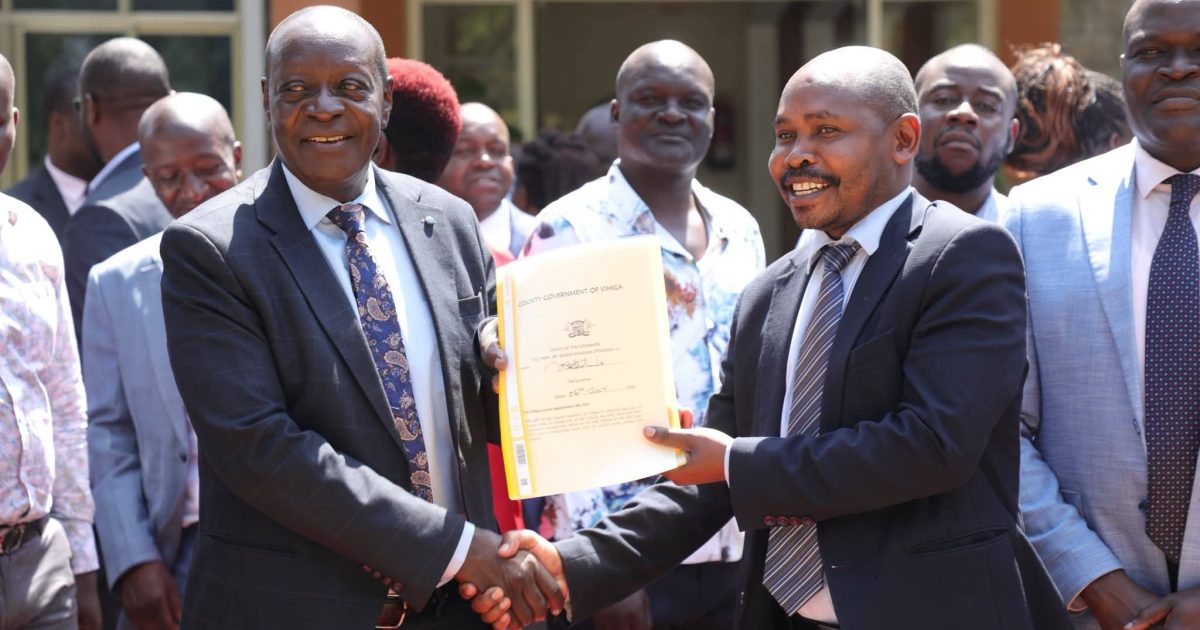
The Governor signed the bill during a ceremony held at the Vihiga County Headquarters, attended by Deputy Governor Wilberforce Kitiezo, Deputy Speaker of the County Assembly, Members of the County Assembly, County Executive Committee members and other stakeholders.
Speaking during the signing ceremony, Dr. Ottichilo described the assent as a significant milestone in the county’s development agenda.
He commended the County Assembly, the Department of Finance and Economic Planning, and residents for adhering to the Public Finance Management (PFM) Act through public participation during the budget-making process.
The Governor disclosed that although he had reservations about several amendments introduced by Members of the County Assembly, he opted to sign the bill to avoid delays that would have disrupted service delivery.
“If I had returned the bill to the Assembly, it would have taken another two or three weeks before reconsideration. Thereafter, the Controller of Budget would still need time to approve withdrawals, delaying implementation until late August or even September,” he said.
He noted that further delays would have affected the implementation of development projects and assured residents that any anomalies identified in the budget would be addressed through a supplementary budget later in the financial year.
The Sh7.72 billion budget represents an increase of Sh820 million from the previous financial year. It will be financed through Sh6.08 billion from the National Government’s equitable share, Sh1.17 billion in conditional and unconditional grants, and Sh472 million from own-source revenue.
Of the total allocation, Sh5.26 billion, representing 70 percent, has been set aside for recurrent expenditure, while Sh2.32 billion, equivalent to 30 percent, has been allocated to development projects.
Key allocations in the budget include Sh4 million per ward for bursaries, Sh15 million for the payment of Early Childhood Development Education (ECDE) teachers, Sh500 million for the procurement of drugs for non-communicable diseases, and Sh12.5 million for health facility infrastructure.
Dr. Ottichilo said the county government will prioritize the settlement of pending bills and the completion of ongoing projects instead of initiating new ones.
The County Assembly has allocated Sh402.5 million towards settling pending bills owed to local contractors. The Governor said clearing the debts would inject money into the local economy and restore confidence among suppliers.
“We must pay our suppliers because they are part of our local economy. Clearing pending bills is critical in supporting businesses and ensuring continued service delivery,” he said.
On development, the Governor announced that the county would suspend the launch of new projects and instead focus on completing and equipping stalled facilities, particularly in the health and vocational training sectors.
Among the priority projects are the completion of the Sabatia Maternity Ward, Kegondi Health Centre and Iduku Health Centre, which have been allocated Sh23 million.
Dr. Ottichilo directed all county departments to prepare comprehensive procurement plans within one week to ensure tenders are advertised by August and project implementation begins without delay.
With the political season approaching, the Governor urged Members of the County Assembly seeking re-election to ensure ongoing projects in their wards are completed, noting that stalled projects could negatively affect their leadership record.
He further encouraged leaders to use the recently launched Mid-Term Review Report (Mwananchi Version) to inform residents about the county’s development achievements and progress made during the current administration.
By Anna Achieng and Victor Zeddy