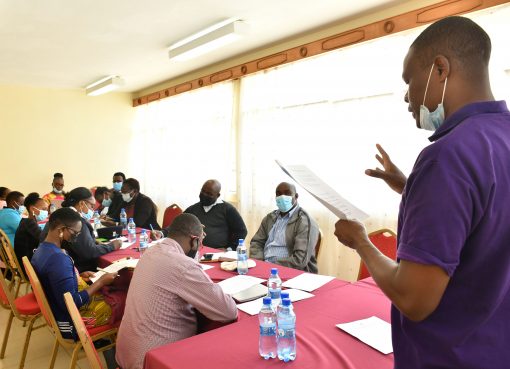
The newly constituted National Cohesion and Integration Commission (NCIC) has issued a strong warning against rising political intolerance, hate speech, ethnic incitement and violent rhetoric, saying the growing trend threatens national unity, democratic governance and peace in the country.
Commission Chairperson Bishop Dr. Kefa Nyamweya Omae said the team assumes office at a critical moment when divisive politics and inflammatory public discourse are becoming increasingly prevalent across the country.
Addressing the press on the rising political temperatures in the country, Omae noted that the fully constituted Commission was ready to execute its constitutional mandate of promoting national cohesion and peaceful coexistence among Kenyans.
“The Commission assumes its mandate at a crucial juncture defined by escalating political intolerance, hate speech, ethnic incitement and violent rhetoric that have become disturbingly prevalent in Kenya’s public discourse,” he said.
He expressed concern over what he termed as deliberate disruptions of political meetings and public gatherings, inflammatory statements by politicians and their supporters, coordinated online attacks, ethnic profiling and demonization of individuals holding differing political views.
According to the chairperson, such actions undermine democratic principles and violate the Constitution and the National Cohesion and Integration Act.
“Democracy is sustained by peaceful engagement, adherence to constitutional principles and fidelity to the rule of law. A democracy that silences dissent through intimidation, weaponises ethnicity to mobilize political support or incites citizens against one another is a democracy in peril,” he said.
Omae cited Article 33 of the Constitution, noting that while every Kenyan has the right to freedom of expression, the law does not protect propaganda for war, incitement to violence, hate speech or advocacy of hatred based on discrimination.
He further pointed out that Article 10 of the Constitution enshrines national unity, human dignity and social justice as binding national values, while the National Cohesion and Integration Act criminalizes ethnic contempt and hate speech.
“These are not aspirational ideals. They are legal obligations binding upon every Kenyan without exception,” he said.
The Commission condemned all forms of hate speech, ethnic incitement, political provocation and violent rhetoric regardless of the political affiliation or social standing of those responsible.
“No political cause, however passionately held, justifies the dehumanization of fellow citizens. No electoral ambition warrants the inflaming of ethnic tensions,” Omae stated.
The chairperson also raised concern over the misuse of digital platforms to spread divisive content, coordinate harassment campaigns and amplify inflammatory messages, warning that online hate speech attracts the same legal consequences as remarks made in public forums.
“Those who believe that the anonymity of a screen or the speed of a share exempts them from accountability are mistaken. The Commission is monitoring both the physical and digital spheres with vigilance,” he warned.
He reminded political leaders, elected officials, aspirants and opinion shapers that leadership carries a responsibility to unite rather than divide citizens along ethnic or political lines.
“Leadership that thrives on fear, contempt and division does not serve the nation. It endangers the nation,” he said.
Omae maintained that no individual would be shielded from accountability due to political influence or social status, saying the Commission would enforce the law without fear or favour.
“The Commission will not be deterred by rank, prominence or affiliation when discharging its mandate,” he said, adding that offenders found culpable under the National Cohesion and Integration Act would face appropriate legal action, including prosecution where sufficient evidence exists.
He called on political parties to enforce discipline among their members and supporters and ensure adherence to constitutional and legal standards during political activities and communication.
“Parties bear direct institutional responsibility for the conduct of their members and cannot distance themselves from the consequences of the toxic environments they permit or encourage,” he said.
Political leaders were urged to embrace restraint, measured language and respect for opponents while publicly condemning hate speech and incitement within their own political formations.
“Silence in the face of intolerance is itself a form of endorsement,” Omae noted and further appealed to the youth not to allow themselves to be manipulated into acts of violence or political intolerance.
“Kenya’s future belongs to young people. That future is best secured through peaceful, constructive and lawful engagement, not through violence, harassment or destructive political agendas,” he said.
At the same time, Kenyans were urged to exercise responsibility when sharing or endorsing information online and offline, with the Commission emphasizing that every citizen has a duty to safeguard peace and national unity.
The chairperson disclosed that the Commission has intensified monitoring of political discourse across mainstream media, social media platforms, political rallies and formal proceedings.
“Our monitoring mechanisms are operational, our legal instruments are clear and our resolve is firm. The Commission will not hesitate to act where evidence of hate speech, incitement or ethnic contempt is established,” he stated.
The Commission also invited members of the public to report incidents of hate speech and political incitement through official channels.
Omae reiterated that Kenya’s ethnic, religious, linguistic and political diversity should be viewed as a national strength rather than a source of division.
“Unity does not require uniformity. It requires mutual respect, shared values and a collective commitment to the idea of Kenya above all else,” he said.
He urged citizens to address political grievances through lawful and peaceful means, including dialogue, constitutional processes, the courts and democratic participation.
“Hate speech is never a legitimate form of political communication,” he emphasised.
The Commission pledged to work closely with political parties, civil society organisations, religious institutions, the media and the public in promoting national cohesion and peaceful coexistence.
“Let us disagree without destroying one another. Let us compete without dehumanizing one another. Kenya deserves better than the politics of hatred,” Omae said.
By Catherine Odoyo and Achieng Nicole