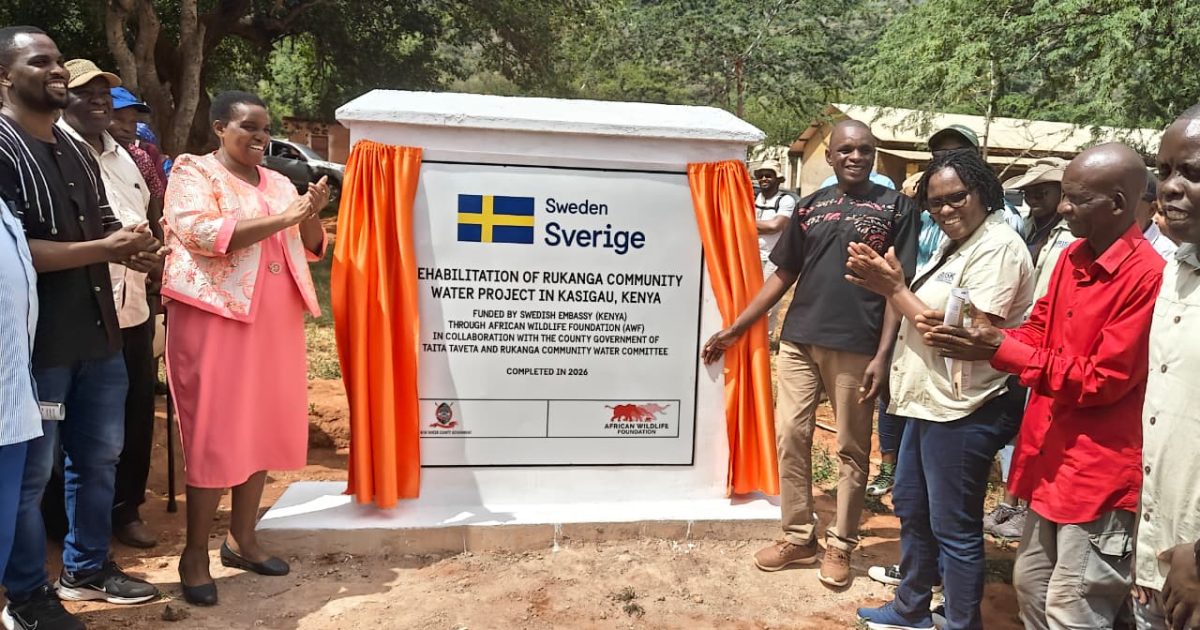
More than 800 households across seven villages in Kasigau Ward, Taita Taveta County, are set to benefit from improved access to clean and reliable water following the commissioning of a Sh4.6 million Swedish-funded water project.
The project, implemented through a partnership between the African Wildlife Foundation (AWF) and the County Government of Taita Taveta under the Improving Livelihoods and Sustainability Programme, sought to enhance water access while strengthening community resilience and sustainable natural resource management.
Its scope included the development of a 25-year water master plan, rehabilitation of three water storage tanks, and replacement of ageing water pipelines with 4.5 kilometres of modern distribution infrastructure.
Speaking during the commissioning ceremony in Rukanga, Deputy Governor Christine Kilalo called on residents to safeguard the project and other water infrastructure to ensure sustainable access to water for future generations.
Kilalo said the county government was in the process of establishing a rural water company that would strengthen governance, operations, and maintenance of community-managed water projects across the county.
“The success of this project depends on collective responsibility. We must protect and properly manage this infrastructure so that it continues serving our communities for many years,” she said.
Residents welcomed the project, saying it had significantly improved water access and reduced the hardships associated with water shortages.
For decades, communities living on the lower slopes of Kasigau Mountain depended on a single water collection point established in the 1990s. Residents often spent hours queuing for water as ageing pipelines, corroded by rust, frequently broke down and caused substantial water losses.
The rehabilitation prioritised replacement of the main pipeline, helping reduce wastage and improve water distribution to households, schools and livestock watering points.
The project also provides a framework for long-term water planning through a county water master plan projected up to 2050.
Kenneth Kimitei, senior ecologist at the AWF, said the project had transformed the lives of residents by reducing waiting times at water kiosks and improving access to clean water.
“Previously, if you passed through here at around 6 p.m., you would find women queuing for water at the kiosk. Nowadays, those challenges have largely been addressed and people no longer have to wait for long periods,” said Kimitei.
He added that the benefits extended beyond households to schools, livestock and public health.
“Everything is now integrated. Livestock, Moi Secondary School and disease control efforts have all benefited from this project,” he said.
Local health officials reported a decline in diarrhea cases at Kasigau health facility following improvements in water access, while residents noted that reliable water supply had strengthened emergency response capacity, including during the recent fire incident at Moi Boys High School, Kasigau.
Speaking at the event, Martin Muriithi from the Embassy of Sweden in Nairobi commended the implementing partners for effective supervision and prudent utilisation of project resources.
Muriithi said the successful implementation of the project demonstrated the value of partnerships in addressing community development challenges and hinted at the possibility of future collaboration despite the programme having officially ended in December 2025.
County Executive Committee Member for Water, Grantone Mwandawiro, praised the county government’s collaborative approach to development, saying partnerships with development agencies remained key to accelerating service delivery and improving livelihoods across Taita Taveta County.
by Arnold Linga Masila