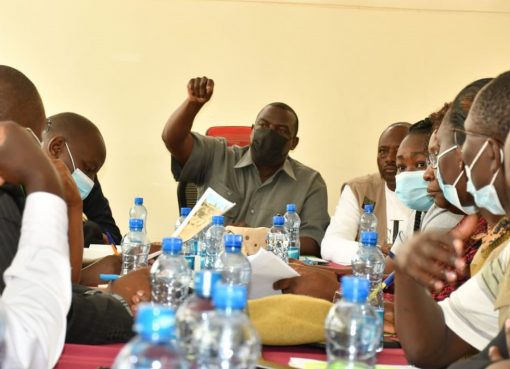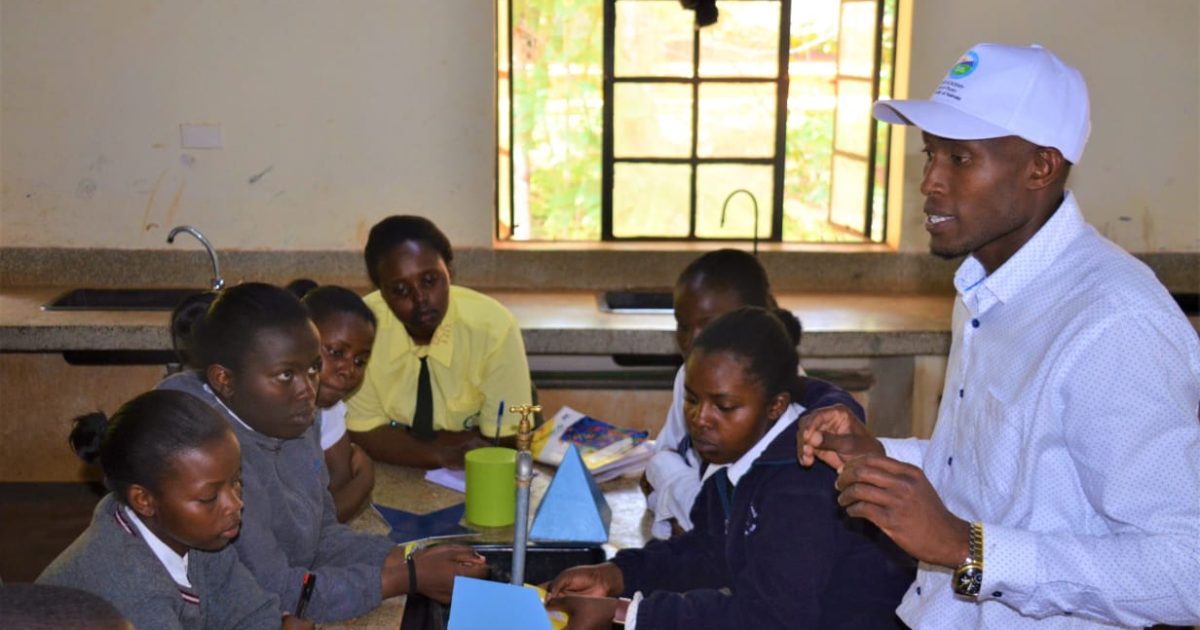
Young learners from Machakos County had a rare opportunity to interact with leading scientists and lecturers from across the world during a science outreach programme aimed at inspiring the next generation of engineers, researchers, and innovators.
The Centre for Mathematics, Science and Technology Education in Africa (CEMASTEA), in collaboration with the African School of Fundamental Physics and Applications (ASP), hosted the outreach programme at Machakos Girls High School to mentor students pursuing Science, Technology, Engineering and Mathematics (STEM), with a special focus on physics.
Speaking during the event, CEMASTEA Coordinator for Junior and Senior School Programmes Philip Maate said the partnership with ASP had enabled learners to engage with renowned scientists and lecturers from the United States, Switzerland, Europe, and Asia, exposing them to global perspectives in science and renewable energy.
“The partnership has made it possible to bring together leading scientists and lecturers from the United States, Switzerland, Europe and Asia who have excelled in this field to engage directly with students and future engineers pursuing STEM pathways, particularly physics,” said Maate.
Philip underscored that the programme also brought together students from neighbouring schools in Machakos, giving more learners an opportunity to explore the role of physics in addressing global challenges, including the development of renewable energy.
He emphasised that the mentorship opportunities and interactions with experienced scientists will motivate learners to pursue careers in science, technology, and innovation.
Maate noted that CEMASTEA has witnessed growing interest in STEM subjects since the introduction of the outreach programmes, with more students enrolling in science pathways and participating in science and engineering competitions.
The coordinator also observed a significant rise in the number of girls choosing STEM subjects, particularly physics, describing the shift as a positive step toward achieving greater gender equity in science education.
“The landscape has changed. STEM pathways are no longer the preserve of boys. We are seeing an increasing number of girls taking STEM subjects, especially physics, and actively participating in science and engineering competitions. This is the direction we want to strengthen,” he said.
The outreach programme forms part of ongoing efforts by CEMASTEA and its partners to cultivate scientific talent, encourage innovation, and prepare young people with the skills needed to address Africa’s future development challenges through science and technology
Beyond Machakos schools, Maate says CEMASTEA is extending the programme to schools at the grassroots level, including junior schools. Through the initiative, learners will be able to access a virtual laboratory to support learning and experimentation in STEM pathways.
The centre says the virtual platform will help bridge resource gaps and ensure more students, regardless of location, can experience practical science learning.
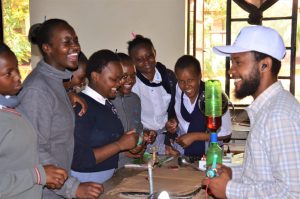
With global expertise, local mentorship, and wider access to tools, CEMASTEA and its partners say the goal is to build a stronger, more inclusive pipeline of young scientists and engineers ready to tackle Kenya’s energy and technology challenges.
Professor Christine Darve of Sweden, a member of the International Organizing Committee of ASP, said the current programme marks the organisation’s ninth biennial outreach initiative. Held every two years, the programme aims to promote physics education across Africa by engaging and inspiring young students.
Speaking during the outreach, Prof. Darve said the initiative seeks to demonstrate the importance of physics in everyday life and its connection to other disciplines, including mathematics, biology, and computer science. She noted that a strong foundation in physics is essential for nurturing the next generation of engineers, researchers, and innovators.
She added that teachers, who have the greatest influence on learners, also receive training through the programme. Equipping educators with additional knowledge and teaching skills ensures they are better positioned to inspire and guide their students.
Prof. Darve also commended the discipline, enthusiasm, and curiosity displayed by Kenyan high school students, describing them as outstanding compared to students in other African countries where the programme has been conducted. She expressed confidence that such qualities will contribute to producing a new generation of scientists across Africa.
Harrison Ndingili a Physics and Chemistry teacher at Machakos girls and an Alumnus of the ASP programme, while speaking during the outreach said that said the programme has had a strong impact on learners, especially those taking physics. He noted that the outreach is opening doors for students to explore different career paths.
“The students really enjoyed the hand-crank generator demonstration that converts mechanical energy into electrical energy using electromagnetic induction, and we fully welcome this initiative and It will help young learners to excel,” Ndingili said.
Since the outreach began, he added, motivation among female students pursuing STEM has grown, leading to increased uptake of physics among girls.
“We hope this will encourage even more girls to take up STEM. In the long run, it means more female engineers and doctors, and that will drive the country’s future development,” he said.
At just 16 years old, Yvonne Mumbua walks the corridors of Machakos Girls High School with a notebook filled with equations and a curiosity because for her physics is more than a classroom subject—it is a way of understanding the world through motion, energy, and the invisible forces that shape everyday life.
Her passion for science was strengthened during a physics outreach programme at her school, where she encountered the Van de Graaff generator for the first time. As the machine built up electrostatic charge, lifting strands of hair and demonstrating the power of electric fields, the experiment captured the attention of students gathered around it.
For Yvonne, however, the demonstration represented more than a fascinating scientific display. It brought to life the concepts she had studied in class, showing how electric charge, potential difference, and controlled energy could be applied in practical ways.
The experience also reshaped her ambitions. She realised that the same logical thinking and precision required to understand physics are equally valuable in computer programming. The principles that explain electric circuits and fields, she believes, can also be used to develop software that addresses real-world challenges.
“I’ve always loved physics because it helps explain how things work,” she said. “After seeing the demonstrations, I realised those problem-solving skills can also help me become a software engineer.”
Yvonne left the outreach programme with more than classroom notes. She left with renewed purpose and a clearer vision for her future—one where her passion for physics serves as the foundation for a career in software engineering.
16-year-old Kelvin Kamau of Kathiani Boys Senior School is discovering that science isn’t confined to one subject or one classroom. It’s everywhere because he started noticing connections he’d never seen before.
In mathematics, he saw how physics formulas explain motion, force, and energy. In biology, he learned that the same principles behind light and refraction are what make lenses possible — the very lenses that help us see the world more clearly.
“What stood out to me is that physics is applied everywhere,” Kelvin says. “It’s not just equations on a board. It’s in how things work.”
Now, Kelvin has his eyes set on the future. He’s determined to deepen his understanding of physics and pursue a career in engineering. For him, engineering isn’t just a job title it’s a chance to take the concepts he’s learning and use them to solve real problems and build things that matter.
For Form Three student Dennis Oloo, of Mumbuni High School, learning about particle accelerators during a physics outreach programme opened a new perspective on the role of science in medicine.
During the interactive session, Dennis was introduced to particle accelerators and their wide-ranging applications, particularly in the medical field, where they are used in cancer diagnosis and treatment, medical imaging, and scientific research.
The experience deepened his appreciation of the relationship between physics and healthcare, reinforcing his ambition to pursue a career in medicine.
“I’ve always wanted to become a doctor, but I didn’t know physics played such an important role in healthcare,” Dennis said. “Learning about particle accelerators has shown me how science and medicine work together to improve people’s lives.”
Dennis said the outreach programme inspired him to work harder in physics and other science subjects, believing that a strong foundation in the sciences will help him achieve his dream of becoming a doctor.
by Anne Kangero