Principal Secretary (PS) for Medical Services, Dr. Ouma Oluga, has challenged African states to enhance collective action towards equitable and quality healthcare for all.
Dr. Oluga noted that Africa currently has the continental architecture to move from fragmented national health demand to aggregated continental markets.
The PS pointed out that Africa’s pharmaceutical dependency is not only a market failure but also threatens to be a governance failure, yet Africa now has the tools to correct it.
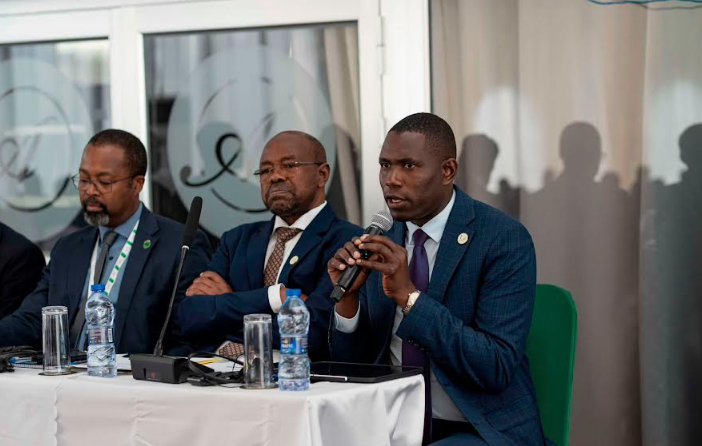
Dr. Oluga was presenting Kenya’s health experience to the 20th Extraordinary Session of the Assembly of Heads of State and Government of the African Union (AU) in Accra, Ghana, where African leaders met to accelerate the continent’s health agenda and strengthen collective action towards achieving key health targets by 2030.
The summit is held under the theme ‘Advancing Justice, Equity, and Universal Health Coverage (UHC): Ending AIDS and TB, Improving Maternal Health, and Addressing Endemic, Non-Communicable, and Neglected Tropical Diseases and Conditions in Africa’.
The conference focuses on ending AIDS by 2030, eliminating preventable maternal deaths, reducing the burden of communicable and non-communicable diseases, tackling neglected tropical diseases and conditions, and building resilient, sustainable health systems that provide equitable and quality healthcare for all.
The engagement also provided a platform for Kenya to contribute to shaping Africa’s future health and development priorities while strengthening collective action towards the achievement of Agenda 2063.
In a parallel session on access to medicines, regulatory harmonization, and local and regional manufacturing of medicines, vaccines, and diagnostics, Dr. Oluga told participants that Kenya’s health legislative reform journey spanning the Social Health Insurance Act, the Digital Health Act, and the Primary Health Care Act, all enacted in 2023, has created the demand-side conditions that make domestic manufacturing commercially viable.
Dr. Oluga highlighted that a defined benefits package covering millions of Kenyans, a national health information system generating real-time consumption data, and a reformed KEMSA positioned as a reliable off-taker with structured financing are inviting incentives for sustainable health investments.
Globally, the antimicrobial resistance (AMR) crisis is failing patients with medicines we cannot make, and the biologics revolution is extending lives on every continent except ours because we import what others produce and we pay what others determine for pricing. That calculus must change,” stated the PS.
Through the African Pooled Procurement Mechanism, the African Medicines Agency, and World Bank’s AIM 2030,
What those mechanisms require to function, he explained, is political leadership and commitment to back them with public money, procurement preference, and multi-year purchase arrangements, and that is exactly what Kenya is preparing to provide.
“No single African country can manufacture everything it needs, and none should try,” cautioned the PS, insisting that specialization, technology transfer, and complementary manufacturing across countries are how the continent must build a resilient supply chain rather than 54 (fifty-four) fragile ones.
He urged that the African Center for Disease Control and Prevention and the African Medicines Agency (AMA) must now move beyond policy and strategy-building and focus their mandate on consolidating single-country actions into a coherent continental supply system capable of converting national legislation, national institutions, and national investment into shared capacity and shared security.
The PS affirmed that Kenya is committed to being a manufacturing hub for Africa: for vaccines, for biologics, for diagnostics, and for priority essential medicines, where the country can achieve quality-assured, cost-competitive production at scale.
“We are not here to make pledges. We have established the Kenya BioVax Institute for this assignment. We enacted the laws. We capitalized the supply institutions. We are inviting partners, continental and global, to co-invest in an ecosystem that is already being built,” Dr. Oluga asserted.
“The question before this summit is not whether Africa should manufacture. The question is whether we will fund it, protect it, and demand accountability for its delivery. Kenya’s answer is yes. We invite the continent to say the same,” he added.
Meanwhile, among the key issues considered was the ‘Draft African Union Roadmap to 2026 and Beyond’, which seeks to strengthen continental cooperation, accelerate the implementation of African Union priorities, and advance sustainable, resilient, and country-led solutions to the continent’s development challenges.
The session also provided an opportunity for member states to review progress, identify emerging priorities, and agree on strategic actions to advance Africa’s shared aspirations.
Kenya’s participation reaffirmed its commitment to advancing the African Union’s health priorities through Universal Health Coverage, sustainable health financing, local manufacturing of health products and technologies, disease prevention and control, maternal and child health, health security, and resilient health systems.
The summit also provided an opportunity for member states and partners to renew political commitment and strengthen collaboration towards achieving a healthier, more equitable, and inclusive Africa by 2030.
By Michael Omondi