The sun hangs low over the dramatic escarpments of the Kerio Valley in Elgeyo Marakwet County, casting a golden hue over a landscape long defined by rugged beauty and environmental challenges.
For decades, farmers in this semi-arid region have battled predictable adversaries, which include erratic rainfall, severe soil erosion, and destructive wildlife invasions from the nearby Rimoi National Game Reserve.
Large herds of elephants frequently breach farm boundaries, trampling crops and destroying livelihoods within hours, yet, amid these historical hardships, a quiet agricultural revolution is unfolding.
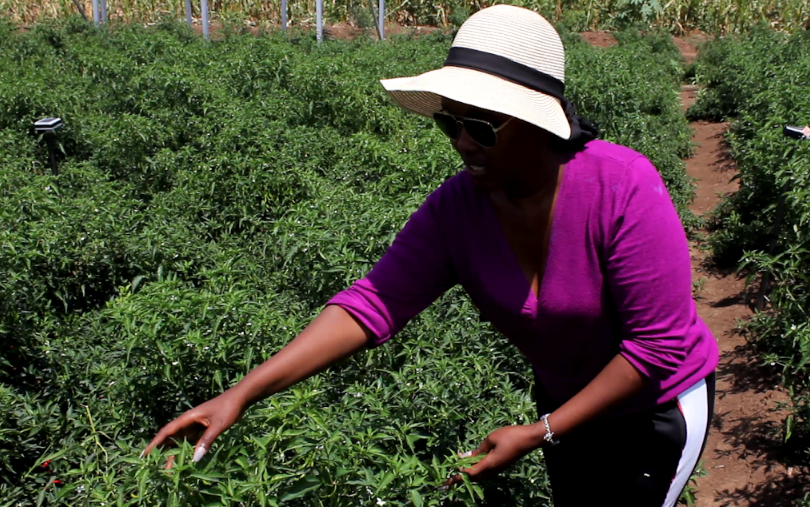
Judy Towett, a journalist turned agripreneur, has unlocked a highly lucrative secret that is transforming the valley’s structural challenges into a distinct competitive advantage, the cultivation of the long cayenne chili variety.
Through her pioneering farm, Ms Towett has proved that the Kerio Valley is an untapped goldmine for modern agribusiness by combining precision agriculture, green technology, and astute international market positioning, making her farm generate an impressive Sh2 million per season, with each kilogramme of chilli fetching two dollars.
At the heart of Ms Towett’s success is a firm departure from traditional agricultural methods in favour of precision or smart farming, saying this data-driven, resource-efficient approach minimises waste while maximising crop yields.
“Through targeted crop management, our farm achieves an optimal production rate where a single acre produces what would normally require three acres under traditional farming methods,” said Ms. Towett.
Under this precision model, she said one acre of land yields up to 30 tons of fresh, vibrant chilies adding that they practice minimal tillage which protects the soil structure and retains moisture, while feeding the crop precisely according to seasonal needs.
“For example, right now the chili is at the flowering stage and requires minerals like potassium which is what we will apply, we also ensure that we spray at the right time to ensure the crop is not affected by pests and diseases,” explains Ms. Towett.
She said that the farm follows a strict spraying schedule every two weeks to combat relentless local pests and fungal infections, ensuring that interventions are proactive rather than reactive.
While technology drives efficiency, the farmer said the unique geography of the Kerio Valley provides the perfect natural incubator for chilli production, as it boasts of a consistently warm climate, with high temperatures sustained during both the day and the night, which speeds up the metabolic growth of the chilli plants, resulting in high-potency production.
Ironically, she said the environmental degradation of the surrounding highlands works to the valley’s advantage as the heavy rainfall on the steep escarpments causes severe soil erosion, washing nutrient-rich topsoil directly down into the floor of the valley.
This natural process makes the valley basin extraordinarily fertile. “In fact, when we went for soil testing, we were told the soils are very conducive to the growth of various crops,” she said.
Furthermore, Ms. Towett said the hot tropical sun serves as a free, high-efficiency processing tool as the long Cayenne chilies must be completely dried before they can be safely packed and exported to international buyers.
“The intense heat allows us to completely sun-dry the crop within three days, preparing it for packaging and shipment abroad,” she noted.
In a semi-arid zone where rain-fed agriculture is unreliable, securing a dependable water supply is a matter of survival, and therefore, to eliminate vulnerability to drought, Ms. Towett said she invested in a borehole.
Noting that she embraces clean energy, the farm uses a solar-powered pumping system that yields an impressive 25,000 litres of water per hour with the infrastructure allowing the farm to irrigate, bypassing the electrical grid, which eliminates power bills, lowering operational overheads significantly.
According to Ms. Towett, the most ingenious aspect of farming chilies in this specific geographical pocket is how it resolves human-wildlife conflict as being located adjacent to the Rimoi National Game Reserve, farms in the area are highly vulnerable to elephant invasions.
Over the years, local farmers have suffered losses running into millions of shillings as elephants trample on crops with the government embarking on the construction of a fence as part of the mitigation measures.
The farmer said chilies possess a natural defense mechanism, saying elephants have an incredibly sensitive respiratory tract and detest the pungent smell of chili, which they can detect 3 km away.
“Chili is a natural deterrent to elephants who smell it 3 km away and change direction, thus making it the best crop for the area,” she points out.
By planting chillies, Ms. Towett has established a natural, non-violent deterrent that completely protects her cash crop from wildlife destruction, solving a security problem that has plagued the region for generations.
Ms. Towett’s strategic foresight extends far beyond agronomy into international trade logistics with one of her primary international export destinations being China, a massive market with an insatiable appetite for hot spices.
Her success in this arena is anchored on a landmark bilateral breakthrough. The Kenyan and Chinese governments signed the Early Harvest Arrangement under the Forum on China-Africa Cooperation (FOCAC) framework. This progressive trade agreement grants quota and duty-free access to 98.2% of Kenyan tariff lines entering China.
Among the high-value commodities eligible for zero tariffs include avocados, macadamia nuts, and chilies, among other horticultural products with the primary objective of this historic zero-tariff framework being to systematically address the trade deficit between Kenya and China by scaling up the volume of high-value Kenyan agricultural products flowing into Asian consumer markets.
Before this agreement, Ms. Towett noted, the logistical framework was heavily one-sided, as China had been importing a lot of goods to the country, but the shipping containers would go back empty because there was so little being exported from Kenya.
“However, with the agreement between the two countries, the containers now go back with horticultural products, thus ensuring that local farmers benefit,” she said.
However the farmer said despite the immense profitability, the venture comes with its share of hurdles as there is a certain bird species completely undeterred by the heat of the chillies, frequently invading the farm.
She added that pests and aggressive fungal infections also require constant vigilance and regular biweekly spraying treatments.
To streamline operations, Towett employs four dedicated workers to manage her current four-acre farm while she hires casuals depending on the work at the farm.
To succeed in farming, she called on farmers to study not only the market but also the crop they want to venture into for them to break even or benefit from their farming. Her message to aspiring agripreneurs remains clear: success requires looking beyond the soil.
Through this deliberate blend of science and strategy, the arid Kerio Valley is finally shedding its harsh reputation, one spicy acre at a time.
By Alice Wanjiru