African governments and development partners have been urged to increase investment in agriculture and give farmers a stronger role in policy and investment decisions to unlock the continent’s food production potential.
The call was made today during a regional farmers workshop in Nairobi where the German development agency (GIZ) launched a four-year Farmers Organization Hub (FO-HUB) initiative aimed at strengthening farmer organizations and ensuring farmers play a central role in transforming Africa’s agri-food systems.
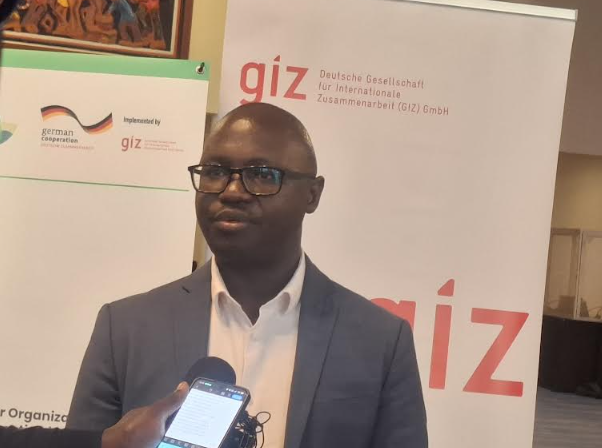
GIZ Senior Technical Advisor Kennedy Okech said the initiative would strengthen the capacity of farmer organizations to participate effectively in policy formulation, implementation, and agricultural investment decisions.
“The aim is to ensure that farmers are at the apex of the transformation of the agri-food system and that their voices are heard,” Okech said.
The initiative will support the East African Farmers’ Federation (EAFF) to engage in national and regional policy processes, generate evidence to inform policymaking, and strengthen its capacity to represent farmers.
Okech said the project would also promote climate-resilient agriculture, strengthen farmers’ ability to adapt to climate change, and increase the participation of women in agricultural policy and decision-making.
He said farmers would also be supported to participate in implementing key policies and investments, including the National Agri-Food System Investment Plan, which serves as a domestication tool for the Kampala Declaration.
EAFF President Elizabeth Nsimadala said Africa’s annual food import bill had risen to between USD 70 billion and USD 100 billion, underscoring the urgent need to boost local production.
She said the money spent on food imports should instead become an investment opportunity for African farmers, noting that the continent was seeking a similar level of investment under the Comprehensive Africa Agriculture Development Programme (CAADP) 3.0.
Nsimadala said EAFF, which represents more than 25 million smallholder farmers through 24 farmer organizations in 10 Eastern African countries, wanted farmers to move from being merely consulted to becoming strategic partners in agricultural policies and investments.
“Farmers must move from being consulted to being recognized as strategic partners,” she said and called for a “business-unusual” approach to agriculture.
She urged stakeholders to translate the Kampala Declaration on food systems transformation into practical action in farms, markets, and communities.
Nsimadala also called for greater investment in climate-resilient farming, water management, extension services, technology, risk management and market access, while urging stronger support for women and youth through digital technology, entrepreneurship and innovation. “Agriculture must be a vibe to Gen Z,” she said.
African Union Development Agency-NEPAD Programme representative Billy Ratemo said Africa had enormous agricultural potential, including abundant arable land, a large youth population, and rich biodiversity, but much of it remained untapped.
He said agriculture and agri-food systems account for about 60 per cent of jobs across African countries and contribute more than 35 per cent of GDP on average, making the sector critical to job creation, trade and food security.
“The challenge is not one of potential. Potential really exists when you travel across Africa, but how do we unlock this potential?” Ratemo said.
Ratemo said Africa must increase domestic production and strengthen intra-African trade to reduce reliance on food imports.
He said the CAADP Kampala Declaration provided a framework for transforming agriculture through an integrated agri-food systems approach, with farmers remaining at the centre of the process.
IGAD representative Dr. Sylvia Henga said early warning systems were generating important information on climate, floods, crops, and pests, but stronger action was needed to ensure the information resulted in timely interventions for farmers.
She called for better coordination and accountability in the use of resources and stronger regional trade and investment in strategic food and input reserves to cushion farmers against climate and market shocks.
Henga said regional food security strategies should be measured by their impact on smallholder farmers, particularly women and young people.
She also identified soil degradation, post-harvest losses, poverty, limited access to land and inputs, weak institutions, and low adoption of agricultural technologies as major challenges requiring urgent action.
Africa’s food systems are predominantly driven by smallholder farmers, yet many of them and their organizations lack the capacity and resources.
And thats why according the EAFF, farmer organizations must be strengthened to play a more influential role in shaping agricultural, climate, trade and food systems policies at national, regional, continental and global levels.
By Wangari Ndirangu