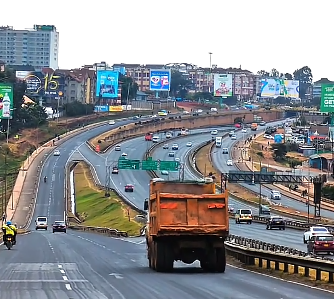
The Kenya National Highways Authority (KeNHA) has called for a new approach to managing the Nairobi-Thika Superhighway, saying the road’s success under Kenya’s Vision 2030 has created a second generation of challenges requiring integrated corridor management.
KeNHA officials said the priority should now shift from construction to preserving the highway, improving road safety, managing traffic, protecting the road reserve, and integrating the corridor with rapid urban development.
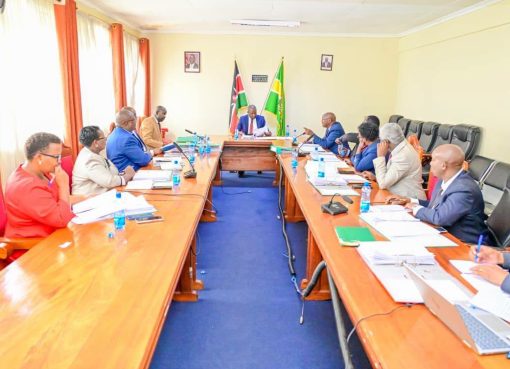
Speaking during an inspection tour of major roads in the Nairobi region on Monday, KeNHA Deputy Regional Director Engineer Antony Mugo said major projects along Corridor C, covering Thika Road to Moyale, had been completed in line with Vision 2030 projections.
Senior Inspector of Roads on Corridor C, Engineer Lawrence Opondo, said the Nairobi-Thika Superhighway had opened up the region, improved connectivity, and eased congestion that previously characterized the narrow Thika Road.
Constructed between 2009 and 2012 and officially opened on November 9, 2012, the approximately 50-kilometer highway was designed to address severe congestion and improve transport links between Nairobi, Thika, and surrounding areas.
The project, which cost approximately US$360 million, introduced widened carriageways, interchanges, flyovers, underpasses, service roads, pedestrian facilities, drainage, and street lighting.
Eng. Opondo said the transformation had also generated wider economic benefits in areas along the corridor.
Speaking at Muthaiga Exchange Road, he said improved accessibility had contributed to enhanced security, increased business activity, employment opportunities, and a rise in real estate development.
At the Roysambu flyover, cleaners and repair workers Meshak Ndungu and Juma Tsuma said the highway had provided them with employment through performance-based maintenance contracts, enabling them to support their families.
Residents also said the road had opened access to previously difficult-to-reach areas.
Joseph Kioko said the highway had reduced congestion, particularly during morning and evening peak periods, while creating opportunities for young people and women.
“Women make and hawk tea and vegetables to pedestrians and other road users, while the youth operate car wash businesses along the highway,” he said.
Francis Njuguna said the highway had contributed to a boom in construction and real estate, resulting in higher land prices and increased rental development.
He added that improved connectivity had made access to health facilities, including Kenyatta University Referral Hospital, easier.
However, residents warned that the growth stimulated by the highway was placing increasing pressure on its capacity and surrounding infrastructure.
Njuguna called for expansion of the highway to accommodate rising traffic volumes, while Kioko requested an access road linking a 500-meter stretch from Kahawa West to Kamiti Road.
Residents also called for additional road-safety measures at identified black spots.
Kioko proposed bumps at a black spot around Njathaine village and Route 44, while Njuguna suggested a footbridge to reduce pedestrian exposure to traffic.
KeNHA’s assessment indicates that recurring congestion is now among the most significant challenges facing the corridor.
Engineer Opondo says that although the original expansion substantially increased capacity and reduced journey times, improved accessibility has encouraged population growth, commercial development, increased vehicle ownership, and greater trip generation.
“There’s congestion around busy activity and interchange areas, including Githurai, Kahawa, Roysambu, Kasarani, Garden City, and Pangani, where through traffic interacts with local traffic, public transport, pedestrians, and roadside businesses,” said Opondo.
He noted that the problem is therefore no longer simply one of highway capacity but also of traffic management, access control, public transport operations, and land-use planning.
The engineer pointed out pavement deterioration as another growing concern after more than a decade of intensive traffic.
He also noted that heavy commercial vehicles, water infiltration, blocked drainage, utility works, overloaded vehicles, and deferred maintenance have contributed to potholes, cracking, rusting, and edge deterioration.
“There’s a need for systematic asset management, regular condition surveys, and preventive maintenance to prevent minor defects from developing into expensive structural failures,” he observed, adding that pedestrian safety has also emerged as a major concern as urbanization creates new pedestrian movement patterns.
Broken or discontinuous footpaths, encroachment on non-motorized transport facilities, inadequate crossings, poor lighting, and conflicts involving motorcycles expose pedestrians to high-speed traffic.
Engineer Mugo said the authority recommends designing pedestrian facilities around actual movement patterns and ensuring continuity between footpaths, bus stages, residential areas, markets, and commercial centers.
Noting that public transport operations present a challenge when matatus frequently pick up and drop passengers outside designated areas, obstructing traffic and creating conflicts with pedestrians, Engineer Mugo said KeNHA proposes rationalizing bus stages and providing properly designed passenger facilities, including bus bays, shelters, lighting, drainage, and controlled entry and exit arrangements.
Uncontrolled development and activities within or near the road reserve have also reduced the effectiveness of the highway.
Informal businesses, roadside parking, advertising structures, uncontrolled access points, markets, and drainage encroachments increasingly compete with the highway’s primary function of moving traffic.
KeNHA is proposing formal roadside stations outside the operational road reserve where traders could operate legally while providing parking, public transport facilities, toilets, waste management, lighting, and security.
Engineer Mugo pointed out that this approach seeks to protect road safety without eliminating the economic opportunities that have developed along the corridor.
Drainage is another priority as rapid urbanization has increased impervious surfaces and storm water runoff.
Blocked drains, siltation, damaged culverts, inadequate outfalls, illegal connections, and encroachment on drainage reserves can cause flooding, pavement deterioration, and traffic disruption.
KeNHA says a comprehensive drainage capacity and condition assessment is needed in addition to routine cleaning.
According to Opondo, KENHA has already undertaken several interventions to preserve and improve the highway.
These include continuous performance-based maintenance contracts, surface dressing, construction of the Allsops overpass, and additional entry and exit lanes at locations such as Safari Park, Githurai, Ruiru, Juja, Kimbo, and Toll, as well as additional pedestrian crossings.
By Donald Ngala