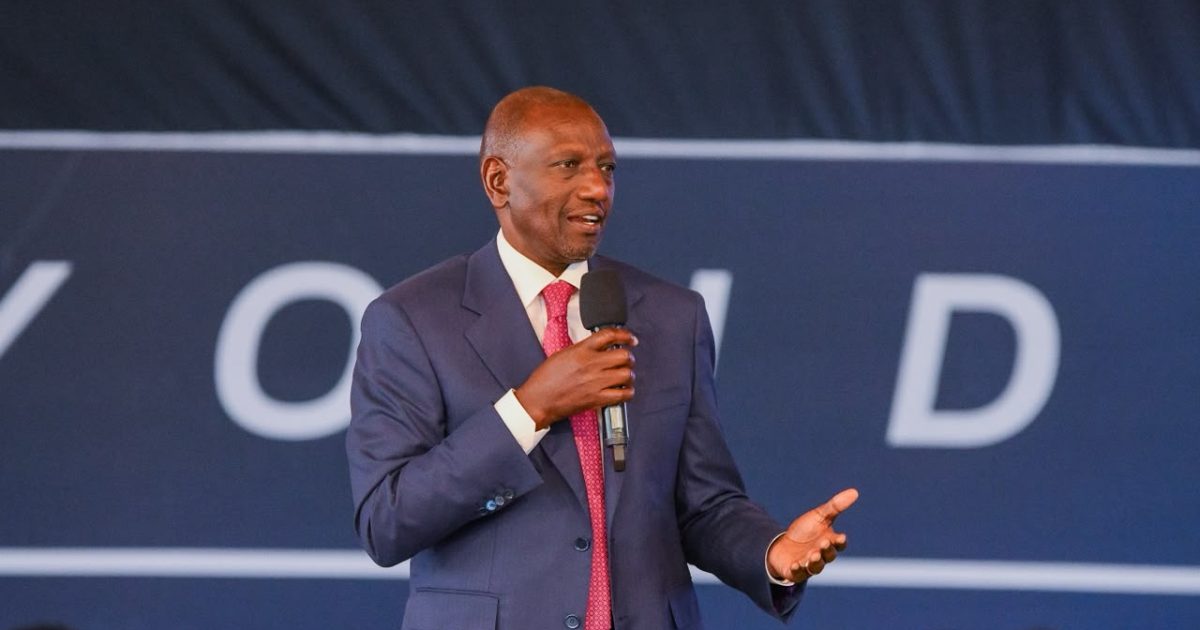
President William Ruto has called for the development of a new long-term national development vision beyond 2030, saying Kenya must plan for future generations rather than allow electoral cycles and changes in administration to determine the country’s development priorities.
The president further proposed the need for a new vision had become urgent because the current Medium-Term Plan IV ends in 2027, while the proposed Medium-Term Plan V will run from 2027 to 2032, overlapping with the expiry of Kenya Vision 2030.
“We need to have a long-term vision for us to be able to plan Medium-Term Plan Five,” Ruto said during a national conversation on Kenya’s development beyond 2030 in Nairobi on Wednesday.
Ruto stated that the new vision should reflect the country’s changed circumstances, including rapid technological advancement, artificial intelligence, emerging global economic trends and the opportunities presented by Africa’s growing population and markets.
Furthermore, he noted that Vision 2030 was formulated before the promulgation of the 2010 Constitution, which provides for public participation in national affairs.
“We have an opportunity, this time around, different from the opportunity that was in 2008, to formulate a long-term plan, one that is done by the people, not by government, not by bureaucrats, by the people themselves,” he said.
Kenya should use the process to determine how it can position itself to benefit from Africa’s growing global economic significance, citing the continent’s youthful population, renewable energy potential, emerging markets and large reserves of arable land as per what he thought on the matter.
“Kenya must think beyond the next election. Kenya must think for the next generation,” he said, urging Kenyans to look beyond individual election cycles and administrations when considering the country’s future.
The government, as its role stipulates, would facilitate the process but should not dictate its outcome, calling for contributions from the private sector, farmers, students, academia, civil society and other sectors.
The president further proposed the formation of a multi-sectoral team whose members would be suggested by various sectors of society to lead the process of developing a roadmap for the new vision and the eventual framework should be anchored in legislation to ensure continuity across successive administrations.
“Part of the challenge we had in Vision 2030 was that it wasn’t underpinned by any law,” Ruto said, noting that successive administrations were therefore not legally obligated to implement the national vision.
The legislation would play a part in ensuring that future governments build on agreed national priorities instead of reversing them whenever there is a change of administration.
The Chairman of the Vision 2030 Delivery Secretariat Dr Emmanuel Nzai said the implementation of Kenya Vision 2030 projects had reached an aggregate 66.1 per cent since its launch in 2008.
Nzai said the political pillar had recorded the highest performance at 88 per cent, followed by foundations and enablers at 61.6 per cent and the social pillar at 59 percent.
“The economic pillar has the lowest. The targets that we put were very, very aggressive – 10 per cent GDP growth consistently. That we have not achieved,” he said.
He revealed the real GDP growth had averaged between 4.5 and 4.6 per cent, despite the resilience of the economy and progress in implementing various reforms.
He stated that the Vision 2030 framework had been implemented through successive five-year plans and that the current process was necessary because the next plan would extend beyond the lifespan of Vision 2030.
Nzai cited projects and programmes in infrastructure, health, education, social protection, digital payments, capital markets and special economic zones as among those contributing to the progress recorded under the vision.
Deputy President Kithure Kindiki, meanwhile, highlighted Government achievements in the economy, agriculture, education, healthcare and infrastructure as part of the country’s development journey.
He also highlighted that the Government had registered 7.2 million farmers, increased education funding, employed 100,000 teachers and expanded public health insurance coverage.
In addition to the same, he said the Government was investing in roads, railways, ports, airports, energy and digital infrastructure to support economic growth and job creation.
Representing the youth, the University of Nairobi students’ president Ahmed Rashid called for greater inclusion of young people in shaping the country’s future, saying the youth should be viewed as an asset rather than a challenge.
“I represent a generation, the young people of Kenya, full of not only questions, but also solutions,” he said.
Rashid pledged that young people would be at the forefront of driving Kenya’s future, urging leaders to ensure that the next national development vision reflects the aspirations of the younger generation.
Ruto said the national conversation would continue across the country to give Kenyans an opportunity to contribute ideas on the direction they want the nation to take beyond 2030.
By Nancy Omondi and Phaeline Motari