Kilifi Governor Gideon Maitha Mung’aro has reaffirmed his administration’s commitment to transforming the county’s health sector by constructing and equipping facilities with state‑of‑the‑art diagnostic technology.
Governor Mung’aro emphasised that his vision was to ensure residents can access quality medical services within their localities, thereby reducing the need for referrals to distant hospitals and easing the financial burden on both patients and their families, while also cutting costs for the county government.
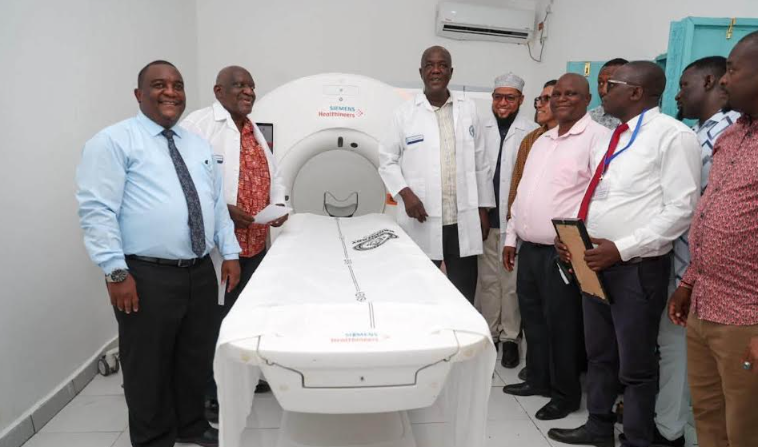
He was speaking at Malindi Sub‑County Hospital on Thursday, where he unveiled a modern 64‑slice CT scan and digital, Artificial Intelligence (AI)‑enabled X‑ray machines, marking a significant milestone in the county’s healthcare advancement.
“These investments are about bringing healthcare closer to our people. By equipping our hospitals with modern technology, we are not only improving service delivery but also ensuring that residents receive timely and accurate diagnoses without having to travel outside the county,” he said.
The new equipment is expected to enhance diagnostic capacity at Malindi Sub‑County Hospital, enabling medical professionals to provide faster and more precise treatment.
The governor announced that his administration had commenced the construction of a modern casualty and emergency facility within the Malindi Sub‑County Hospital at a cost of about Sh700 million.
Mung’aro said the CT scan is expected to handle between 20 and 30 patients daily, while the digital X‑ray machine can produce up to 250 images per day, with results transmitted instantly to doctors.
He further revealed that investment in modern surgical facilities had already increased the number of operations conducted monthly from 140 to 250, while the opening of a new maternity building earlier this year had boosted deliveries from 320 to 520. Laboratory services and dental equipment have also been strengthened to improve diagnosis and treatment.
The governor announced that the hospital’s Intensive Care Unit (ICU) and High Dependency Unit (HDU) would become operational within two months. In addition, the facility is transitioning to an electronic records system, eliminating the need for patients to purchase hospital books.
“Survivors of gender‑based violence and persons with disabilities holding valid cards will receive services free of charge, provided they are registered with the Social Health Authority (SHA),” he added.
Mung’aro said the county’s ambition was to transform Malindi Hospital into a major referral center serving Kilifi and neighbouring counties, thus reducing delays and the financial burden associated with seeking specialised treatment elsewhere.
Beyond healthcare, he highlighted ongoing infrastructure projects, including a four‑kilometer road linking Surai to Mtangani Prison, aimed at improving accessibility in the area.
County Executive Committee Member for Health Peter Mwarogo explained that patients would no longer need to carry film results, as images are now sent directly to doctors digitally.
Meanwhile, Shella Ward, a member of the County Assembly (MCA), Twahir Abdulkarim, urged health workers to embrace the new technology responsibly and cautioned patients against mistreating staff.
Kilifi County Assembly Health Committee Chairman and Mwanamwinga MCA Edward Ziro urged striking health workers to return to the negotiating table with their employers in order to resolve the impasse that has paralyzed services in many public health facilities.
He said most grievances were national in nature, as they are between their unions and the Salaries and Remuneration Commission (SRC), noting that the county government had done its best to ensure that the health workers are remunerated as already agreed.
By Emmanuel Masha and Shani Rhai