The Nakuru County Government has launched a coordinated multi-agency operation targeting the growing number of street families and vulnerable youths.
Officials have termed the situation both a humanitarian concern and a rising security issue.
County Executive Committee Member (CECM) for Youth, Sports, Gender, and Social Services, Elga Riaga, said the intervention brings together the county government, the office of the County Commissioner, Kenya Red Cross, the Department of Children Services, County Social Services and the office of the County Attorney.
Ms. Riaga emphasized that the approach is centered on rescue and rehabilitation, not enforcement.
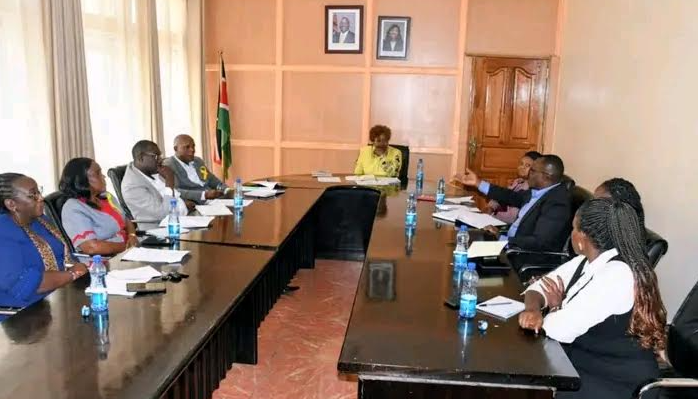
The CECM spoke when she chaired a steering committee meeting that brought together senior officials from the participating departments to establish a coordinated framework for implementing the programme.
The programme will onboard county departments responsible for health, education, trade, social services, enforcement, and public service management to coordinate interventions for affected children and households.
Authorities warned that anyone obstructing the operation or engaging in unlawful activities will face legal action.
Ms. Riaga said the intervention aims to restore dignity to affected individuals while reclaiming public spaces.
The CECM assured that the coordinated approach would help the County address the different challenges facing street-connected children and families.
The Committee will coordinate child protection, healthcare, education, family tracing, rehabilitation, economic empowerment, and enforcement interventions under the initiative.
According to Riaga, the approach will consequently move beyond rescuing children from streets to supporting their families and creating conditions for sustainable reintegration.
The programme will also connect children to essential services, including healthcare and education, as part of the rehabilitation process.
Families facing economic challenges will be linked to appropriate empowerment interventions to strengthen their capacity to support children after reintegration.
The Trade Department will consequently contribute to interventions aimed at improving household economic opportunities, while the Health Department will support access to healthcare services.
The Education Department will support efforts to return children to learning, while Social Services will coordinate family tracing, rehabilitation, and reintegration activities.
The Enforcement Department will complement the programme by supporting child protection and addressing situations that require enforcement action.
Public Service Management will support coordination across county departments to ensure that the interventions are implemented through a common framework.
Ms. Riaga explained that the steering committee will develop and implement sustainable interventions targeting both street-connected children and their families.
She pointed out that the ultimate objective was to create a supportive environment where children can grow safely, access opportunities, and realize their potential.
The initiative comes as new national data shows that Nakuru has one of the largest populations of street-connected persons in Kenya.
The 2025 National Census for Street Families recorded 18,049 street-connected persons across the country, with Nakuru accounting for 1,546.
Nakuru had the second-highest number nationally after Nairobi, which recorded 4,690 street-connected persons.
Mombasa followed with 1,428 persons, while Kiambu recorded 1,370.
The figures place Nakuru among the counties facing the greatest need for sustained interventions targeting street-connected populations.
The Census also recorded 3,910 children living on the streets nationally.
Of these, 1,536 children, representing 39.3 per cent, were living with their parents on the streets.
Another 2,374 children, representing 60.7 per cent, were living separately from their parents.
Nakuru recorded 182 children living with their parents on the streets, according to the census.
Ms. Riaga observed that the figures demonstrate Governor Susan Kihika’s administration’s rationale to craft the programme that will require both child-focused interventions and measures targeting vulnerable families.
She elaborated that family tracing will, therefore, form a critical component of the programme because children may require different forms of support depending on their family circumstances.
“Some families may require economic assistance, while others may need social protection, healthcare, counselling, or other services before reunification can succeed. The county’s multi-sectoral structure is designed to bring these services together rather than addressing individual problems separately,” said the CECM
The KNBS national census established that street-connectedness is influenced by several social and economic factors, reinforcing the need for interventions that address household vulnerabilities.
The CECM said economic empowerment will be particularly important for families whose inability to meet basic needs contributes to children spending time on the streets. She added that by involving the Trade Department, the county can connect social protection efforts with opportunities that strengthen household livelihoods.
According to Ms. Riaga, education will provide another pathway for children leaving street life and that reconnecting children with schools can help restore access to learning while providing a structured environment for their continued development.
Healthcare interventions will also help address immediate and longer-term health needs among children and families reached through the programme.
The county government said collaboration among departments would ensure that these services are delivered in a coordinated manner.
CECM for Public Service Management, Ambrose Ngare, attended the Steering Committee meeting, alongside CECM for Trade, Stephen Kuria.
Director of Enforcement Charles Nyanaro and other county officials also participated in the meeting.
The involvement of senior officials is expected to strengthen accountability and coordination as the county develops the programme’s implementation framework.
The County will also need to work with other stakeholders involved in child protection and rehabilitation to strengthen the reach of the interventions.
The national government has previously identified family reintegration and rehabilitation as important components of the response to street families.
The latest census provides the County with updated evidence that can help inform interventions targeting street-connected populations.
Nakuru’s 1,546 street-connected persons account for about 8.6 per cent of the national total recorded during the census.
According to Ms. Riaga, the County is committed to protecting vulnerable children, strengthening families, and creating an environment where every child could access opportunities and develop their potential.
The programme provides Nakuru with a structured platform to combine child protection with family support and economic empowerment.
Its success will ultimately depend on effective coordination, adequate resources, family participation, and sustained follow-up after rehabilitation.
By Jefther Simeon Afuyo