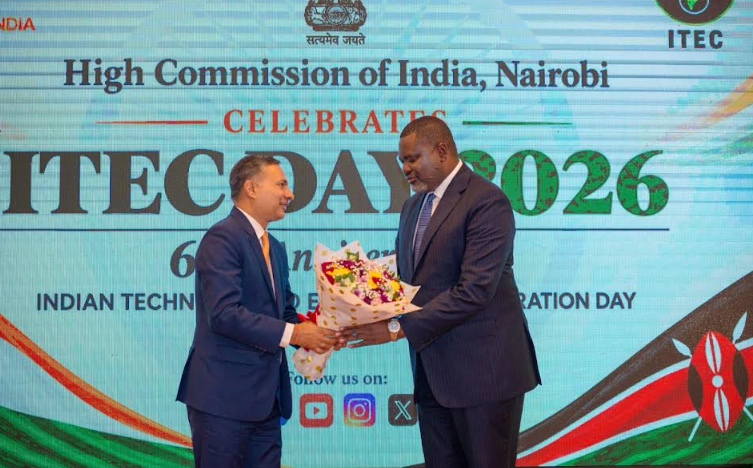
Kenya and India are seeking to deepen cooperation in technology, digital skills, and public-sector capacity building based on a partnership that has seen more than 3,000 Kenyan professionals benefit from India’s Indian Technical and Economic Cooperation (ITEC) programme over the past decade.
Public Service, Human Capital Development, and Special Programmes CS Geoffrey Ruku said Kenya was keen to strengthen technical cooperation with India in emerging areas including artificial intelligence (AI), digital public infrastructure, cybersecurity, digital skills, e-government, and technology-enabled service delivery.
Speaking during the 62nd ITEC cooperation celebrations in Nairobi Tuesday, Ruku said rapid technological change was transforming governments, businesses, and societies, presenting both opportunities and challenges for developing countries.
“For Kenya, this presents both an opportunity and a challenge. The opportunity is to use technology to accelerate development and improve public services, and the challenge is to ensure that technological change does not create new inequalities or leave some ethnic groups behind,” he said.
The CS called for greater exchange of expertise, joint research, institutional partnerships, innovation, and technology transfer between the two countries, saying Kenya’s development priorities required knowledge, skills, and technology alongside financial resources.
He said ITEC’s value should not be measured only by training Kenyan officials receive in India but by how the acquired knowledge is applied after they return home.
“The greatest value of ITEC to Kenya’s public service is not simply the training that state and public officers receive in India. The greatest value is what happens after the training,” Ruku said.
He noted that Kenya’s youthful population made investment in skills and knowledge particularly important, saying ITEC could help prepare the next generation of professionals, entrepreneurs, innovators, and public officers for the emerging economy.
Ruku also urged the two countries to use their partnership to support wider South-South cooperation in addressing common challenges, including employment creation, poverty reduction, climate change, food security, healthcare, and technology access.
Indian High Commissioner to Kenya Dr. Adarsh Swaika said Kenya’s participation in ITEC had grown considerably, with the country’s annual training allocation now exceeding 400 slots.
He said the programme had increasingly shifted towards customized training tailored to the needs of Kenyan institutions, citing programmes involving officials from the Attorney General’s Office, Kenya Revenue Authority, Directorate of Criminal Investigations, and Kenya Space Agency.
Dr. Swaika said India had also introduced on-site ITEC and e-ITEC programmes, enabling specialized training to be delivered virtually, particularly to senior officials unable to spend extended periods abroad.
He encouraged Kenyan ministries, county governments, and training institutions to approach the Indian High Commission with proposals for customized programmes.
Globally, Dr. Swaika said ITEC had trained more than 200,000 officials from over 160 countries in civilian and defence fields since its establishment in 1964, with the programme currently offering nearly 400 courses at more than 100 institutions across India, providing about 10,000 fully funded training opportunities annually.
Major General Peter Limo, Assistant Chief of Defence Forces in charge of Personnel and Logistics, said Kenya and India would deepen defense cooperation in military training, maritime security, healthcare, technology, and regional security.
Limo said India’s support had strengthened the Kenya Defence Forces through enhanced professional competence, strategic leadership, interoperability, and operational readiness.
He said Kenya also welcomed expanded cooperation in specialized military training and institutional development, including maritime security initiatives such as the establishment of the National Maritime Information Sharing Centre.
“We look forward to the second edition of Exercise I-Kenya to be co-hosted by the Kenya Navy and Indian Navy in 2027,” Limo said.
Kenya and India continue to strengthen education and skills partnerships through university exchanges, public-sector capacity building, and digital learning.
By Wangari Ndirangu