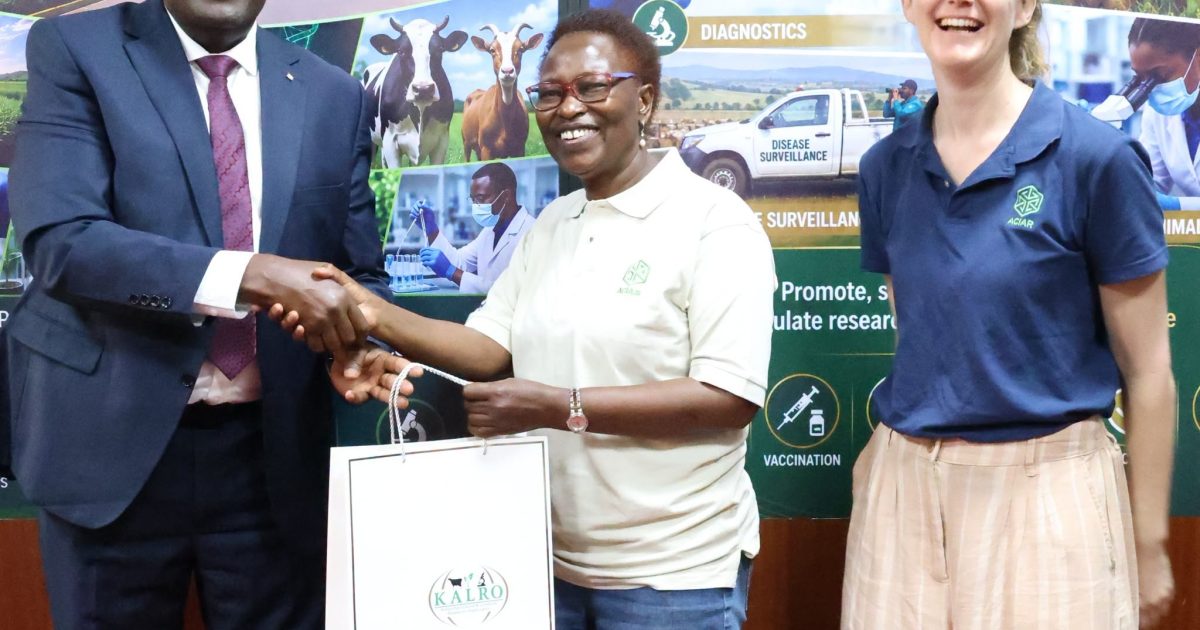
The Kenya Agricultural and Livestock Research Organisation (KALRO) and the Australian Centre for International Agricultural Research (ACIAR) are exploring areas of collaboration in agricultural research and innovation, with focus on soil health, digital soil mapping and forages for animal feed.
The discussions took place at KALRO Kabete where an ACIAR delegation visited the research organisation to learn about its ongoing research and identify areas where the two institutions could combine their expertise.
KALRO Director General Dr Patrick Ketiem highlighted the importance of partnerships in advancing research and developing practical solutions for farmers.
“Partnerships are important in advancing agricultural research and developing practical solutions for farmers.” He said.
The delegation toured KALRO Kabete research facilities, including the soil laboratories, where it was briefed on ongoing research in soil health and digital technologies used to support agricultural decision-making.
The delegation showed particular interest in digital soil mapping, which provides information on soil characteristics and fertility conditions in different locations.
The information will help farmers and agricultural practitioners make informed decisions on soil management and fertilizer application.
KALRO’s digital soil fertility mapping work has already included Kiambu County, which was among two counties covered during the pilot phase of the project. According to KALRO’s 2024 annual report, 26 agripreneurs from Kiganjo and Kiamwangi wards were trained on soil sampling and the use of digital applications to identify sampling locations and record soil data.
The exercise led to the collection of 204 soil samples from the two wards, with 111 samples collected in Kiganjo and 93 in Kiamwangi.
The samples were taken to laboratories, including KALRO Kabete, for analysis.
Soil testing helps establish the nutrient status of farmland and identify deficiencies, providing a basis for appropriate fertilizer recommendations. This can help farmers avoid applying the same type or amount of fertilizer across farms with different soil conditions.
KALRO Kabete has also continued to engage farmers in practical soil sampling and testing activities, linking its laboratory research with agricultural practices at farm level.
The ACIAR delegation further explored KALRO’s research on forages for animal feed, which seeks to support livestock farmers through improved availability and quality of feed.
ACIAR is an Australian government agency that works with research institutions and partners in developing countries to address agricultural challenges through international research collaboration.
Its work supports research aimed at generating practical solutions for farmers and strengthening agricultural and food systems.
The visit provided an opportunity for the two institutions to exchange knowledge and explore potential areas of future cooperation in agricultural research and innovation.
For farmers in Kiambu, continued advances in soil mapping and testing could provide more detailed information to support fertiliser use, soil management and crop production.
The county’s participation in the digital soil fertility mapping pilot also provides an existing basis for applying further developments in soil research to local agriculture.
by Winjoy Makena and Grace Naishoo