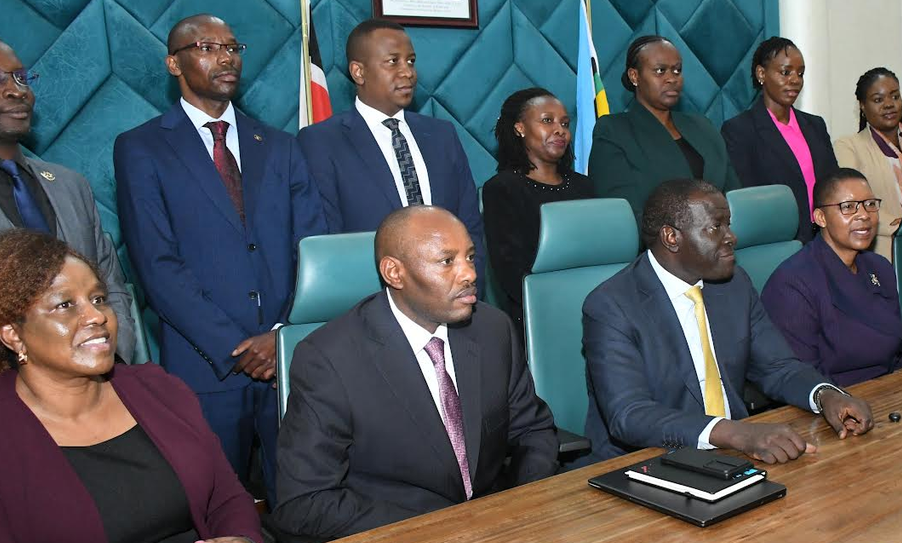
Attorney General, Dorcas Oduor, has launched a Multi-Sectoral Committee on Legislative Reform and Alignment to review obsolete, outdated and unconstitutional laws in a move aimed at harmonising Kenya’s legal framework with the Constitution of Kenya, 2010.
Speaking during the launch at Sheria House in Nairobi, Oduor said the committee had been tasked with identifying laws and subsidiary legislation that have either been declared unconstitutional by courts, become obsolete or no longer serve any legal or administrative purpose.
She said the committee would also identify legislative gaps and recommend amendments, repeals, consolidation of statutes and the enactment of new laws to ensure Kenya’s legal system remains responsive to constitutional principles and emerging governance needs.
According to the Attorney General, although courts have over the years declared several statutory provisions unconstitutional, many of the affected laws remain in the official Laws of Kenya because Parliament and the Executive are yet to complete the legislative processes required to amend or repeal them.
“When the High Court, Court of Appeal or the Supreme Court declares a statute or a section unconstitutional, that provision becomes null and void to the extent of its inconsistency. However, court decisions alone do not automatically clean up the physical text of the Laws of Kenya. The responsibility falls on the Executive and Parliament,” said Oduor.
She noted that the continued existence of outdated and unconstitutional laws had created legal uncertainty, complicated implementation of government programmes and exposed the State to avoidable constitutional disputes and litigation.
Oduor said a coherent legal framework was essential for promoting economic development, social justice, good governance and political stability.
“A cohesive legal framework is the foundation of economic progress, social justice and political stability. By aligning our laws with the Constitution, we will reduce litigation, protect public resources and build a more predictable legal environment for all Kenyans,” she said.
The Attorney General urged members of the public, legal practitioners, civil society organisations, professional bodies and other stakeholders to actively participate in the review process by submitting proposals on laws they consider obsolete, unconstitutional or in need of amendment.
She emphasised that public participation would be critical in ensuring the reforms reflect the aspirations of Kenyans while strengthening constitutionalism and the rule of law.
Kenya Law Reform Commission Chairperson Christine Anyango Agimba said the Commission had already undertaken preliminary analyses that would guide the committee’s work.
She disclosed that the Commission had identified 64 court decisions delivered between 2014 and 2024 affecting 50 Acts of Parliament, four statutory instruments and approximately 128 statutory provisions that had been declared unconstitutional.
Agimba observed that the continued presence of unconstitutional laws in Kenya’s statute books was more than a legal technicality because it affected citizens, public institutions and investors who depend on clear and predictable laws.
“The continued existence of laws that courts have found unconstitutional, or that may be obsolete, is not merely a technical legal issue. It affects citizens who need clear and consistent laws, public institutions that require harmonised legislation and businesses that depend on a stable and predictable regulatory framework,” she said.
She further revealed that the Commission had identified 42 statutes that may have become obsolete after being overtaken by the Constitution, replaced by subsequent legislation or having established institutions that no longer exist.
Agimba said the committee expects to complete its preliminary review within three months before embarking on public participation and preparing legislative proposals for submission to Parliament.
Solicitor General Shadrack J. Mose called on Kenyans to actively support the review process, noting that implementation of the Constitution is a collective responsibility requiring the participation of all citizens.
“All Kenyans are urged to participate actively in ensuring this process is undertaken effectively because this is our country, and we all have a responsibility to ensure the laws that govern us remain constitutional, relevant and responsive,” said Mose.
He also encouraged the media to continue highlighting laws that have been declared unconstitutional but remain in the statute books, saying such reporting would strengthen accountability and promote constitutional compliance.
Mose expressed confidence that the committee’s recommendations would help modernize Kenya’s legal framework, improve legislative coherence and support effective service delivery across government institutions.
The committee is expected to work closely with government ministries, constitutional commissions, independent offices, legal experts and other stakeholders to ensure the country’s legal framework is fully aligned with constitutional requirements and contemporary governance needs.
By Sharon Njeru