Agriculture is known as the backbone of Kenya`s economy with the sector contributing about 30 per cent of the Gross Domestic Product (GDP) and accounts for 80 per cent of national employment, mainly in the rural areas.
The sector provides employment to a significant number of Kenyans, with some estimates indicating that over 70 per cent of rural people depend on agriculture for employment.
The livestock sector in agriculture is a significant pillar of Kenya’s economy, contributing approximately 12 per cent to the national Gross Domestic Product (GDP) and accounting for about 42 per cent of the agricultural GDP.
The Bottom-Up Economic Transformation Agenda (BETA) for the livestock sector aims to increase its economic contribution from Sh. 390 billion to Sh1 trillion. Key priorities include expanding dairy, leather, and red meat value chains, boosting export value, and putting more money directly into the pockets of farmers.
Data from the same ministry shows that in 2023, Kenya earned approximately Sh190.5 billion from livestock production, including livestock products, which is roughly 1.5 billion US dollars. Cattle and calves alone contributed Sh112.7 billion (about 870 million US dollars) to this total.
Kenya’s total livestock population is estimated at over 146 million. The livestock sector employs about 50 per cent of the agricultural workforce and contributes significantly to the national GDP.
Data from the Ministry of Agriculture, Livestock Development and Fisheries also shows that as of 2024, the country’s animal population comprised 44.6 million poultry, 22 million cattle, 35 million goats, 28 million sheep, 4.3 to 6 million camels, 1.9 million donkeys, and 0.5 million pigs, which contributed 4.4 per cent of the Gross Domestic Product (GDP) same year.
According to Food and Agriculture Organization (FAO), Kenya’s beef production stands at 588,000 metric tonnes and cow milk production at 4.1 billion litres per year, and the demand for livestock products is projected to increase exponentially driven by population growth by the year 2050.
The study titled; Future of Livestock in Kenya 2019 shows that by the year 2050, meat and cow milk consumption will increase by 1.4 and 6.6 million metric tons annually respectively.
Consequently, the Government and stakeholders are working together to increase the productivity of the livestock sector in order to meet the demand for meat and other livestock products.
However, agricultural productivity has been growing at a slower pace in recent years as smallholder farmers and agricultural enterprises continue to face challenges growing their businesses and improving the quality and quantity of agricultural goods due to climate change and high skyrocketing prices of farm inputs.
With a number of farmers opting for goat farming which is both profitable and sustainable, requiring a smaller space and lesser resources to sustain it.
The venture is preferred for both meat and dairy products with success relying heavily on better planning and proactive management.
Today, many people in urban areas are opting for various options in agriculture sector which can help them not only utilize the small spaces at the back of their houses but also improve their food security and income.
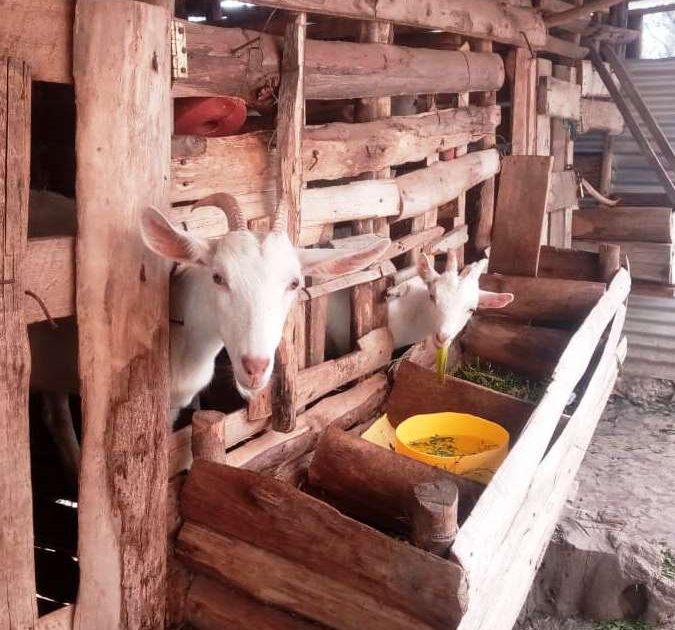
Kevin Omondi, an Electrical Engineer has established a thriving goat framing venture on his small parcel of land in Nyamasaria area in Kisumu city.
He is currently rearing about 150 goats on his slightly over half an acre farm and is reaping the fruits thereof.
“Goats farming is a very profitable when you look at the monetary side of it. When I started in 2019, I had around four goats producing around nine liters of milk per day but today the number has grown considerably to more than 150 thus allowing me two more youths to help manage the farm.”
Despite being an urban farmer, Mr. Omondi also works as an electrical engineer which also poses a challenge on how he manages to balance his time and ensuring his goats are well taken care of.
His main challenge is feeds and water considering the climate and low rainfall in Kisumu. Kisumu’s climate can be unpredictable, but goats tend to be hardy and adapt easily to the environment.
Thus, Omondi says that goats are proving to be a climate-smart animal to rear.
Their natural adaptability allows them to thrive on a variety of forages, including agricultural byproducts that other animals might not live on. To further boost productivity, community-led initiatives, often supported by agricultural organizations have introduced improved, resilient breeds.
For Omondi, his herd is a crossbreed between Saneen breed and Galla breed for higher milk production and higher adaptability.
By crossbreeding local, hardy strains with more productive varieties, farmers are now producing goats that grow faster and fetch better market prices, turning what was once a subsistence activity into a profitable business venture.
For farmer Omondi, his 150 goats give him over 200 litres of milk everyday which he supplies to his regular clients like hotels and individuals for prefer goat milk for its health benefits. This translates to over Sh20, 000 everyday, making our farmer smile all the way to the bank.
Experts say goat milk is a highly nutritious dairy alternative known for its easier digestibility and lower allergenicity compared to cow’s milk. It is packed with essential nutrients, including calcium, magnesium, potassium, and Vitamin A, which help build strong bones and support immune function
Farmers are discovering that with just a handful of Does (female goats), they can build a sustainable income stream. Whether through the sale of meat—often referred to as chevon, or the increasingly popular dairy goat milk, these animals offer a quick return on investment due to their short gestation period and high reproductive rates, (their gestation period if five months, so it can give you kids twice a year.
The impact of this shift is perhaps most visible in the empowerment of women. Traditionally, women in many local communities have had less access to land and capital, but the manageable nature of goat farming allows them to integrate livestock rearing with their domestic responsibilities.
Take Grace Auma for example, a Kisumu-based farmer and neighbor to engineer Omondi. She has turned her passion for dairy goats into a thriving enterprise. By managing a flock of Toggenburg Does, she provides fresh milk to local hotels and processes the surplus into yogurt, proving that small-scale efforts can yield commercial success.
Her story is echoed across the county, where the proceeds from goat sales are helping parents pay school fees, cover medical costs, and improve their families’ daily diets. Being in a self-help group with other farmers in the area, these farming are turning around their lives, one day at a time.
For the small-scale farmers in Kisumu, the goat is more than just an animal; it is a symbol of stability. In a changing world, these small herds are proving that you don’t need vast acres of land to make a big difference—just a bit of dedication and the right livestock.
By Mabel Keya – Shikuku and Peter Omondi