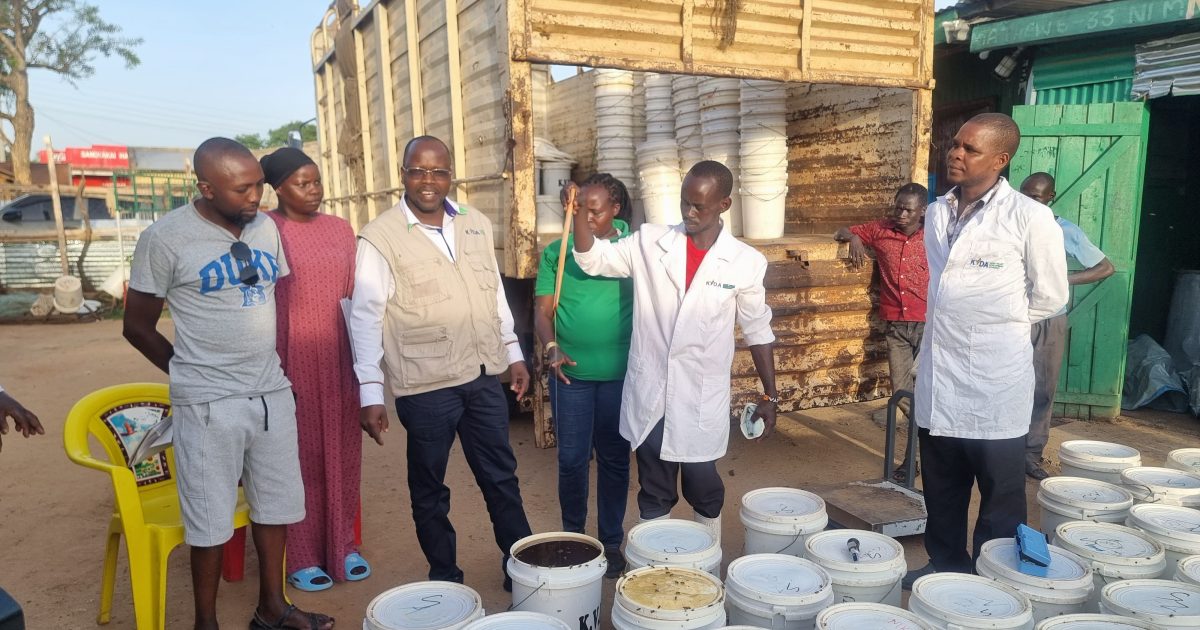
In the semi-arid landscapes of West Pokot, women are turning beekeeping into a lifeline of hope, income, and environmental conservation.
What was once a small-scale traditional activity has grown into a thriving honey enterprise that is transforming communities across the region.
Through support from the Government, under the Kerio Valley Development Authority (KVDA), hundreds of women have embraced modern beekeeping as a sustainable source of livelihood, helping them achieve financial independence while protecting the region’s fragile ecosystem.
For years, many women in West Pokot struggled financially, relying heavily on livestock or depending on their husbands for support.
Honey farmers were also vulnerable to exploitation by brokers and middlemen who bought honey at throwaway prices, sometimes as low as Sh100 per kilogram.
Today, the story is different. KVDA has stepped in to stabilize honey prices, provide market access, modernize beekeeping practices, and train farmers on honey processing and value addition.
The Authority currently purchases more than 130 tonnes of semi-processed honey annually from farmers across the Kerio Valley regions, injecting over Sh45 million directly into local communities.
KVDA Acting managing Director Moses Kipchumba says the Authority’s interventions were aimed at protecting farmers from exploitation while promoting sustainable livelihoods.
“Beekeeping is favorable due to the prevailing ecological conditions, especially the availability of acacia trees. Unlike livestock, bees are more resilient to drought and erratic weather conditions,” said Kipchumba.
He noted that KVDA has modernized the sector by introducing Kenya top-bar and Langstroth hives to replace traditional log hives, which were less productive and difficult to manage.
The Authority has also established a honey processing plant at Rokocho in Elgeyo Marakwet County with a capacity to process 150 tonnes of honey annually, helping improve honey quality and support value addition.
Beyond improving livelihoods, the honey value chain is also contributing significantly to environmental conservation.
“The honey value chain is part of conservation and biodiversity protection. Through beekeeping, farmers now value trees because they understand the economic benefits of honey production,” Kipchumba explained.
He said the acacia tree, once heavily targeted for charcoal burning, is now being preserved because it plays a key role in producing the region’s highly valued acacia honey.
“Instead of cutting trees for charcoal, communities are protecting them and keeping beehives, which ensures the environment is conserved,” he added.
In the Kodich area of Kacheliba Sub-County, women’s groups own more than 1,000 Kenya top-bar hives.
The women harvest, semi-process, and aggregate honey before selling it to KVDA at a farm-gate price of Sh400 per kilogram from Sh100.
Some of the active women’s groups involved in beekeeping include Nakwijit Women Group, Kapele Women Group, Chelelochkwan Women Group, Pamba Mutyo Women Group, Nguritukeia Women Group, and Achawa B Women Group.
For many women, the honey business has become a pathway to financial independence and dignity.
Rita Kamosong says she started honey farming in 2005 with support from KVDA. At the time, she used to transport between 20 to 30 jerrycans of honey for sale.
She recalls how difficult life was before KVDA intervened. “We used to sell honey to brokers and sometimes lose our money through fraud. At one point, I lost Sh2 million,” she said.
Today, Kamosong proudly says the honey business has transformed her life. She has built a permanent house, educated her children, and even bought a car through proceeds from honey farming.
“My firstborn is now serving as a police officer because of the income from honey,” she said.
Kamosong explained that in the Pokot Community, women traditionally have little control over livestock sales, making beekeeping one of the few businesses where women can independently earn income.
“Honey business has given women financial freedom and improved our lives,” she added.
Similarly, Lucy Maira says the support from KVDA helped women escape exploitation by middlemen and access stable markets for their products.
“Before KVDA came in, brokers controlled the business, and we suffered many losses. Now we can sell directly and earn better income,” she said.
Maira says proceeds from honey farming enabled her to construct rental houses worth Sh4.2 million, educate her children, and support her family after the death of her husband.
She also praised KVDA for training women on modern beekeeping, honey harvesting, and processing techniques.
“Honey business is accepted for women in our community, and it has changed many families,” she noted.
At Kapereng Women Group, Chairlady Margaret Kapachikwa says members have significantly improved their livelihoods through honey production.
“Our group has 16 members, and we earn up to sh800,000 annually from honey sales. The income helps us feed our families and educate our children,” she said.
Kapachikwa noted that women have also gained important skills in honey quality control, processing, and value addition through KVDA training programs.
As the honey sector continues to grow, women in West Pokot are now calling on the government to allocate more resources to KVDA to expand support for beekeeping and rural development programs.
For many families in the region, beekeeping is no longer just a traditional practice.
It has become a reliable source of income, a tool for environmental conservation, and a pathway to women’s empowerment and sustainable development.
By Anthony Melly