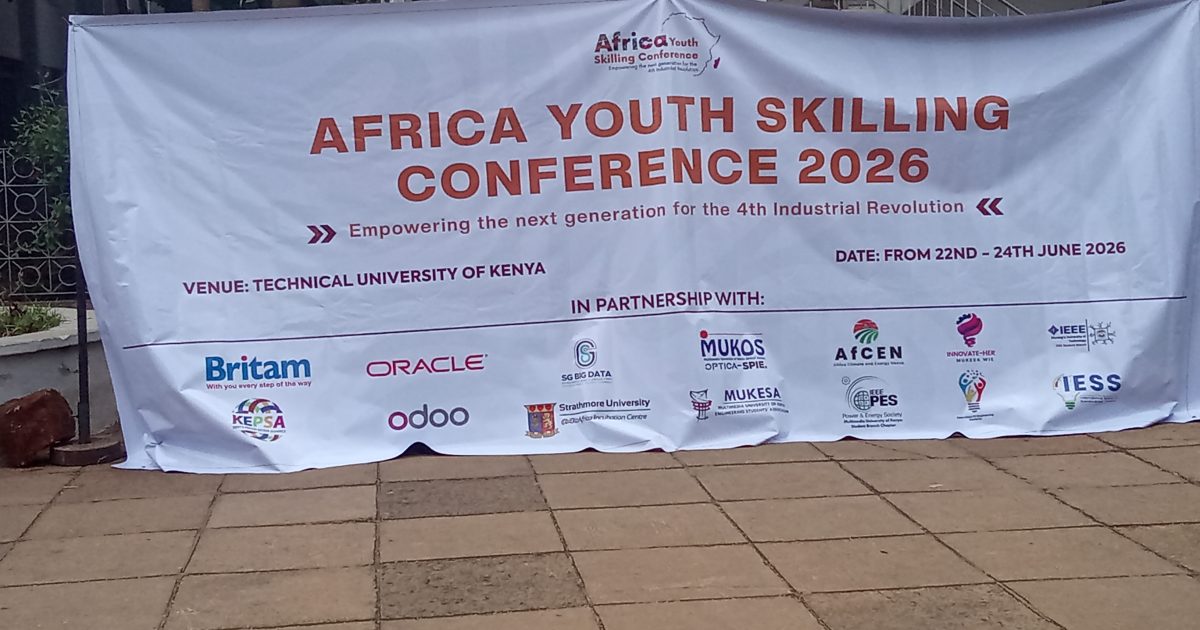
Technology experts have encouraged the younger generation in Kenya and the whole of Africa to position themselves at the forefront of Africa’s digital revolution in the era of Artificial Intelligence (AI).
The Tech experts engaged the youths in an interactive session during the Africa Youth Skilling Conference 2026 in Nairobi organised by the International Energy and Sustainability Summit (IESS) with the aim of bringing in Kenyan youths whose interests are majorly aligned in the tech world.
With the conference expected to run from June 22nd till June 24th at the Technical University of Kenya, the event brought together technology experts, innovators, industry leaders and young professionals, who are thriving in the current digital world.
At the opening day of the conference, which centered on the theme “Tech and AI – The Digital Engine,” the main focus was on how the youths can transition from being consumers of technology to creators of AI-driven solutions.
Notably, the event featured four sessions, with the first session themed Advanced AI Engineering and Deployment, highlighting the growing importance of Artificial Intelligence in solving real-world challenges across various sectors.
The session had an interactive engagement with two panelist speakers, Timothy Laku, a Chief Information Officer & Global AI Technology Advisor and Louise Mwarangu, a Senior Data Analyst, an AI Researcher and Trainer.
Both panelists highlighted the immense opportunities AI presents for Africa, while underscoring the need for investment in local infrastructure, skills development, and inclusive innovation.
The duo noted that although global AI platforms such as ChatGPT, Claude and other frontier models have accelerated software development and innovation, African developers continue to face significant challenges, including high computing costs, limited access to graphics processing units (GPUs), internet connectivity constraints, and inadequate local infrastructure.
“If we could localize, let’s say, for example, we have a huge server somewhere here. Put in one of those local models and then allow the students to be able to connect to it. The students who are developing those platforms here will not need to pay an official amount of money. Without putting that infrastructure in place, we will continually be paying for the likes of Tropic, a hundred dollars per month, to be able to use that platform. It becomes very costly,” implored Laku.
The panelists further pointed out that one way to reduce dependence on foreign AI systems is through the adoption of open-source and locally deployed AI models. Such systems can run on local servers, allowing students, researchers and developers to access AI capabilities without incurring the high costs associated with cloud-based platforms.
In addition, the discussion also focused on the importance of designing AI solutions with end users in mind, where developers were urged to engage communities before building products to ensure technologies address real problems and are accessible to intended beneficiaries.
In particular, Mwarangu argued that AI systems intended for African populations must support local languages and dialects to promote accessibility and digital inclusion.
“I also tend to find that if you’re designing something for local content, there’s a high chance that you might have to think about language translation because comprehension is not something that will be available. You tend to think that everyone knows and understands English and Swahili, which is not the case,” she opined.
On the other hand, the second session centered around ‘Software Engineering and Rapid Prototyping,’ which encouraged young innovators to embrace rapid prototyping and modern software engineering practices as powerful tools for transforming ideas into practical solutions that attract future investments.
The session was led by guest speaker Kori Gichuki, a cloud solutions architect and engineer, who stated that rapid prototyping enables innovators to create minimum viable products that demonstrate the potential of an idea before significant resources are invested in full-scale development.
Additionally, he advised developers to focus on understanding users’ needs and designing products that address specific challenges within communities.
Further, Gichuki also echoed the growing influence of Artificial Intelligence in software development, outlining that AI-powered coding tools are increasingly assisting developers in writing code, generating documentation and accelerating product development cycles.
“Forty-one percent of all committed code in the world right now is built by AI,” disclosed Gichuki.
He also emphasized the use of Cloud computing platforms that provide developers with scalable infrastructure and services needed to build and deploy digital solutions, which would be achieved by selecting appropriate cloud services, monitoring application performance, managing data effectively and ensuring reliable user experiences.
“Have a monitoring framework for your application. That is when you’re going to know what’s happening in your system,” he challenged.
Ultimately, Gichuki urged the young innovators to adopt a growth mindset, remain curious about emerging technologies and actively participate in technology communities where they can learn from peers and industry experts.
Meanwhile, the third session, ‘No-Code Website Building,’ provided participants with practical experience on creating websites using solutions offered by the Odoo Software Company facilitator.
Importantly, participants were guided through a four-step process of building functional websites without requiring advanced programming skills.
The facilitator explained that Odoo Software provides an integrated platform where multiple business applications operate within a single interconnected system, allowing organizations to operate efficiently through automatic sharing of information across the departments.
Eventually, the event’s final session centered on ‘Climate Smart Systems and Space Energy,’ where the focus was on how high tech can provide environmental solutions today.
The session was chaired by guest speaker Nancy Wayua, a geospatial analytics specialist, who underscored the growing role of drones in modern agriculture.
She explained that the technology provided farmers with detailed information about crop health, soil conditions, and land management practices on small farms.
“Drones usually fit a small area. You can use it to light the satellite, but you cannot utilize the satellite in a small farm. So, at that point now, we use drones,” stated Wayua.
The Geospatial Analytics Specialist also added that alongside using drone technology, they also use geospatial technologies, which enable them to collect and analyze critical agricultural data on large farms, which enables farmers to make informed decisions that improve productivity and reduce losses.
“At the end of the day, we usually have the solutions where we advise the farmers. So, I think for me, drones can be used in a wider range for better safety,” she remarked.
To relate more easily with the young innovators, Wayua discussed opportunities available to young people pursuing careers in climate technology and environmental innovation, stressing that many organizations are eager to engage young talent and provide practical experience through projects and research initiatives.
Having encouraged more youths to take a step in advocating for climate change, she finally examined the relationship between engineered climate solutions and nature-based approaches by emphasizing that sustainable development requires a balance between technological interventions such as solar energy systems and ecosystem restoration efforts including tree planting and green infrastructure development.
Consequently, she argued that while engineering solutions can provide immediate benefits, long-term environmental sustainability depends on preserving and restoring natural ecosystems that support biodiversity and climate resilience.
Throughout the conference sessions, a common message emerged: Africa’s youth must become active creators of technology rather than passive consumers and by doing so, many young Africans can drive innovation, create employment opportunities, and contribute meaningfully to the continent’s socio-economic transformation.
By Catherine Odoyo and Milka Nyawira