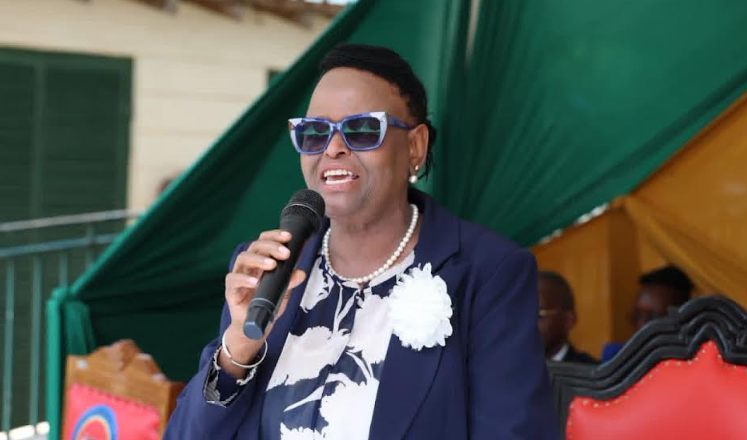
Chief Justice and President of the Supreme Court of Kenya, Justice Martha Koome, has called for coordinated efforts among justice sector actors, community leaders and residents to address the rising cases of Sexual and Gender-Based Violence (SGBV) in Vihiga County.
Speaking at Vihiga Law Courts during a meeting with the Court Users Committee (CUC), Justice Koome expressed concern that the county, despite being known for agriculture and environmental conservation, continues to record high numbers of SGBV cases.
She urged stakeholders, particularly members of the Court Users Committee, to focus on tackling the root causes of SGBV and ensure that children both girls and boys, are protected from sexual exploitation and abuse.
“I urge all persons of interest, especially members of the Court Users Committee, to work towards eliminating SGBV cases in the county by addressing the root causes of this menace because our children should never be viewed as sexual objects,” she said.
The Chief Justice acknowledged efforts by the Vihiga County Government in establishing a Gender-Based Violence Rescue Centre and a Child Protection Unit. However, she emphasised the need for refurbishment and proper management of the Child Protection Unit to ensure that children requiring care and protection are not detained in remand facilities while awaiting court processes.
Justice Koome directed the CUC, led by Vihiga Presiding Judge Justice Reuben Nyakundi, to establish a dedicated technical working group on SGBV cases.
The team will be tasked with monitoring investigations, ensuring witness attendance in court and spearheading public awareness initiatives.
She further encouraged religious institutions, chiefs and community leaders to intensify awareness campaigns on SGBV through churches, public forums and chiefs’ barazas to sensitise communities on the severity of the crime and promote prevention measures.
On succession matters, the Chief Justice raised concern over the challenges faced by widows in accessing inheritance rights.
She noted that many widows are subjected to prolonged legal battles after losing their spouses, often facing harassment, eviction and intimidation.
To address these delays, Justice Koome said the judiciary has introduced a digitised system aimed at expediting succession processes. The system ensures that applications for letters of administration are processed within two months.
“We have put in place a digitised system that ensures that when letters of administration are applied for, they should not take more than two months to be issued, to avoid unnecessary delays,” she said.
She also called on the Court Users Committee to prioritise integrity and accountability within the justice system to ensure that Vihiga remains a corruption-free zone and to enhance public confidence in judicial processes.
Justice Koome observed that unresolved land and succession disputes have often escalated into criminal cases such as assault and murder.
She urged residents to embrace alternative justice systems and mediation as effective and peaceful mechanisms for resolving disputes at the community level.
The Chief Justice further pledged the judiciary’s support in equipping correctional facilities with technology to facilitate virtual court sessions.
She said this would reduce logistical challenges associated with transporting inmates to courts located far from detention centres, thereby improving efficiency in case management.
Meanwhile, Civil Society Organisations (CSOs) representative Tom Onzere commended the partnership between civil society and the Judiciary through the Court Users Committee, noting that it has significantly enhanced access to justice in the county.
Onzere said the formation of a technical working group to promote access to justice was among the key achievements of the partnership.
However, he called for the full implementation of the Legal Aid Act and the establishment of the Legal Aid Fund to support vulnerable and marginalised groups seeking justice.
He highlighted increasing cases of SGBV, including defilement and incest, particularly in Emuhaya and Luanda sub-counties, as major challenges facing the region.
He also raised concern over cases of widows facing eviction and harassment in succession disputes, calling for stronger protection mechanisms.
The Witness Protection Agency (WPA) also raised concerns over low witness participation in SGBV cases, attributing the trend to fear and intimidation by suspects and their associates.
Jedidah Waruhiu, Director and Chief Executive Officer of the Witness Protection Agency, said the agency continues to sensitise the public on the importance of witness protection and works closely with justice sector actors to ensure witnesses are safe and able to support prosecutions.
She noted that the agency has supported the Office of the Director of Public Prosecutions in handling cases in Kakamega and Bungoma counties through provision of witness protection services.
Waruhiu further called for the enactment of the Victim Protection Bill to provide a comprehensive framework for the rehabilitation and compensation of victims.
“Another challenge is rehabilitation and compensation. We are keen, as an agency, to see the Victim Protection Board facilitate the enactment of the Victim Protection Bill to provide a framework for issues such as rehabilitation and compensation of victims because we cannot manage this as an agency alone,” she said.
She added that the agency collaborates with non-state actors to create public awareness on witness protection services, noting that it does not have a dedicated budget for awareness campaigns.
Waruhiu explained that the agency’s funding comes from the Consolidated Fund and is primarily allocated to protecting witnesses. Through partnerships, the agency conducts public forums to educate communities on its mandate and available services.
Members of the public seeking witness protection services can contact the agency through the toll-free hotline 0800 720 460 or 0725 222 422.
By Florence Oteng’o and Yvonne Misango