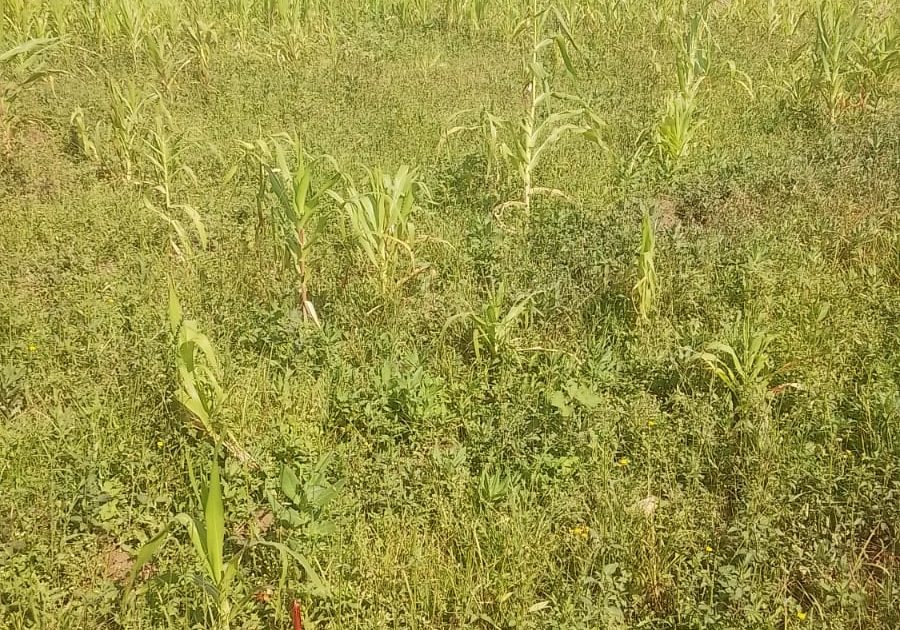
For decades, Lugari Sub-County has been regarded as one of Kenya’s maize baskets, with thousands of households depending on the crop for food and income.
Currently, changing weather patterns, prolonged dry spells and unpredictable rain seasons are threatening the future of maize farming, forcing many farmers to rethink their livelihoods.
Farmers across Lumakanda, Mautuma, Chekalini and Lugari wards say the once predictable planting seasons have become increasingly unreliable. Rains now arrive weeks later than expected period or stop abruptly before crops mature, leaving maize crops with stunted growth, leading to far reduced yields.
“I used to harvest between 40 and 50 bags from my two-acre farm, but in the last two seasons I have barely managed 20 bags,” said farmer Joseph Barasa from Mautuma. “The rains no longer follow the seasons we knew. We invest heavily in seeds and fertilizer, only for the crops to dry up,” he added.
Mary Nanjala, a farmer from Chekalini Ward, said failed rains have dealt a heavy financial blow to many households that depend almost entirely on maize farming.
“We have always relied on maize to pay school fees for our children and meet other household expenses,” she said.
“Last season I harvested only 18 bags from my three-acre farm instead of the more than 60 bags I expected. The harvest was only enough to feed my family, leaving nothing to sell. I had to sell two dairy cows to raise school fees. If the rains continue failing, many parents will struggle to educate their children and provide for their families,” she said
According to Lugari Sub-County Agriculture Officer Kakai Wekesa, climate change has become one of the greatest threats to food production in the area.
“Farmers are experiencing irregular rainfall, rising temperatures and increasing outbreaks of pests such as the fall armyworm, all of which have contributed to declining maize yields,” he said. “Climate-smart agriculture is no longer optional; it is necessary if farmers are to remain productive.”
The officer encouraged farmers to adopt drought-tolerant maize varieties, conserve soil moisture through minimum tillage and mulching, diversify into traditional crops and vegetables, sorghum and sunflower, and embrace rainwater harvesting for supplementary irrigation.
Beyond changing weather, farmers say soaring production costs have worsened the situation. The prices of certified seed, fertilizer, pesticides and labour have continued to rise, shrinking profit margins even in seasons with good harvests.
Many are now diversifying into dairy farming, poultry, beekeeping and the cultivation of traditional vegetables such as managu, terere and saga, whose demand has grown steadily in urban markets.
Agricultural experts warn that unless adaptation measures are accelerated, maize production in Lugari could continue declining, threatening household incomes and national food security.
Data from the Kenya National Bureau of Statistics indicates that agriculture remains the backbone of rural livelihoods in Kenya, contributing significantly to employment and food security. However, experts note that climate variability is increasingly undermining productivity across major maize-growing regions.
By Linet Wafula