The drought spell being witnessed in various parts of the country is a wake-up call for Kenyan farmers to start embracing Climate Smart Agriculture (CSA).
A shift to climate-smart agriculture will not only address food security and climate change but also ensure farmers cushion themselves from crop losses and greenhouse gas emissions.
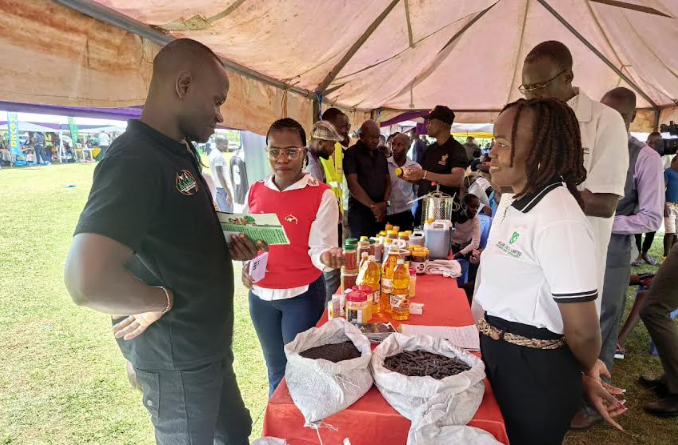
In the recently concluded Rongo Expo show organized by Migori County and its agricultural partners, a shift to Climate Smart Agriculture was not only advocated but also demonstrated by every exhibitor.
With more than 100 exhibitor stands at the Rongo Stadium, modern farming technologies, climate-smart innovations, and value-chain solutions were practically showcased to residents and farmers.
The second-ever annual agricultural exhibition to be held at Rongo Sub County lived to this year’s theme of ‘Transforming agriculture through innovation, climate-smart technology and sustainable value chains for enhanced food security and prosperity, ‘that aligns with the county blueprint of making Migori food secure.
According to the Migori County Executive Committee Member (CECM) for Agriculture, Lucas Mosenda, the growing participation of farmers and exhibitors in this year’s Rongo expo demonstrates the importance of partnerships and knowledge-sharing in transforming Climate smart agricultural into a reality.
Mosenda said the county has recruited nearly 65 agricultural extension officers over the past three and a half years, while more than 200 agri-entrepreneurs are working alongside the extension team to support Migori farmers through providing relevant and up-to-date policy frameworks and tools, designing climate change adaptation plans and supporting access to climate finance.
The official added that the recruitment of extension officers aims to promote and realize the transformative agenda of making climate-smart agriculture a reality for Migori farmers.
An Agronomist from Kuria West Sub County, Raphael Mwita, explains the Climate-Smart Agriculture (CSA) model, as sustainably medium that increases productivity, enhances resilience, and climate change mitigation, with the intention of contributing positively to food security and development goals of a nation.
“In 2026, Migori County, just like the majority of other regions in Kenya, has been experiencing unreliable and unpredictable rainfall. The surest way to cure unreliable and unpredictable rainfall patterns is to embrace irrigation systems that allows for continuous crop production all seasons round,” he explained.
“The only better way for climate-smart agriculture is to encourage irrigation; more so drip irrigation for short-season crops like beans, vegetables and other horticultural crops,” he further elaborated.
According to Mwita, climate-smart farming can only be achieved successfully if farmers can understand how to mitigate climate change through crop production and diversification.
The agronomist, who has also trained over 1000 youths through a programme sponsored by a body known as Afrihub Limited to empower them to take agricultural activities as a means to solve unemployment and generate wealth, says that youths have started to embrace farming as a means to an end in solving the unemployment menace and addressing climate change.
Currently, Mwita has been given a task to train 15 youths from Kuria West Sub County on climate-smart agriculture by the government through the National Youth Opportunities Towards Advancement (NYOTA) programme.
The youths are being trained on horticulture farming with the intention of making them become agri-entrepreneurs with cash support from the programme.
Organic Green System Cooperative from Rongo Sub County, for example, is a youth group organisation that deals with grafted fruits production that aims to empower youths from Migori County.
Mr Fred Odhiambo, an official from the group, says that the majority of grafted fruits start to flower between six and 12 months depending on the kind of fruit.
“We are having very unreliable rainfall, more so this year, and having fruits that can mature within a year is good in terms of saving costs of maintaining the fruit to its maturity,” he says.
Grafted mangos from the organisation matures less than a year, with the flowering process appearing within the first six months of planting, Mr Odhiambo explains, adding:
“Climate-smart farming entails having tree fruits that can mature within a year, which maximizes the little water it can get within a short period of time from the short rains.”
The organisation is also promoting Hass Avocado that the national government is promoting for export. He says that the availability of a market for Hass avocado should be a driving force for the youth to embrace agriculture.
Odhaimbo, however, encouraged the organizers of the expo to ensure the show is held quarterly instead of yearly to help more farmers learn and gain knowledge on various crop production and farm systems.
Ms. Ruth Akoth, a smart farmer from Uriri Sub County, says that climate change farm mitigation aspects require farmers to embrace smart technologies.
“I used to plant maize and beans that heavily relied on rainfall for crop sustainability. The venture produced low yields with little profit. After visiting the Rongo expo last year, my eyes were opened through the knowledge and skills I acquired,” she narrated.
Akoth is now engaged in horticultural farming in her native home, a venture she says has brought her and the entire family joy from the profit she reaps.
Every season, she tests her soil PH to establish its acidity adding she has been using organic fertilizer to produce healthier crops that are easily accepted in various institutions in Uriri and Awendo Sub Counties.
She acknowledges the importance of treating the soil right by embracing crop rotation, saying doing so increases yields.
The farmer disclosed that many youths are willing to venture into agri-business but lack the necessary support, knowledge and skills that would enable them become successful farmers. She recommended such agricultural forums to be held frequently.
Meanwhile, Peter Chacha, an official from Ikerege United Sacco Society, an organisation that mainly comprises horticultural farmers practicing climate-smart farming in Migori, has been championing poverty reduction through agriculture.
Through a programme dubbed ‘Mali Shambani ’, the Sacco’s collectiveness has given them a common pool in training sessions, extension services, market links and loan access.
Chacha, who is also the Chairperson of the Kenya National Federation of Farmers (KENAF)-Migori branch also encouraged youths to join Saccos and seek constructive work that can generate income instead of engaging in unhealthy and destructive vices like drug abuse, theft and idleness.
Chacha also urged farmers from Migori to embrace Climate Smart Agriculture to create wealth and steer the county’s economic growth and make it food secure.
Although the Food and Agriculture Organisation (FAO) has continued to provide policy advice to inter-governmental processes by playing a unique role in raising awareness on the importance of Climate Smart Agriculture in achieving food security, it’s the work of farmers to fully embrace the initiative to propel the country forward.
Assistant County Representative-Food and Agriculture Organisation (FAO)-Migori official Hamisi Williams explained that climate change, rising production costs, population growth and changing market demands are some of the key challenges facing agricultural activities in the country.
Hamisi called for increased innovation and collaboration among farmers, agricultural partners, and the county government to ensure the county is food secure.
The official also reaffirmed FAO’s commitment to supporting sustainable agriculture, climate resilience, food security and inclusive rural development in partnership with government entities, farmers, researchers, development partners and the private sector.
By Makokha Khaoya and Charles Agimba