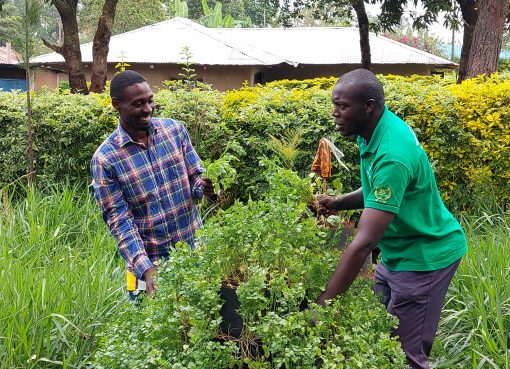
The Financing Agri-Food Systems Sustainably (FINAS) summit officially adjourned last evening with a resounding call for sustained collaboration and investment to transform Africa’s agri‑food systems.
The message from the three days of dialogues resonated on transforming food systems, demanding collective action, innovative financing, and inclusive policies that ensure farmers, agribusinesses, and communities thrive.
The three-day summit brought together governments, financial institutions, development partners, investors, researchers, and farmer organizations to explore sustainable financing solutions for Africa’s agri-food systems.
Speaking during the closing ceremony, Cabinet Secretary for Cooperatives and Micro, Small, and Medium Enterprises (MSMEs) Dr. Wycliffe Oparanya reaffirmed the government’s commitment to strengthening cooperative societies as a key strategy for improving access to affordable agricultural finance and accelerating the transformation of Kenya’s food systems.
In a speech read on his behalf by Principal Secretary (PS) State Department for Micro, Small, and Medium Enterprises (MSME) Development Susan Auma Mang’eni, the CS said cooperative societies remain the most effective model for enabling smallholder farmers to access credit, markets, technology, and extension services.
Oparanya said many farmers continue to face challenges accessing formal credit because conventional lenders demand land titles, regular incomes, and extensive credit histories that most smallholders do not possess.
“We must design agricultural finance around the realities of farming. Financial products should recognize alternative forms of security such as warehouse receipts, buyer contracts, produce, movable assets, and group guarantees while aligning repayment schedules with production cycles,” he said.
The CS noted that cooperative societies enable farmers to aggregate produce, purchase farm inputs collectively, invest in value addition, and negotiate better prices while reducing the cost of delivering financial and insurance services.
He added that Savings and Credit Cooperative Organizations (SACCOs) complement these efforts by mobilizing savings and extending affordable credit to members who may not qualify for conventional bank loans.
However, Oparanya stressed that expanding agricultural credit must be accompanied by sound governance, prudent financial management, and stronger regulation to safeguard members’ savings.
“My ministry is implementing reforms aimed at strengthening governance, improving supervision, enhancing liquidity management, and protecting members’ deposits. Strong regulation is the foundation of confidence and will attract more investment into the cooperative sector,” he said.
The Cabinet secretary said the government was also implementing reforms to revive the coffee sector by placing cooperative societies at the center of production, processing, value addition, and marketing.
He observed that poor returns had previously forced many farmers to abandon coffee farming for real estate developments, underscoring the need to make agriculture more profitable.
“Our objective is not just to increase coffee production but to ensure farmers receive fair returns from the value chain. The farmer who plants, harvests, and delivers the crop must retain the greatest benefit from the final sale,” he said.
Oparanya added that similar integrated approaches would be extended to other value chains, including dairy, livestock, cereals, horticulture, and fisheries.
He further underscored the critical role played by MSMEs in agricultural transformation through food processing, storage, transportation, value addition, and technology development.
The government, he said, would continue supporting entrepreneurs through institutions such as the Kenya Industrial Estate, Agricultural Finance Corporation, Kenya Development Corporation, Youth Enterprise Development Fund, Women Enterprise Fund, and other financing agencies.
The Cabinet secretary called on financial institutions, development partners, researchers, and the private sector to translate commitments made during the summit into practical investments that improve farmers’ livelihoods.
Oparanya urged the FINAS Secretariat and its partners to establish a robust monitoring mechanism to track implementation of commitments, investments, and partnerships agreed upon during the summit.
“The next engagement should begin with an honest account of what has been implemented, the impact achieved, and the work that remains outstanding,” he said.
The CS said the success of the summit would ultimately be measured by the number of smallholder farmers accessing affordable credit, stronger cooperatives, thriving agribusinesses, increased productivity, and improved incomes across rural communities.
Oparanya declared the Financing Agri-Food Systems Sustainably (FINAS) 2026 Summit closed by calling for continued collaboration in building resilient, inclusive, and sustainable food systems for Kenya and the African continent.
By Wangari Ndirangu