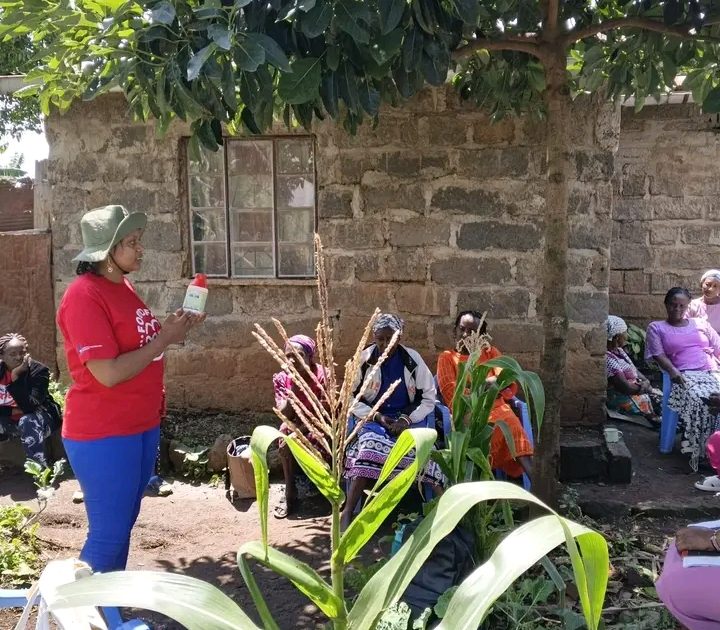
The County Government of Nakuru has initiated a training program targeting small holder farmers in all the 11 Sub-Counties on sanitary and safety criteria for the production, handling, and sale of flowers, ornamentals, fruits, vegetables, herbs, and spices.
Already over 200 farmers from Bahati Sub-County have received training on the mandatory standards their produce is expected to meet in the local, regional, European Union (EU) and other export markets.
Kabatini Ward Agricultural Officer Ms Ruth Njoroge said the initiative was to help Kenya meet the KS1758 food safety standard for its fruits, vegetables, and flowers.
“The initiative is aimed to guarantee the supply of high-quality, healthy, and safe produce for both the domestic and international markets,” stated Ms Njoroge
The Kenya Standard 1758: 2016 (KS 1758) is a code of practice for Kenya’s horticulture industry, outlining the sanitary and safety criteria for the production, handling, and sale of flowers, ornamentals, fruits, vegetables, herbs, and spices. It is divided into two parts, with part one covering floriculture and part two covering fruits and vegetables.
Speaking at the training venue in Mwaki Mugi Kwa Amos Village within Bahati Sub-County the Ward Agricultural Officer noted that the initiative also targets improved produce quality, reduced pesticide risks and stronger market access for farmers, while supporting Kenya’s wider efforts to build safer and more sustainable food systems.
The horticulture industry players in Kenya, in recognizing the importance of the sub-sector, and the challenges faced by the sub-sector, developed a code of practice to regulate the production of horticultural produce to guarantee the supply of high-quality, healthy, and safe produce for both the domestic and international markets.
This move gave birth to KS 1758. The Standard is based on four major pillars, namely: food safety, good agricultural practice, worker welfare, and care for the environment.
“There is a need for the implementation of the standard at the grassroots level to ensure food safety, especially in food crops in the country. Young farmers in the county eyeing international markets, should also be aware of post-harvest treatment requirements and standards set by the EU and other marketing agencies,” stated Ms Njoroge
The training tackled key issues such as post-harvest handling, labor safety, pesticide use, plant nutrition, traceability, and record keeping.
The participants were taken through food safety, quality, and hygiene. The objective of the session was to enable the participants to understand the concept of food safety and quality and the requirements of good hygiene practices.
The farmers were enlightened on the pre-harvest interval which is the time between applying fertilizer and harvesting- that is supposed to allow fertilizer to disintegrate to ensure low residual levels.
“We are working to promote compliance with applicable laws and regulations among farmers through training to help them acquire the necessary requirements to tap into the export market.
“We will be talking to farmers on the appropriate methods to use in order to contain the presence of quarantine pests and diseases in their produce and protect our European market,” stated Ms Njoroge
The Ward Agricultural Officers affirmed that Governor Susan Kihika’s administration has been strengthening the capacity of various value chain actors in the horticultural sector to comply with food safety and export regulations.
The intervention comes as Kenya seeks to strengthen the competitiveness of its horticultural sector, which remains an important source of farm incomes, employment and export earnings.
The National Agri-Food Systems Investment Plan 2026–2030 proposes stronger monitoring of agrochemical residues and public awareness on allowable Maximum Residue Levels in food.
It targets an 80 per cent reduction in chemical and medicine residue levels in food on the market.
According to the Agriculture and Food Authority (AFA), Kenya exported 16,208 tonnes of vegetables between April and June 2025, earning Sh4.56 billion.
The value of vegetable exports increased from Sh3.60 billion during the corresponding period in 2024, according to AFA data.
However, Kenya’s horticultural export market continues to face food safety challenges linked to pesticide residue compliance.
AFA reported that vegetable export earnings fell from KSh50.9 billion in 2023 to Sh23.5 billion in 2024.
The authority attributed the decline partly to increased Maximum Residue Level interceptions involving Kenyan French beans and snow peas.
The number of residue-related interceptions increased from 25 in 2023 to 57 in 2024, prompting the European Union to raise inspection frequencies for Kenyan vegetables at designated entry points.
The developments have increased pressure on producers to adopt farming practices that meet domestic and international food safety requirements.
Some of the pests that attack horticultural produce, locking it out of the export market, include False Codling Moth (FCM), white flies, thrips, leaf-miners, mites and caterpillars, which attack all crops and fruit flies, which mainly infest mangoes and oranges.
Ms Njoroge pointed out that phytosanitary diseases and pests pose a great challenge for Kenya since some of the agrochemicals recommended for their control are banned in the European Union (EU). Their use quite often leads to high levels of residues in the crops, which results in a ban on the exports
In 2014 the EU gave Kenya an ultimatum to ensure all produce meant for the market should not contain more than 2 percent of chemicals or herbicide sprayed on the crop.
Various trainers at the event emphasized the importance of strict regulations on pesticide use, adherence to protocols, and mandatory government inspections.
They also highlighted the need for strong public-private partnerships and a robust monitoring and documentation system to ensure compliance.
Ms Njoroge said other measures that farmers angling for the export market must observe include not contaminating water sources, keeping records, avoiding environmental pollution through use of dangerous chemicals, having produce traceability measures and minding the welfare and conditions of employees.
“Any produce found to be non-compliant or contravenes the standard rules is denied entry into the target export market, shipped back at the farmer’s cost or destroyed,” stated the Ward Agricultural Officer
She advised farmers to ensure that produce destined for the export market is not wilted, has no soil or dirt residues, is free of chemical traces and is clearly labeled.
Farmers were also introduced to Integrated Pest Management (IPM) techniques and organic pesticides as alternatives that can reduce dependence on synthetic chemicals.
County agriculture officials said the training seeks to ensure farmers understand that food safety begins at the farm and extends through harvesting, handling, and marketing.
The approach is also expected to protect soils, water sources and beneficial organisms while helping farmers produce vegetables that meet increasingly stringent food safety requirements.
Ms Njoroge pointed out that globally, the Food and Agriculture Organization promotes Integrated Pest Management as an approach that combines biological, physical, cultural and chemical methods to control pests while minimizing pesticide use and associated risks.
“FAO says IPM can reduce pesticide residues, protect biodiversity and water resources, reduce production costs and improve farm profitability through better-quality produce. The agency also warns that inappropriate pesticide use can harm farmers, consumers, and ecosystems while contributing to pesticide resistance and environmental contamination,” she explained.
Agriculture remains central to Kenya’s economy. The Kenya National Bureau of Statistics says the sector directly contributes about 24 per cent of the country’s Gross Domestic Product, while about 72 per cent of the population derives livelihoods directly or indirectly from it.
County officials said the continued promotion of sustainable technologies and practical farmer education will help improve food quality, protect the environment and create stronger market opportunities for producers.
By Jefther Simeon Afuyo and Esther Mwangi