By A, KNA
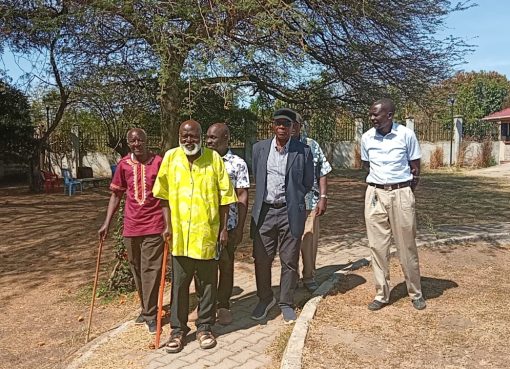
Among the farming fields of Kipsobe village in Rimoi sub location of Keiyo North sub county stands tall majestic indigenous trees forming a protective circle of the Kabore shrine as if guarding it from outside interference.
The trees some of them bent while others have been felled are still struggling to survive through regeneration to continue protecting the memory of the many rituals and ceremonies which were conducted at the shrine itself a simple earthly structure.
“This is a place where the community came to connect with their god, to offer him sacrifices of burnt offerings to appease him to give them rain during times of drought. To us it was a place of worship which can be equated to the holy of holies,” said William Chemitei.
According to 75 years old, Chemitei who is also a village elder, the Kabore which is a Keiyo word for a sacred place also served as the supreme court where community delinquents would be cursed and banished from the society through the intervention of the elders.
“This place ensured that the community norms and values were kept intact because if one went against the norms and refused to comply, this was the last place where he/she was brought and once cursed by the elders’ chances of survival were minimal,” he said.
Fifty five year old Paul Talam remembers with nostalgia the 1980’s when he was a young man that the 4 acre plot was a dense forest providing habitation to birds and snakes saying the birds would follow anyone who tried to carry even a branch from the shrine.
“I remember this one time I took a branch and made a wooden spoon out of it and the birds invaded our home chirping through the night until my dad had to wake up the whole family to ask what we had done,” he narrated.
“Shaking I told him how I took a branch from the shrine and he ordered me to return it immediately and after that the birds left,” he said.
However Talam says since human beings invaded the shrine and started cutting trees with power saws, all the snakes and birds left and with it the shrine was left exposed. Recently Talam who neighbours the shrine says a surveyor accompanied by some people descended on the shrine and started cutting down trees.
“I called the area chief to report the incident and the people left but not after they had cut the trees which were donated to the nearby Kipsabo primary school,” he said.
Peter Kiplagat 59 years regrets that the current generation does not revere the place which he blames on modernity and the introduction of religion saying people go to church and no longer use shrines.
He however says the shrine is of great importance saying the trees have since time immemorial offered herbal drugs and treatment from various diseases affecting mankind saying elders have been using herbal medicine from indigenous trees to treat disease outbreaks.
The elders in the community have continued to express their frustration with the destruction of the shrine saying it was one of the few remaining shrines after others were destroyed. They believe that the shrine despite modernity is a divine place saying the trees were planted by god himself as no one has a recollection of who planted them since they all found them there as they were growing up.
According to 65 year old Ann Suter, in 2019 during a budget public participation exercise, they successfully managed to lobby for funds to have the shrine fenced as they believed that once fenced the trees would regenerate restoring the shrine to its original state but no sooner had they finished fencing, it was destroyed by youth.
“We wanted the place to become a cultural centre where we put in cultural artefacts which having been replaced by modern living are slowly being forgotten,” she said.
Due to the frustrations, the elder had even proposed to allocate the land to a public school to protect it from being grabbed and ensure that it continues benefitting the community.
However Irene Tanui 70 want the place to continue being preserved not only as part of the conservation of the forest but also as a cultural heritage where they can pass the traditional knowledge to generations.
She believes that there was a breakdown in passing vital information about shrines from a certain age set which has led to their current destruction. Mrs Tanui says women from the area still have traditional plates, grinding stones, skins which were used as clothes and guards for honey among others which they would want to be kept at the cultural centre.
She says if a cultural centre is established, it will not only preserve the culture but also offer employment directly and indirectly to people from the area.
“Those within the cultural centre will get money from tourists while others will benefit from becoming tour guides and also providing hospitality services while local farmers will get market for their produce,” she said.
They want the county government to step in and help them in protecting the shrine which they believe is still a part of the community, a connection between the past and the present and therefore the importance of preserving it.