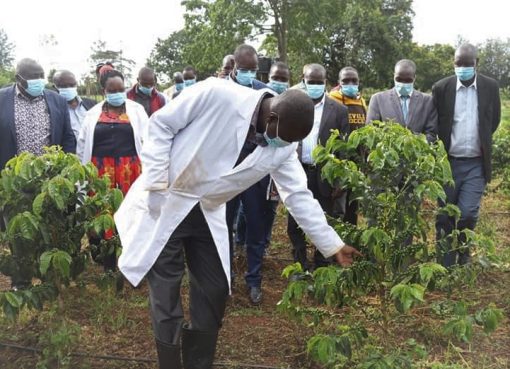
At least 20,000 beans farmers from five counties are set to benefit from a training on innovative farming of high-yielding, drought and disease-resistant bean seed varieties courtesy of
the Kenya Agricultural and Livestock Research Organization (KALRO) and the International Center for Tropical Agriculture (CIAT).
The venture which is promoting proper agronomical practices in farming of the ‘Waithera’ bean variety developed by KALRO, is being supported by the Pan-Africa Bean Research Alliance (PABRA) Program and Alliance of Biodiversity International and incorporates farmers drawn from Nakuru, Nyeri, Nyandarua, Bomet and Elgeyo Marakwet counties.
KALRO’s national coordinator for Grains and Legumes Dr David Karanja noted that due to climate change, pests and diseases that were absent or rare have become rampant thereby affecting bean yields and resulting in losses to the farmers.
To ensure a ready market for the new bean variety’s yields Dr Karanja said the initiative includes negotiating favorable prices for farmers and linking them to potential markets. This he noted was after encouraging farmers to aggregate their yields through cooperatives.
“We have been training them on aggregation, where they bring their individual harvest together under one roof through cooperatives so that it can ferried to markets, we source for them in bulk,” noted the official.
To further ensure consistent supply, KALRO is exploring the creation of a bean value chain, allowing farmers to supply processors who can combine bean powder into consumable products like noodles.
He further noted the initiative involves a component of training farmers on the mandatory standards their produce is expected to meet in the European Union (EU) and other export markets to enable them tap into regional and international markets.
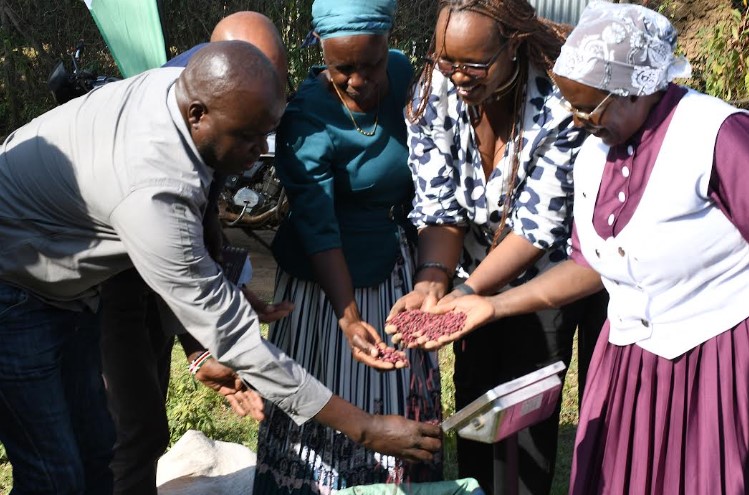
Dr Karanja spoke at Kiambogo center within Gilgil Sub-County in Nakuru when he joined the leader of the global bean program at the Alliance of Biodiversity International and CIAT and Director of the Pan-Africa Bean Research Alliance (PABRA) Dr Jean Claude Rubyogo to flag of 12 tonnes of beans produced by the Ushirikiano Women Group, a group of over 100 members engaged in agribusiness.
He stated that the women group has been linked directly to buyers who do value addition to avoid exploitation by middlemen.
He said adoption of high yielding and disease resistant ‘Waithera’ bean seed variety was crucial in enabling bean farmers to harvest quality produce that can access international markets.
Dr Karanja said the ‘Waithera’ bean variety is fast maturing and richer in nutrients and also took between 15 and 27 minutes to cook compared to the traditional ones that took three hours.
“The beans are known for their ability to produce 6-10, 90 kg bags per acre, making them a popular choice for farmers. ‘Waithera’ beans also mature early (60-70 days), are drought-tolerant, and are relatively resistant to common bean diseases,” he added.
While indicating that trials for the seed variety were being conducted in Laikipia County, the national coordinator for Grains and Legumes disclosed that they were intending to introduce the crop in Kakamega and Nandi counties in a venture that is targeting a total of over 2,400 small holder farmers in the country.
Kenya yields on average 650,000 kilograms of beans against a consumption of 750,000 kilograms. In addition, industries involved in bean value addition import at least 200,000 metric tons of beans.
It is this deficit that KALRO and its partners are said to be striving to plug through development of high yielding, disease and pest resistant seed varieties.
Dr Karanja said they were encouraging farmers to take up ‘Waithera’ bean production which is gaining rapid popularity among small-scale and subsistence farmers boosting yields and ensuring food security and nutrition from the household level in the county.
The red-mottled group bean stands out for its fast maturity and adaptability to varying climates, making it a valuable choice for farmers.
‘Waithera’ was developed by KARLO Katumani and released for national trials and commercialization in 2024. It has proven to thrive in both hot dry regions and cold dry highlands, offering farmers versatility.
Dr Karanja said when consumed the beans cannot cause flatulence unlike other varieties, and are also easy to prepare into snacks after pre-cooking.
Leader of the global bean program at the Alliance of Biodiversity International and CIAT and Director of the Pan-Africa Bean Research Alliance (PABRA) Dr Jean Claude Rubyogo said the farmers were being enlightened on compliance with applicable laws and regulations to tap into the local, regional and export market.
He said the bean variety which has high iron and zinc content prevents stunted growth in children and boosts body immunity and has the potential of growing the country’s horticultural world market share.
Dr Rubyogo noted that though a significant proportion of young farmers in the county were eyeing international markets, most were unaware of post-harvest treatment requirements and standards set by the EU and other marketing agencies.
He said as they promote adoption of this seed variety, they were also enlightening farmer groups on the pre-harvest interval which is the time between applying fertilizer and harvesting, that is supposed to allow fertilizer to disintegrate to ensure low residual levels.
Dr. Rubyogo added that they had been talking to farmers on the appropriate methods to use in order to contain the presence of quarantine pests and diseases in their produce to protect and grow our European marke.
The bean variety he said was also a rich source of essential proteins which would lead to a healthy populace and were resistant to the vagaries of pest attacks and climate change.
The seed was developed after scientists and breeders conducted tests on 47 bean varieties in Kenya and Uganda to determine the most suitable ones before they narrowed down to 4 varieties in Kenya and 8 from Uganda.
Micronutrient deficiencies remain unacceptably high in Kenya. According to official statistics zinc deficiency affects the entire population but is highest among children aged 6–59 months, at 83 per cent, with no significant difference between boys and girls. Anaemia and iron deficiency are higher among children under 5 and pregnant women and girls aged 15–49.
Records from Nakuru’s Department of Health, indicate that of the 275,921 children under five years living in the county, an estimated 27.9 per cent are stunted way above the national level of 26 per cent, a further 5 per cent are wasted while 10.2 per cent are underweight.
Dr Rubyogo noted that the long-term purpose of promoting the varieties was energy conservation and minimizing deforestation since it takes less charcoal to prepare the beans.
Chief Executive Officer of Cherubet Foods Ms Mercy Cherubet, one of the main off takers of the harvested crop yielded by the new seed variety from farmers in Nakuru expressed concern that bean consumption in the country still remains low with an average Kenyan consuming between 50-60 kilograms per year. She attributed the low consumption to the tedious and long process of preparing bean meals.
She stated the new bean variety was easy to prepare and turn into value added products as it took less time and fuel to process compared to conventional varieties.
Ms Cherubet stated that ‘Waithera’ takes 75-84 days to mature adding it can give between 1400-2200kg per hectare.
“This partnership is also encouraging traceability of crop origin which is a standard requirement in the local, regional and international markets making it easier to use the bean variety for value addition,” she indicated.
Elizabeth Osono, a member of Ushirikiano Women Group said since the 1960s most farmers in the region have been relying on traditional ‘Mwitemania’ and ‘Wairimu’ seed varieties which were low yielding and prone to diseases.
“For these traditional varieties one requires 90 kilograms of seeds to plant one acre. Adopting new varieties such as ‘Waithera’ will save the farmer huge losses as an acre only requires 24 kilograms of planting material. Taking into account the varieties are disease and pest resistant, farming will be a lucrative venture for youth and women groups,” said Ms Osono
She observed that a 90-kilogram bag of ‘Mwitemania’ and ‘Wairimu’ beans was retailing at Sh4500 as compared to Sh7500 that a 90-kilogram bag of the ‘Waithera’ variety fetched.
KALRO aims to establish a bean corridor across the country, encouraging farmers with half an acre of land and above to participate.
Karlo estimates that bean consumption in the country will double this year, and the ‘Waithera’ variety already meets the micronutrient levels of Zinc and Iron crucial for immunity and blood supply.
A 2025 report by the Kenya National Bureau of Statistics reveals nutritional challenges, with 18 percent of children under the age of five experiencing stunted growth and 42 per cent of pregnant women suffering from anaemia.
By Esther Mwangi and Dennis Rasto