Commercial banks, institutional investors, and international development agencies have been urged to scale up funding mechanisms for green enterprises, climate-resilient farming, and low-carbon infrastructure projects to safeguard national economic growth.
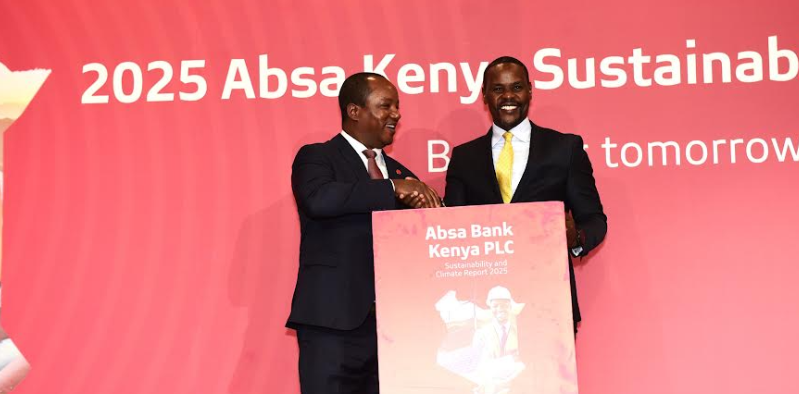
The call was made by the Principal Secretary in the State Department for Environment and Climate Change, Dr. Festus Ng’eno during the official launch of Absa Bank Kenya PLC’s 2025 Sustainability and Climate Report at Strathmore University in Nairobi.
Commending the lender for taking a front-row seat in private-sector climate stewardship, Dr. Ng’eno emphasized that the adverse effects of climate change continue to disrupt local livelihoods, critical infrastructure, ecosystems, and overall national economic productivity.
“Climate change is already affecting livelihoods, infrastructure, ecosystems, and economic productivity. The cost of inaction continues to rise, making climate investment not only an environmental necessity but also a sound economic decision. I encourage financial institutions, investors, and development partners to continue expanding support for climate solutions, green enterprises, and sustainable infrastructure,” Dr. Ng’eno stated.
The Principal Secretary further observed that climate risks have increasingly transformed into core financial risks, making proactive environmental governance essential for institutional stability.
He cited key state-led interventions, including the ‘Adopt an Ecosystem Strategy’, the Kenya Online Continuous Emissions Monitoring System (KOCEMS) for real-time industrial emissions tracking, and the Extended Producer Responsibility (EPR) regulatory framework aimed at advancing circular economy practices across manufacturing sectors.
Speaking at the same event, Absa Bank Kenya Interim Managing Director and Chief Executive Officer, Yusuf Omari affirmed that the report marks the successful culmination of the bank’s 2021–2025 Sustainability Strategy, which was anchored on 13 core commitments aimed at delivering measurable economic, social, and environmental impact.
“Our 2025 Sustainability and Climate Report highlights what we have achieved under our 2021–2025 sustainability strategy. From supporting businesses to grow and enabling access to affordable housing, to financing climate-smart agriculture, renewable energy, and broader financial inclusion, we have intentionally deployed capital where it can make the greatest difference,” Omari said.
Omari reiterated the institution’s commitment to collaborating with state agencies, corporate clients, and local communities to advance national economic priorities while mitigating climate vulnerabilities.
“As Kenya accelerates its transition towards a greener and more inclusive economy, Absa will continue partnering with government, businesses, development partners, and communities to finance solutions that create lasting value and contribute meaningfully to the country’s long-term development priorities,” the Interim CEO added.
The report revealed that Absa Bank Kenya advanced over Sh204 billion in sustainable finance between 2022 and 2025, significantly expanding funding for climate action, micro, small, and medium enterprises (MSMEs), and social development initiatives across the country.
In the 2025 financial period alone, the bank disbursed Sh55.3 billion toward sustainable projects, up from Sh47 billion recorded in 2024. Sustainable lending accounted for 30 per cent of Absa Bank’s total gross loan disbursements during the year, effectively tripling its initial annual benchmark target of 10 per cent.
Out of the Sh55.3 billion allocated in 2025, Sh48.8 billion supported financial inclusion initiatives targeting MSMEs, women-led enterprises, youth entrepreneurs, and historically underserved communities.
A further Sh6.5 billion was directed into climate-specific financing, funding renewable energy installations, green residential and commercial buildings, energy efficiency solutions, and climate-smart agricultural enterprises.
Beyond direct lending activities, the report demonstrates significant operational environmental stewardship. Absa planted 283,969 trees in 2025 nearly quadrupling the 72,000 trees planted in 2024 bringing its cumulative environmental restoration footprint to over 1.5 million trees toward its broader target of 10 million trees by 2032.
The bank also achieved a 96.4 per cent waste recycling rate across its facility operations and registered a 41 per cent reduction in its operational energy footprint compared to its 2019 baseline. In line with its net-zero operational goals, Absa successfully completed branch solarization pilots across select units, delivering energy efficiency gains of up to 51 per cent.
On the social impact front, the lender’s flagship empowerment initiative, the ReadyToWork program, equipped 37,930 young people with digital skills, entrepreneurship, and job-readiness training in 2025, pushing the program’s total lifetime reach past 300,000 beneficiaries nationwide. Furthermore, through the newly structured Absa Kenya Foundation (AKF), the lender expanded community outreach interventions spanning education, health, humanitarian relief, and natural resource management.
Absa unveiled its next multi-year sustainability roadmap built on four strategic pillars: maintaining at least 30 per cent of annual loan disbursements in sustainable and green finance, attaining net-zero Scope 1 and Scope 2 operational emissions by 2040 and Scope 3 financed emissions by 2050, bolstering climate risk governance aligned with the International Sustainability Standards Board (ISSB) frameworks (IFRS S1 and S2), and embedding sustainability into internal workplace culture.
By Lilian Gichohi