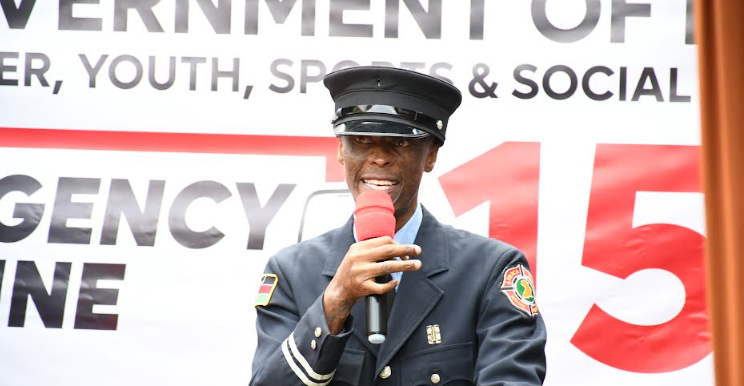
In June 1980, when Jose Njuki-imwe Ngunjiri was only four months old, the house he was sleeping in suddenly caught fire.
At the time his mother was attending to her green grocery stall situated along 6th Street in Eastleigh, about 400 meters away from the burning house.
The house help had also left the house to pick Ngujiri’s elder sister from a nearby school where she was studying.
By the time neighbours raced to put out the fire, the helpless infant had suffered severe burns on his face and left hand but miraculously survived.
But it was this near-death incident that was to shape his future career when decades later he decided to train as a fireman.
Today, his main mission at Africa Fire Mission (AFM) as a Fire Safety Advocate Representative in Africa is to sensitize the public on the basics of preventing and confronting the very enemy that had threatened to nip his life in the bud while still an infant.
“On coming back, she (house help) could see smoke billowing at a nearby house. When she came back, she saw the smoke was coming right from where she served. She quickly left my sister by herself and ran as fast as she could, broke the door, and crawled through the smoke and rescued me,” narrates Ngunjiri, who now works and lives in Nairobi with his family.
He, however, identifies himself with Nyeri County, owing to the fact that his ancestral home is in Mukurwe-ini.
“I stayed at the Kenyatta National Hospital Burns Unit with my mother for nine months. My mother literally moved house, and my dad took over the other siblings. Six years ago I decided to follow my path and went back to school and became a fireman.”
Besides having its main office in Nairobi, the US-based emergency responder operates in five other African countries, including Malawi, Zambia, Ghana, Sierra Leone, and Ethiopia.
Through training, material support, and partnerships, the organization actively increases the sustainable capacity of local fire departments and emergency responders.
Now close to 46 years after the tragedy, Ngunjiri believes Kenya and Africa at large still need more advocacy on best practices when it comes to preventing and combating fire disasters.
Though he says Africa cannot be placed on the same pedestal with the West due to differences in terms of technological advancement, the officer believes all is not lost.
With enhanced training on basic firefighting tips right from the home, schools, and workplaces, the number of fires in the country can be reduced a great deal.
“In many developing countries in Africa, emergency times are often delayed due to lack of a simple toll-free number or easy-to-remember phone numbers. During emergencies the public needs quicker access to the nearest fire station or ambulance. But they must first find out their location and then remember to look up a number sometimes up to ten digits long, he describes.
He notes that at times calling fire stations costs money that can create barriers and make the difference between a human being saved or being burnt to death.
“The time spent searching for such digitals can be critical, sometimes making the difference between life and death or preventing a small fire from escalating into a major disaster.”
But Ngunjiri emphasizes that all is not lost, and many firefighting services being a devolved function has forced many governors to invest in modern firefighting engines besides recruiting additional disaster management officers.
And to enhance communication between the public and fire brigade, some counties have adopted easier-to-remember toll-free numbers for use during fire emergencies.
“Recently some counties in Kenya have introduced their own digital toll-free emergency numbers, representing a significance for the country. These simple new numbers can enable people to react to emergency services swiftly, easily, and without cost greatly improving response time and safety,” he explained.
Nyeri is among counties that have already unveiled a toll-free number for use by the public when reporting about a fire breakout.
On March 19 this year Nyeri Governor Dr. Mutahi Kahiga led the county in launching its first emergency toll-free number, 1549, for use by the public in case of a disaster.
Dr. Kahiga noted that the free emergency line would eliminate barriers to reporting emergencies and at the same time strengthen the county’s disaster preparedness and response framework.
“I am aware of the fact that when a disaster strikes, seconds matter and cost should never be a barrier to seeking help. It is therefore our duty to put in place systems that are not only responsive, inclusive, and technology-driven but also accessible, efficient, and reliable,” he said during the ceremony.
The governor said that the emergency number had come at a time when the county was dealing with a high rate of emergency cases, having recorded a total of 386 incidents in the last one year alone.
Among the cases included were 277 structural fires, 46 bush fires, 46 road traffic accidents, six drowning cases, four emergency aid cases, three vehicle fires, two gas explosion fires, and two search and rescue operations.
Dr. Kahiga similarly revealed that among the reported cases, 20 perished through structural fires.
He at the same time called for close collaboration between partners, stakeholders, and emergency service providers, saying that disaster management is a shared responsibility.
“I can tell you that when disasters happen, the first people to be blamed are governments. Disasters can only be well taken care of only when you mitigate them, not after they have happened, and therefore let us work towards collaboration,” he said.
Statistics from the Kenya Red Cross Society (KRCS) Emergency Operations Centre (EOC) show that over the past 14 years alone, fire incidents have steadily risen in frequency, though the number of fatalities has been decreasing.
The data also say fires now rank second only to road traffic accidents in terms of occurrence and third in fatalities after armed conflict and road fatalities.
According to Relief Web, an online humanitarian information hub under the United Nations Office for the Coordination of Humanitarian Affairs (OCHA), between 2020 and 2024, a total of 1,606 fire incidents were reported across 17 counties.
Nairobi, Nyeri, Kiambu, Nakuru, Mombasa, and Bomet were among the worst-hit counties in terms of overall impacts.
These fires affected 28,000 households, resulting in 2,392 casualties, 11 missing persons, and 293 fatalities.
Among the fatalities are students who have perished after the dormitories they were sleeping in either caught fire or were set ablaze by arsonists.
For instance, on July 13, 1991, another 19 female students were reported to have died at St. Kizito Secondary School after their dormitory was allegedly set on fire by their male counterparts.
Seven years later a total of 26 girls from Bombululu Secondary School in Kwale lost their lives after a suspected electric fault caused a major fire in a crowded dormitory.
The worst school inferno ever recorded in Kenya was the Kyanguli Secondary School fire disaster, in which 67 male students perished after their dormitory was set ablaze by two of their colleagues on March 25, 2001.
And on September 5, 2024, 21 pupils at Hillside Endarasha Academy were burnt to death after a fire erupted in the dormitory they were sleeping in.
To date, the cause of the fire remains unknown, and the matter is currently an issue of judicial inquest.
Ngunjiri argues that a lot still needs to be done in terms of advocacy and policy formulation to enable the country to be in a position to address cases of frequent fires that often leave a trail of destruction and death in their wake.
He says the nation can no longer continue to sit on the fence on the issue of disaster preparedness since fires are now being reported in school dormitories.
He nevertheless says all is not lost for the country on the issue of policy formulation following the signing of the Disaster Reduction Bill by President Dr. William Ruto, which he says can go a long way in mentoring citizens on critical disaster preparedness skills.
“If we need to address the problem of how we can reduce the number of fires in our country, we need to start such a conversation right in our homes. Every member of the household should know how to crawl under billows of smoke while heading to the nearby fire exit if the house he or she is living in is ablaze,” he advises.
“This information should afterwards be extended to all our learning institutions, where students need to be educated on how to prevent the outbreak of fire and what to do in case one breaks out. We should talk to our children when they are as young as seven years old in order to inculcate the culture of disaster preparedness in their psyche at all times.”
By Samuel Maina