The Global Alliance for Improved Nutrition (GAIN) has launched a county-level initiative aimed at improving financial tracking and accountability in food systems to strengthen investment, food security, and climate resilience.
The County-led Food Systems Financial Tracking and Investment (COFFCI) project will be piloted in Kisumu County to help counties monitor food systems financing, improve investment planning, and attract sustainable funding for agriculture and nutrition programmes.
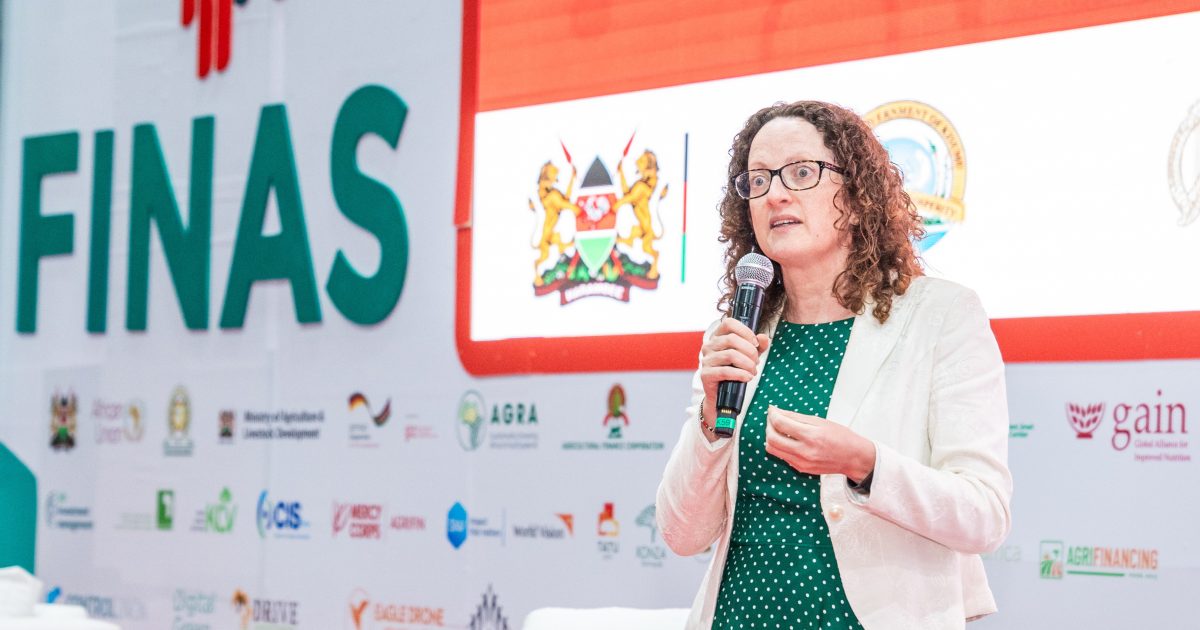
Speaking during the Financing Agri-food Systems Sustainably (FINAS) 2026 side event on sustainable financing for nutrition-sensitive food systems, GAIN Kenya Country Director Ruth Okowa said Kenya has invested heavily in food systems but lacks effective mechanisms to track expenditure and measure its impact at the county level.
She said stronger financial accountability would enable counties to make evidence-based investment decisions while supporting the implementation of the National Agri-food Systems Investment Plan (NASIP) 2026–2030.
“Every shilling invested in food systems should translate into improved food security, better nutrition outcomes, stronger livelihoods, and greater climate resilience,” she said.
The project, implemented by GAIN in partnership with the Ministry of Agriculture and Livestock Development and funded by the Embassy of Ireland, seeks to strengthen county financial tracking systems, improve institutional coordination, and build technical capacity for investment planning.
Okowa said an assessment conducted between 2024 and 2025 across 20 counties identified major gaps, including weak financial tracking systems, poor institutional coordination, limited capacity to monitor public expenditure, and inadequate data to measure the impact of food systems investments.
She explained that the weaknesses have limited countries’ ability to design high-impact programmes capable of attracting sustainable public and private financing.
Okowa said Kisumu was selected for the pilot because it has an established county food systems strategy and has demonstrated progress in food systems reporting, making it suitable for testing innovative financing models.
She expressed confidence that lessons from the pilot would be replicated across other counties to strengthen governance, transparency, and investment in food systems.
Ireland’s Ambassador to Kenya, Caitriona Ingoldsby, said the initiative would improve accountability by generating evidence to guide investment decisions and help successful approaches tested in Kisumu to be replicated in other counties.
She noted that the changing global development financing landscape, marked by reduced donor funding, makes efficient use of available resources more critical than ever.
“The funding that is available, whether national or international, must be absorbed and utilized in the most efficient, accountable, and transparent manner,” she said.
Ingoldsby added that sustainable food systems require coordinated investments beyond agriculture, including water, energy, infrastructure, and governance.
She also announced that Ireland is preparing a new five-year Ireland-Kenya Agri-Food Strategy to guide future partnerships and investments in the sector.
Meanwhile, Agricultural Finance Corporation (AFC) Chairman John Mruttu called for reforms to Kenya’s succession laws, saying delays in transferring land ownership are preventing many young people from accessing agricultural credit.
He said the lack of collateral remains one of the biggest barriers to youth participation in agriculture, as many prospective farmers cannot use family land to secure loans because ownership has not been legally transferred.
Mruttu urged Parliament to fast-track amendments to succession laws to simplify and speed up the transfer of estates, particularly for small landholders.
He said reforms would unlock access to credit, increase youth participation in agriculture, and support the country’s agricultural transformation agenda.
By Wangari Ndirangu