The government has urged farmers to integrate cocoa and avocado with coffee as part of a new agroforestry strategy aimed at increasing farm incomes, enhancing climate resilience, and expanding Kenya’s agricultural exports.
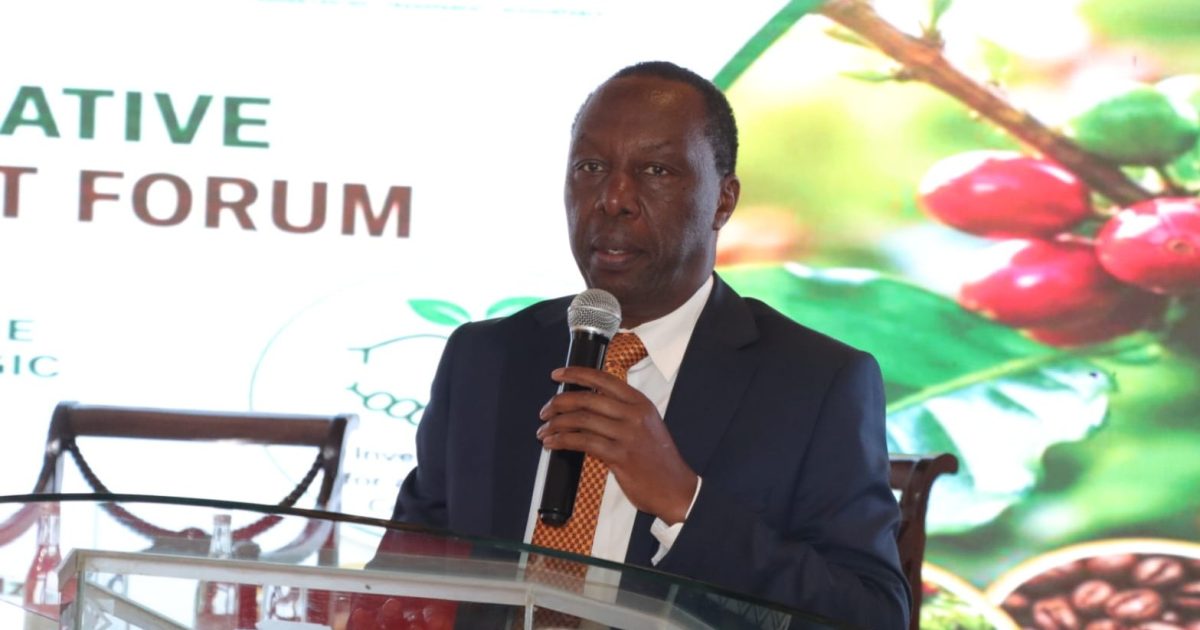
Speaking during a coffee investment forum in Nairobi, Forestry Principal Secretary Mugambi Gitonga said the initiative would diversify farmers’ earnings while supporting sustainable land use and meeting international environmental standards.
Gitonga said the government has identified about 5.9 million hectares suitable for cocoa production and plans to distribute two million cocoa seedlings this year as it rolls out cocoa as a new strategic value chain.
He challenged private investors, cooperatives, and development partners to invest early in cocoa processing and value addition to help Kenya export finished cocoa products and avoid the structural and marketing challenges experienced in the coffee sector.
“We must build the cocoa value chain from the beginning by investing in processing and markets so farmers earn maximum value,” he said.
The PS also encouraged coffee farmers to plant avocado trees alongside coffee, saying the crop provides shade while offering farmers an additional source of income through its strong export market.
“As we grow coffee, let us also grow avocado. It is another major business opportunity with a huge international market. All we need is to produce more,” he said.
At the same time, Gitonga assured international buyers that Kenya’s coffee complies with global forest conservation standards, saying no coffee is grown in gazetted forests, positioning the country well under the European Union Deforestation Regulation (EUDR).
“There is no coffee in Kenya that is grown in forests. We have undertaken the necessary assessments and standards, and we do not intend to have coffee grown in forests,” he said.
Instead, the government is promoting agroforestry by encouraging farmers to grow coffee alongside trees on their farms to improve environmental sustainability while increasing productivity.
Gitonga noted that coffee contributes significantly to carbon sequestration and proposed the creation of a national digital platform to track coffee tree planting alongside other tree species to monitor progress in increasing the country’s tree cover.
He added that sustained investment and ongoing reforms could enable Kenya to increase coffee production beyond the target of 100,000 metric tonnes to as much as 200,000 metric tonnes, while reaffirming the government’s commitment to restoring forests through tree planting and natural regeneration without expanding coffee production into protected forest areas.
The government had recently launched Kenya’s national cocoa programme in Elgeyo Marakwet where the first 400 cocoa seedlings were planted, establishing Kenya’s national demonstration hub for cocoa production, farmer training, and research.
Research by Kenya Forestry Research Institute (KEFRI) has identified Elgeyo Marakwet as one of the country’s most suitable production zones, with cocoa offering significantly higher returns per acre than many traditional cash crops.
To accelerate production, the government is establishing a KEFRI Seed Centre in Kaptagat and rolling out seedlings across other suitable growing areas, including Elgeyo Marakwet, Meru, Kirinyaga, Kilifi, and other high-potential regions.
Kenya already exported about Sh3.6 billion worth of cocoa beans in 2024, with Indonesia and Malaysia among the leading destinations, demonstrating that the country has an established export market on which this ambitious expansion can build.
By Wangari Ndirangu