The government has reported significant progress in restoring the Mau Forest Complex through the Mau Forest Complex Integrated Conservation and Livelihood Improvement Programme (MFC-ICLIP).
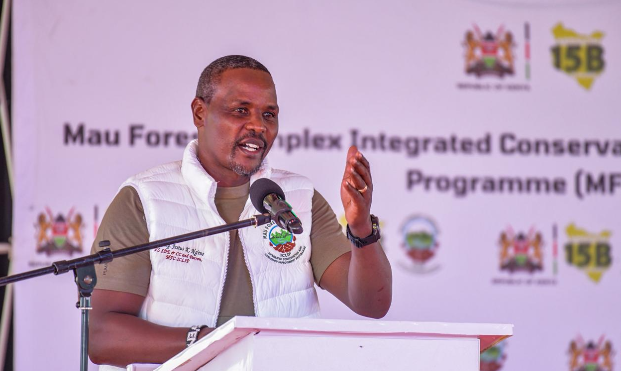
Speaking at Baringo Primary School in Kuresoi North during a tour by First Lady Rachel Ruto to launch the one-million fruit tree nursery project at Marindas Forest Block and commission the Mama Kitchen Garden and Biogas project, Principal Secretary for Environment and Climate Change Dr. Eng. Festus Ng’eno said the programme demonstrates that environmental conservation and economic empowerment can be pursued simultaneously to achieve tangible results.
“By integrating conservation, livelihood improvement, circular economy, and environmental education through school programmes and sporting activities, the MFC-ICLIP is restoring the Mau Forest while uplifting the livelihoods of communities that depend on it,” said Dr. Ng’eno.
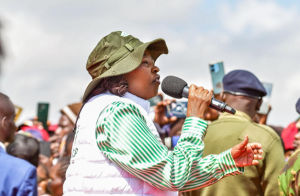
First Lady Mama Rachel Ruto visited Kuresoi North to boost ongoing efforts to restore the Mau Complex while improving livelihoods through community empowerment around the country’s largest water tower.
Eng. Ng’eno said the initiative, themed “Linda Mau, Boresha Maisha,” is a community-owned and partner-driven programme aimed at reversing decades of environmental degradation while promoting sustainable livelihoods.
“The MFC-ICLIP is a mission to restore the Mau Forest to its former beauty and value at local, national, regional, and international levels, while renewing its ability to sustain freshwater systems, regulate rainfall, support agriculture, and secure millions of livelihoods,” he said.
He emphasized that protecting the Mau Forest is not only an ecological duty but also a moral responsibility.
The Mau Forest Complex, the largest Afro-montane forest in East Africa, covers approximately 403,000 hectares and is Kenya’s most important water tower, serving millions of people across the country and beyond.
It is the source to 12 major rivers, including the Mara, Sondu, Nyando, and Ewaso Ng’iro, which support agriculture, wildlife, tourism, and domestic water supply. These rivers drain into Lakes Victoria, Nakuru, Turkana, Baringo, and Natron, sustaining ecosystems of global significance.
The forest also supports internationally renowned landscapes such as the Maasai Mara and Serengeti and is a biodiversity hotspot valued at an estimated Sh197 billion.
However, PS revealed that illegal logging, charcoal burning, overgrazing, encroachment, unsustainable farming practices, and climate change have placed the ecosystem under severe pressure, prompting the launch of the MFC-ICLIP programme.
The initiative, spearheaded by the Ministry of Environment, Climate Change and Forestry led by Cabinet Secretary (CS) Dr. Deborah Barasa, is expected to create income-generating opportunities while supporting landscape restoration and reducing pressure on forest resources.
Eng. Ng’eno noted that environmental degradation has disproportionately affected surrounding communities, with women and girls bearing the greatest burden through longer journeys in search of firewood and water.
According to PS, the programme has already restored about 1,500 hectares of degraded forest using 1.5 million tree seedlings in Marindas (Bararget Forest Station, Eastern Mau) and Gacharage (Kuresoi Forest Station, Western Mau). An additional 1,635 hectares have been adopted for restoration under the Adopt-a-Forest initiative, including contributions from national leaders, institutions, and private sector partners. During the visit, the First Lady adopted 33 hectares for restoration.
“And just today, you have adopted 33 ha of forest land. We thank you for leading by example!” said Eng. Ng’eno.
Beyond tree planting, more than 10,000 farmers have benefited from value chains such as potatoes, pyrethrum, avocado, dairy farming, beekeeping, fodder production, and tree nurseries.
Through the Trees Establishment and Livelihood Improvement Scheme (TELIS), households are allowed to grow food crops while nurturing tree seedlings, with 1,387.5 acres already allocated to 4,650 households. The programme is projected to generate over Sh333 million per potato harvest, potentially reaching nearly Sh1 billion annually.
Eng. Ng’eno said the initiative is also promoting clean energy and climate resilience through electricity connections, boreholes, irrigation rehabilitation, and energy-saving cooking stoves.
In education, schools have been integrated into conservation efforts through kitchen gardens, fruit orchards, and environmental clubs. So far, 180 schools have established fruit orchards, with Baringo Primary School serving as a demonstration centre for climate-smart agriculture. The programme aims to expand to all 534 schools in the MFC-ICLIP area.
Conservation awareness is also being promoted through the Mau Conservation Marathon, which combines environmental stewardship with talent development.
Despite progress, Eng. Ng’eno said more work remains to achieve long-term targets, noting that the programme aims to restore over 33,000 hectares, support 148,000 farmers, develop 50 nature-positive value chains, and create at least 100,000 green jobs over the next decade.
“We are far from our target,” he said, calling for stronger collaboration between development partners, the private sector, county governments, and local communities.
By Ian Chepkuto and Faith Chebet (PCO)