Kenya’s exclusive breastfeeding rate has stagnated at 60 percent over the past several years, raising concern among health stakeholders as bottle feeding continues to increase and only six in every 10 newborns are breastfed within the first hour after birth.
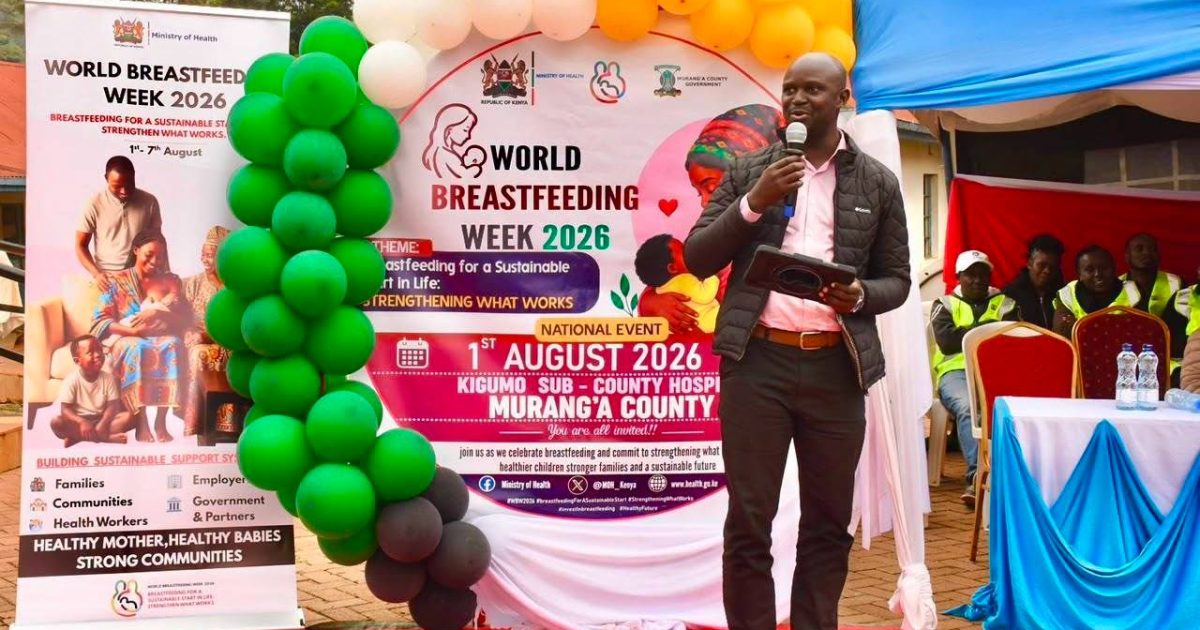
The concerns were raised on Saturday during the national launch of World Breastfeeding Week 2026 at Kigumo Sub-County Hospital in Murang’a County, where the Ministry of Health and development partners called for increased investment in maternal and child nutrition, improved newborn care and stronger support systems for breastfeeding mothers.
The event, held under the theme, “Breastfeeding for a Sustainable Start in Life: Strengthening What Works,” brought together officials from the national and county governments, development partners, healthcare workers and Community Health Promoters.
Speaking on behalf of Health Principal Secretary Mary Muthoni, Deputy Director of medical services Dr. Norbert Abuya said the 2022 Kenya Demographic and Health Survey indicates that 60 per cent of infants below six months are exclusively breastfed, surpassing the World Health Assembly target of 50 per cent.
He, however, noted that the rate has remained unchanged in recent years while bottle feeding is on the rise.
Dr. Abuya said although 89 percent of births in the country are attended by skilled health workers, only 60 percent of newborns are breastfed within the first hour after delivery.
“The gap shows that improving skilled delivery must go hand in hand with improving the quality of newborn care,” he said.
The director described breastfeeding as one of the most effective interventions for child survival, saying it boosts immunity, supports brain development and protects infants from life-threatening illnesses.
The government, he added, will continue strengthening policies and mobilizing resources to support counties in improving maternal, newborn and child nutrition services.
Nutrition International Kenya Country Director Martha Nyagaya said despite Kenya’s progress, four out of every 10 infants are still not exclusively breastfed during their first six months of life.

She attributed the stagnation to early weaning and increased bottle feeding and urged Community Health Promoters to intensify household sensitization on the importance of exclusive breastfeeding.
Nyagaya also called for greater investment in nutrition programmes, establishment of more workplace lactation centres and increased involvement of men in supporting breastfeeding mothers.
UNICEF Chief of Field Operations Dominic Stolarow said Kenya’s progress demonstrates the benefits of sustained investment in maternal and child health.
He noted that exclusive breastfeeding has risen from 13.2 per cent in 2003 to 60 percent in 2022, while infant mortality has declined from 77 deaths per 1,000 live births to 32.
“For a newborn, breast milk is more than food. It is the first vaccine and, for many babies, the difference between life and death,” he said, adding that UNICEF and the World Health Organization would continue supporting Kenya’s breastfeeding programmes”.
Murang’a Chief Officer for Health Vainusa Aburro said Community Health Promoters continue to play a key role in supporting mothers and families through household education and follow-up services aimed at improving breastfeeding practices.
Murang’a Deputy Director of Health Dr. Kairo Kimende said the county has invested in mother-friendly health facilities, including a modern lactation centre equipped with refrigerators and microwaves to enable working mothers to breastfeed and safely store breast milk.
He added that the county has also expanded maternity wards to provide a conducive environment for mothers and newborns.
Murang’a County Nutrition Coordinator Nancy Mwangi observed that 15 health facilities in the county have attained Baby-Friendly Hospital status, while all the county’s 1,969 Community Health Promoters and Community Health Assistants have been trained to support breastfeeding at the community level.
She added that the county has established 720 mother-to-mother and father support groups to encourage family participation in child nutrition and developed a five-year Multi-Sectoral Food and Nutrition Security Policy.
According to Mwangi, the interventions have helped reduce the county’s stunting rate from 19 per cent to 10 per cent.
Journalist Rebecah Muiruri, who spoke during the event, shared the challenges of balancing work and breastfeeding after maternity leave, calling for stronger workplace support for nursing mothers.
Breastfeeding champion Peter Kuria appealed to men to actively support their spouses during pregnancy and after childbirth, saying shared responsibility was critical to successful breastfeeding.
Stakeholders reaffirmed the need to protect, promote and support exclusive breastfeeding for the first six months of life, followed by continued breastfeeding alongside appropriate complementary feeding up to two years, describing it as a vital investment in child survival and the country’s future human capital.
By Bernard Munyao and Purity Mugo