The Kenya Agricultural and Livestock Research Organisation (KALRO) has stepped up efforts to transform the country’s pig value chain through improved breeding, feeding, disease management, and stronger market linkages.
Speaking during a media tour of the KALRO Pig Research Programme in Naivasha, animal scientist Benedict Oduor Olale said the interventions were being implemented under the World Bank-supported Food Systems Resilience Project (FSRP), focusing on developing and disseminating technologies to raise productivity and farmer incomes.
Olale said smallholder farmers made up about 80 per cent of Kenya’s pig value chain, making the sector a significant source of employment, household income, and food security.
He said Kenya produced approximately 23,000 metric tons of pork against a market demand of about 38,500 metric tons, leaving a deficit that presents an opportunity for farmers to scale up production.
“Pork is an alternative source of protein, and the demand is there, and once we address the challenges facing farmers, there is an opportunity to produce more, create employment and increase household incomes,” Olale said.
He added that Kenyan pork was also finding demand in neighbouring Uganda and Tanzania, as well as in Gulf markets, including the United Arab Emirates.
Olale said the shortage of quality breeding stock remained one of the sector’s biggest constraints, and added that the organisation was poised to receive major new germplasm to promote artificial insemination.
He added that the Naivasha pig unit had recorded strong growth in recent years, though demand for KALRO breeding stock continued to outstrip supply, with the centre currently meeting only about half of farmers’ requirements.
“KALRO was working to bring in new germplasm and promote artificial insemination to widen access to superior genetics”, said Olale.
On feeds, Olale said high costs of protein sources such as soya and fishmeal, which are largely imported, remained a major obstacle to profitable pig farming.
He said KALRO was promoting alternatives such as black soldier fly larvae, which can be produced locally using pig waste and encouraged farmers to formulate their own feeds.
On disease control, Olale stressed that biosecurity, cleanliness and proper sanitation remained the only effective safeguards in the absence of a vaccine for swine fever, noting that the virus’s tendency to mutate had complicated vaccine development.
Olale said KALRO was strengthening farmer capacity through a lead-farmer training model, in which researchers and extension officers train selected farmers who then pass on the knowledge to others.
He said the organisation was also working to link farmers with buyers and processors, noting that stronger market linkages were essential if increased production was to translate into higher incomes.
According to the Kenya National Bureau of Statistics, National Agriculture Production Report, 2024, Kisumu County led in pork production at 7,972,399 kg, followed by Kiambu at 5,484,110 kgs, Murang’a 4,563,907 and Busia 3,205,162kgs.
KALRO’s strategic plan identifies agricultural transformation, technology and innovation, commercialization and value chain strengthening as key pillars for improving food security, creating jobs and raising incomes.
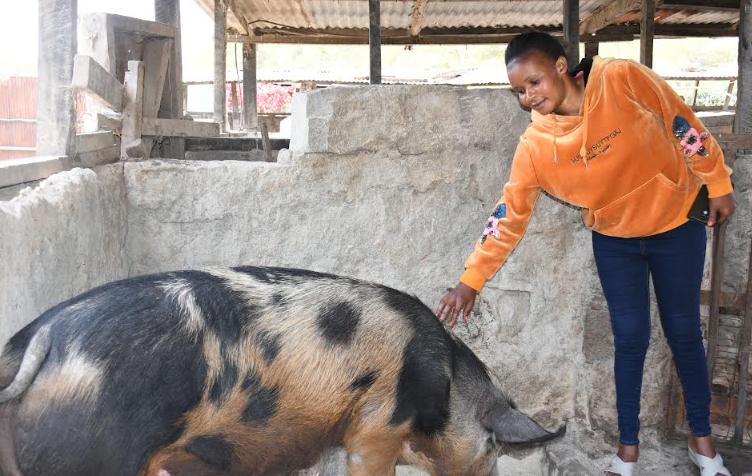
Farmer Mwanya Migadde of Kinamba town in Naivasha, who began pig farming with two pigs last year and has since expanded to about 80 pigs said access to knowledge, quality breeds and affordable feeds was critical to success.
He said he had obtained his initial weaners from KALRO and benefited from its technical support but had turned to formulating his own feed to manage rising costs.
Migadde said he was also exploring value addition of pig products to cushion his business against declining market prices.
However, Damaris Njoroge, proprietor of Buffalo View Farm in South Lake, Naivasha, said African swine fever had wiped out large numbers of her piglets over the past year, forcing her to scale down her herd from between 250 and 400 pigs to about 82.
She said the cost of a 70-kilogramme bag of commercial feed had also risen from Sh2,800 to Sh3,400 over the same period, while local buyers were offering poor prices, which she said were inadequate to cover production costs.
Njoroge called for interventions from research-based facilities to cushion farmers from the losses currently being faced, including high animal feed costs and the outbreak of African swine fever.
By Beatrice Wanjiku and Erastus Gichohi