The government has welcomed partnership between TVET and the Kenya Accountants and Secretaries National Examinations Board (KASNEB) that will see the integration of professional accounting and management certifications with technical training.
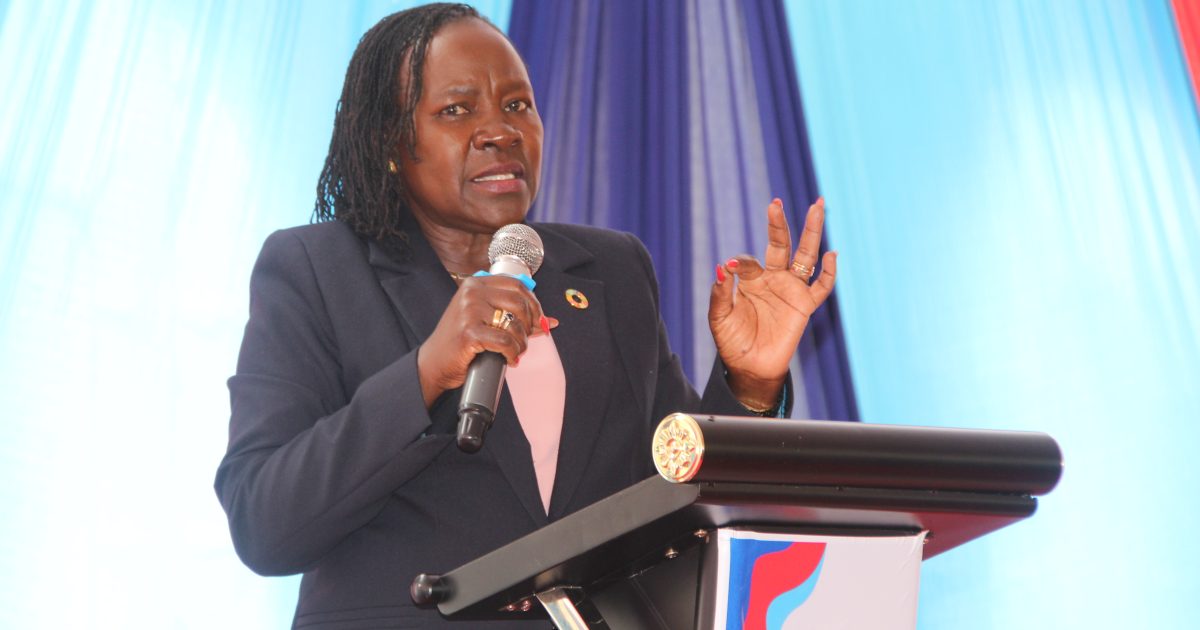
Speaking as she presided over the launch of KASNEB Revision Guides during a Consultative Forum for Centres of Excellence and Accredited Training Institutions held at the Eldoret National Polytechnic, Technical, Vocational Education and Training, PS Dr. Esther Muoria said the move is part of efforts to bridge the gap between technical skills and professional expertise in the country.
“We are very happy as technical trainers to integrate with KASNEB, who are professional trainers and business trainers, so that when we are able to work together, then it means that we are going to graduate people with technical skills, as well as entrepreneurial and management skills,” she noted.
The event marked a key milestone in improving the quality of learning and boosting the national training curriculum to match the changing needs of the job market. The focus is on combining specialized training with entrepreneurship to improve employability among young people.
PS Muoria said the government is working to integrate KASNEB professional business training with practical technical programs offered in TVET institutions across the country to ensure both technical and professional training are taught together for better learning outcomes.
Dr. Muoria announced that KASNEB is revising its syllabus and learning guides to support this integration with the goal of ensuring technical training and professional training work together in a more structured way.
The PS lauded the Eldoret National Polytechnic, which is among the 11 National Polytechnics partnering with KASNEB, noting that these institutions will help to implement the new training approach across the TVET sector.
She hinted on the introduction of micro-credentials revision studies, which are short courses that usually take about three months to complete and are designed to give young people targeted skills in specific areas in order to become more competitive in the global job market.
“A micro-credential is a small portion of the whole program, and these are well stackable, so you train in that micro-credential, and then you train in the next one until you have the full qualification at the end of the day,” said Dr. Muoria.
The PS decried that the country has lacked focused training in specific skill areas, emphasizing the need to train young people with precision so that they can meet international standards and perform effectively in specialized roles.
She added that Kenya needs to produce skilled workers who can adapt quickly and bring strong impact in different industries, as this will help learners become more productive and competitive in global spaces.
Dr. Muoria further announced the government plans to utilize modern equipment in TVET institutions more effectively, adding that 11 TVETs were in the process of being registered to operate as official commercial garages.
These garages will be allowed to repair and maintain government vehicles, and it will help students gain real work experience while still in training. It will also allow institutions to generate income through service delivery.
The PS said this approach will shift training from theory to practical experience, where students will learn better because they will be working on real vehicles that belong to customers, who expect quality service.
In line with this vision, the State Department for TVET continues to strengthen industry linkages, promote work-integrated learning, expand industrial training programs and ensure continuous review of occupational standards and development of curriculum that is fully responsive to the evolving labor market.
The PS commended KASNEB for this initiative and encouraged trainers, students, and institutions to fully utilize these guides as tools valuable for professional success.
KASNEB Independent Director Samantha Kipury lauded the new changes, saying the revised syllabus focuses more on practical skills and empowerment instead of only academic completion.
She explained that the goal is to produce learners who fully understand their field and can apply the skills effectively in real situations in a rapidly changing world of work, which also highlights the need for flexible training opportunities to establish expertise in a specific niche.
Kipury also clarified that theory is still important in the new system and still remains the foundation of all learning and is strengthened through practical training.
The Director described the new approach as a balanced system that combines theory and practice to give students a complete learning experience.
“Our goal is not just to have skilled people or skilled generations, but empowered ones, because that is the only way we can succeed as a nation,” she noted.
By Ekuwam Sylvester and Nelson Obwana