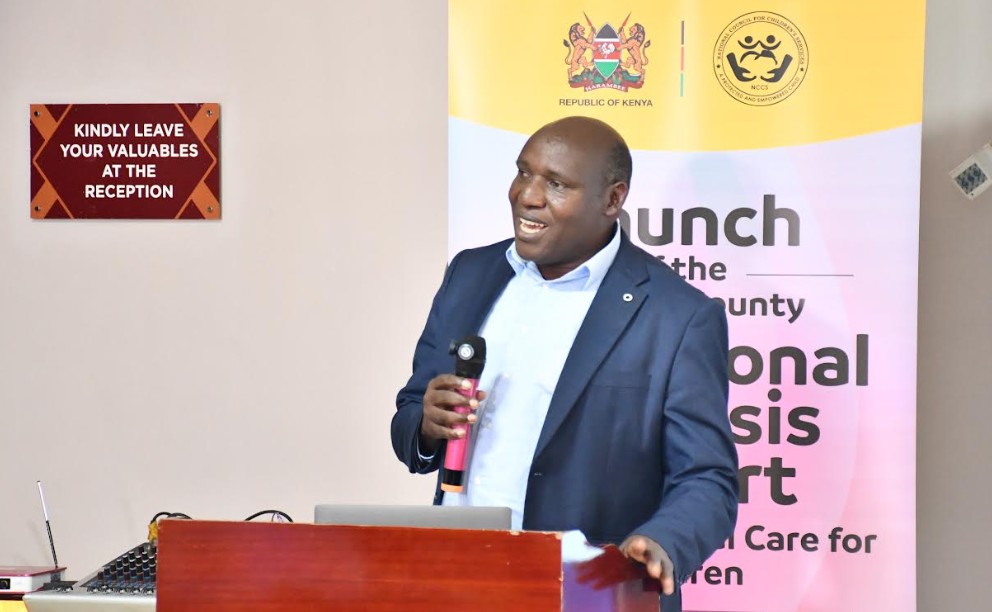
Kiambu County on Monday launched the Situational Analysis Report on Institutional Care for Children, calling for accelerated implementation of comprehensive care reforms that prioritise family-based care over institutional placement.
The launch ceremony was held at The Luke Hotel along Thika Road, and Area County Commissioner George Matundura was the chief guest.
Matundura urged stakeholders to embrace change while acknowledging the role played by Charitable Children’s Institutions (CCIs). “We must embrace change while appreciating CCIs for the work they have done. The family setup has to be embraced,” he said.
The report was presented by Chris Wadoyi of Legacy 4 Children. It provides an evidence base for reforming the care system for children in institutional care within the county.
The report revealed significant gaps in gatekeeping and documentation, indicating that of 787 case files reviewed, only 28 per cent had valid court orders. Forty-five per cent of existing orders had expired, while 17 per cent lacked any referral or legal admission documents.
The report recommended urgent strengthening of standard admission protocols, timely case reviews and digital tracking systems.
Of the origin of a total of 3,058 children in need of care, 2,009 were from Kiambu County, 930 from other counties and 117 of unknown origin. Sixty-six per cent originated within the county, creating opportunities for family tracing and reintegration. Two children were identified as coming from Tanzania, highlighting the need for inter-county and cross-border coordination.
Primary drivers of admission reported by institutional managers included abandonment, violence, abuse or neglect, orphanhood, poverty and street-connectedness. The system was found to be more responsive than preventive.
Children and care givers expressed appreciation for basic provisions such as food, education, clothing and shelter. However, they highlighted emotional gaps, conditional affection within institutions, community suspicion and challenges during reintegration, including family rejection and abrupt exits with limited support.
Outreach programmes were being implemented by 74 institutions, covering 80 per cent of facilities. Common services included psychosocial support, feeding, health care and education assistance. However, gaps remained in special-needs support, internships, employment linkages and bursaries.
The report’s recommendations are structured around all the core care reform pillars, including prevention of separation and family strengthening through scaled-up positive parenting, household economic empowerment and emergency support.
Others are strengthened gatekeeping and referral systems, promotion of family-based alternative care options, systematic reintegration and aftercare support, improved case management and data systems and enhanced community protection mechanisms so that institutional care remains a last option.
The launch marks a critical step for Kiambu County as it aligns local practice with national care reform priorities aimed at ensuring every child grows up in a safe and nurturing family environment.
By Kipkorir Felix and Grace Naishoo