The Kenya Ports Authority (KPA) is steadily upgrading capacity of its Inland Container Depots (ICDs) to streamline regional logistics and decongest the Port of Mombasa.
The State Corporation has indicated that it has upgraded and equipped ICDs in the country as they are strategic cargo clearance hubs for transit goods destined for neighbouring countries.
Manager for Inland Container Depots at KPA, Paul Bor, pointed out that key interventions include expanding the Naivasha ICD that handles 450,000 twenty-foot equivalent units [TEUs] annually and utilizing the Standard Gauge Railway (SGR) and Metre Gauge Railway (MGR) to seamlessly transport transit cargo to Uganda, Rwanda, DRC, and South Sudan.
Bor stated that by routing domestic and transit freight away from roads to Standard Gauge Railway (SGR) and Meter Gauge Railway (MGR) networks, via the ICDs, the country aims to significantly reduce transport costs and cargo turnaround times.
The official who doubles up as Senior Logistics Manager at KPA noted that ICDs bridge the gap between seaport and hinterland markets, significantly easing supply chain congestion, adding that Kenya’s strategically placed dry ports consolidate import and export cargo using the Standard Gauge Railway (SGR).
Speaking at the Authority’s exhibition stand at the Nakuru Agricultural Society of Kenya Trade Fair on Sunday, Mr. Bor said upgrade of the facilities was easing a sustained surge in cargo volumes at Kenya’s principal seaport, which has previously resulted in clearance delays, higher logistics costs and slower turnaround times for importers and regional transit traders.
According to official data, the Port of Mombasa handled 45.45 million metric tonnes of cargo in 2025, up from 40.99 million metric tonnes in 2024, placing significant pressure on port infrastructure and customs operations.
He said the Naivasha ICD was being prioritized for long-haul cargo bound for Uganda, Rwanda, the Democratic Republic of Congo and South Sudan, allowing Mombasa Port to focus on domestic and short-haul traffic.
“The utilization of Naivasha ICD will reduce congestion at the port, lower clearance timelines and cut transport costs for regional traders while maximizing the efficiency of the Northern Corridor,” he indicated.
The depot, which is linked to Mombasa by the Standard Gauge Railway and onward to the Metre-gauge railway, has a handling capacity of 4,000 twenty-foot equivalent units but is currently operating at just 19 per cent occupancy.
“Mombasa has remained the port of choice as regional players pursue stability and reliability in their supply chains, but we seek to utilize the Naivasha ICD to decongest and improve efficiency,” he said.
He noted that increased uptake by neighbouring countries were unlocking Kenya’s ICD’s full potential and improving cargo turnaround times across the Northern Corridor, a key artery to the regional bloc.
“In order to bring port services closer to customers and reduce port congestion, Kenya Ports Authority (KPA) has constructed or refurbished inland container depots (ICD) at Nairobi, Naivasha, Kisumu and Eldoret. These depots are linked to the Mombasa Port container terminal by rail connections and service,” elaborated Mr Bor.
“They are also accessible by road allowing trucks to continue delivering large numbers of containers. Imports are delivered directly from Mombasa to the depots on a ‘Through Bill of Landing’, while exports can also be consolidated at the ICDs and sent by rail to the Port for international shipping,” he added,
Mr. Bor stated that the ICDs have revolutionized cargo handling in Kenya and East Africa, allowing the Port of Mombasa to maintain its prime position as the go-to port for exports and imports in East Africa and that they were easing backlogs at the Port and ensuring speedy delivery of containers to various inland destinations where they then undergo customs and security checks.
While indicating that ICDs include facilities for storage and consolidation of goods, maintenance for road or rail cargo carriers and customs clearance services, Mr. Bor observed that their location relieve competition for storage and customs space at the Port of Mombasa and that they had been designed to realize maximum benefits of containerization of cargo and to avoid over-investment in port facilities and storage capacity.
“The ICDs were established to realize maximum benefits of containerization of cargo, which is the current trend and to avoid over-investment in port facilities and storage capacity. The ICDs serve as “Dry Ports” linked directly to Mombasa Container Terminal by a special regular “Railtainer” service,” he stated.
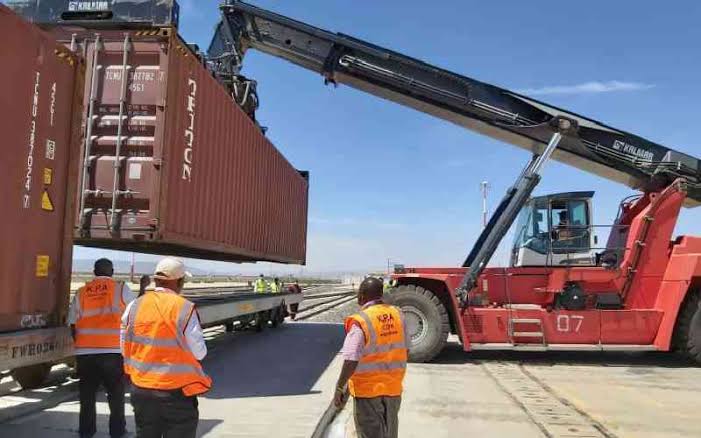
The facilities, he explained, have transit sheds and stacking grounds equipped with various types of cargo handling equipment like forklifts trucks, front loaders, tractors, trailers, reach stackers and cranes.
He described ICDs as a strategic shift toward a modern port ecosystem.
“The ICDs are not only a national asset but also a critical regional gateway. Our objective is to eliminate bottlenecks, reduce cargo dwell time and build a predictable, efficient and digitally enabled clearance system that supports trade and economic growth,” observed Mr. Bor.
He said improvement of ICDs was in line with the government’s quest to modernize transport infrastructure in order to stimulate economic growth.
This, he added, is on the backdrop of increased cargo volumes at the country’s and the East African region’s main sea port in the wake of rising trade, with the number of vessels calling having significantly risen in recent years.
Cargo throughput, which is the total volume of goods, is projected to have risen by at least six per cent in 2025 above the 40.9 million metric tonnes recorded in 2024, which was a 13.9 per cent rise from 35.9 million metric tonnes in 2023.
Container traffic is reported to have gone up by at least seven per cent last year above the more than two million recorded in 2024, leading to congestion at the port towards the end of the year into 2026.
According to the Shippers Council of Eastern Africa (SCEA), which represents the interests of importers, exporters and other stakeholders in the logistics and shipping industries across Eastern Africa, yard population as at December 31, was between 50,000 and 52,000 Twenty-foot Equivalent Units (TEUs)–the standard measure for shipping container capacity.
The Chairman of the Organizing committee of the Nakuru Agricultural Society of Kenya Trade Fair, Peter Odera, observed that the ICDs facilitate the diversion of heavy container traffic from the road to rail which in turn minimizes road damage caused by heavy trucking thus ensuring smoother roads while giving them more life.
He said cargo transported by rail is safer and more secure therefore ensuring the safe transportation of cargo to and from the port of Mombasa and that customers reduce the amount of time and money that would have otherwise been spent traveling all the way to the Port of Mombasa to clear or forward cargo.
“Efficient ICDs encounter fewer delays in cargo transit, resulting in heightened trade volumes Consequently, it is imperative to enhance the operational efficiency of ICDs through the implementation of advanced technologies, real-time tracking systems and a skilled workforce to ensure the smooth flow of international trade. ICDs significantly influence trade facilitation measures, trade costs and trade volumes by providing an alternative to seaport operations and improving the efficiency of cargo handling,” noted Mr Odera.
Charles Chebii a teacher at Forest Academy commended the seamless clearing processes at Kenya’s ICDS which he said allows traders to pay less in demurrage charges, hence increasing export and import volumes.
While saying that Uganda is the biggest transit market for Kenya, accounting for over 60 percent of transit cargo, Mr Chebii encouraged KPA to continue ensuring the port, along with other inland waterways, remain competitive in the region.
He explained that Inland Container Depots within the Northern Corridor enhance the Port of Mombasa throughput capacity, the clearance of cargo and container handling.
By Jane Ngugi and Dennis Rasto