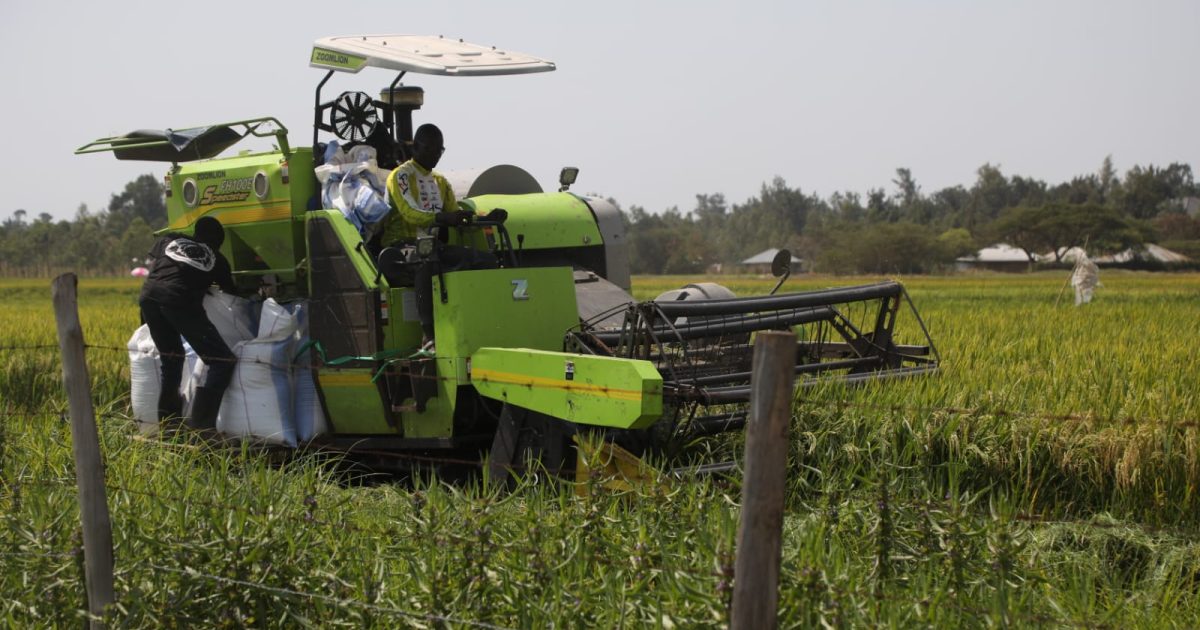
The Lake Basin Development Authority (LBDA) has launched the first-ever rice harvest at the Ondago Swamp in Karachuonyo Constituency, marking a major milestone in efforts to enhance local rice production and reduce Kenya’s dependence on imports.
Speaking Wednesday during the launch, LBDA Managing Director Wycliffe Ochiaga said they started rice cultivation at the site about five months ago, leading to the massive harvest.
More than 200 acres are now ready for harvesting, while over 5,000 acres have been put under production across the broader Kimira-Oluch Irrigation Scheme.
Ochiaga said the authority aims to expand production to more than 20,000 acres within the next year once the scheme is fully operational.
“Kimira-Oluch Irrigation Scheme has enormous potential to support more than 20,000 acres under rice production. At an average yield of between 3.5 and 4 tonnes per acre, the project will significantly boost local rice production and help bridge the gap between domestic demand and imports,” he said.
He noted that there had never been rice cultivation in Ondago, making the project the area’s first commercial rice farming initiative.
Beyond increasing food production, the project has created employment opportunities for youth, women and men while improving household incomes.
The Managing Director said the authority’s support extends beyond production through its rice milling plant in Kisumu, where harvested paddy is processed, packaged and marketed, creating additional jobs along the value chain.
Ochiaga attributed the project’s success to strong partnerships between the national government, private sector players and the county government.
He acknowledged Green Tech Hub Limited for managing production and providing agronomic support, while Syngenta has supported crop protection and Tingaling has facilitated mechanization.
Other partners have also contributed technical expertise and resources.
He said the LBDA was working closely with the Homa Bay County Government to address key challenges affecting farmers, including inadequate water supply, destruction of crops by quelea birds and limited access to capital.
To tackle water supply challenges, LBDA plans to rehabilitate damaged infrastructure at Kimira-Oluch Irrigation Scheme to ensure seamless agricultural production.
The MD highlighted that the irrigation scheme has not been fully operational for more than 20 years with much of its infrastructure having been vandalized over time.
Ochiaga assured farmers of continued government support through provision of farm inputs, improved market access and greater private sector investment.
Homa Bay County Executive Committee Member for Agriculture Dr. Joash Oloo emphasized the importance of collaboration between the county and national governments in implementing large-scale agricultural projects.
While agriculture is a devolved function, Dr. Oloo noted that many of the resources required for major irrigation projects remain under the national government, making partnerships with agencies such as the Lake Basin Development Authority essential.
He said the county government continues to provide extension services through ward and sub-county agricultural officers and operates a toll-free Climate Information Centre where farmers receive advice on weather forecasts, planting schedules and crop management.
To further support the project, Dr. Oloo announced that the county government had acquired six tractors and encouraged farmers in Ondago to form a cooperative society to enable them to access mechanization services.
“We are ready to allocate one of our tractors to this group once they organize themselves into a cooperative. This will greatly improve land preparation and increase productivity,” he said.
Green Tech Hub Limited Chief Operations Officer Helen Orwa said the company had overseen production from the initial land preparation stage through to harvesting.
“When we began, this land was completely bare. Today we are harvesting rice, demonstrating what is possible through proper planning, commitment and partnership,” she said.
Orwa expressed confidence that the project would continue expanding to more acreage, increasing rice production for both local and national markets while improving farmers’ livelihoods.
By Sitna Omar