Mombasa County has intensified efforts to improve road safety and promote sustainable transport through the establishment of dedicated cycling lanes, pedestrian-friendly walkways, and additional road safety measures across the county.
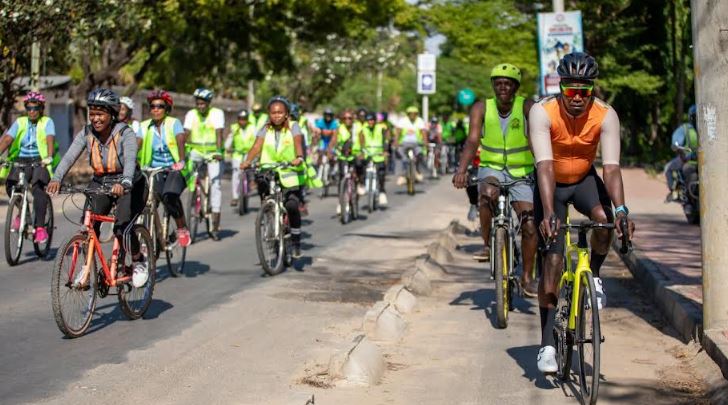
One of the flagship initiatives is the newly completed cycling lane along Links Road in Nyali, developed through a partnership between the Mombasa County Government and Bloomberg Philanthropies.
The dedicated cycling lane currently stretches four kilometers and is intended to provide cyclists with a safer alternative to sharing busy roads with motorists.
Bloomberg Philanthropies Communications Officer Kevin Ismael said the project was launched as a pilot initiative to encourage cycling, improve road safety, reduce traffic congestion, and minimize environmental pollution.
“Together with the County Government of Mombasa, we have completed the Nyali Links Road Cycling Lane, and we are happy with how cyclists have adopted the idea,” said Ismael.
He said the partners were planning to extend the four-kilometer lane to eight kilometers and eventually connect it to Mombasa town center.
Ismael said authorities were also working closely with the traffic police to ensure that the facility remained exclusively for cyclists.
“We will continue to work with the police traffic department to make sure that the lane is used only by cyclists since bodaboda operators may use it as an alternative route to evade traffic jams and cause more harm to cyclists,” he said.
Mombasa Deputy Governor Francis Thoya said cycling was gradually becoming part of the lifestyle of residents and aligned with the county’s long-term vision of promoting environmentally friendly transport.
“We are already putting up infrastructure to inculcate a cycling culture in Mombasa and make cycling a preferred mode of transport, just like in major cities around the world,” said Thoya.
He said the county government was encouraging residents to embrace green transport alternatives as part of efforts to combat climate change and reduce carbon emissions.
“We want our people to go green. Cycling is one way of addressing climate change by reducing carbon emissions,” he said.
The county has also improved pedestrian infrastructure by paving walkways with cabro blocks to make them more accessible and encourage residents to walk.
Thoya said the improvements were intended to motivate residents to leave their vehicles behind and walk or cycle when travelling to and from work.
“This is a motivation to our residents to leave their vehicles behind and either walk or cycle to and from work,” he said.
Local cyclist Charles Mngenyi welcomed the county’s efforts to improve road safety but called for the expansion of cycling infrastructure to other parts of Mombasa.
“I am happy that the County Government of Mombasa took the initiative to put up the cycling lane on Links Road, but it will be better if the exercise is extended to other roads for our safety,” said Mngenyi.
Beyond cycling infrastructure, the county government has introduced additional road safety measures, including the installation of road signs, road markings, and speed-slowing features in accident-prone areas.
Chief Officer for Transport, Infrastructure, and Public Works Ali Shariff said his department remained committed to improving safety for all road users.
“For all our major roads with many schools, we have installed road signages, painted road markings, and increased the number of speed bumps,” said Shariff.
He said the programme had started with Kisauni Road, Koinange Road in Tudor, and other roads identified as requiring additional safety measures.
Shariff said the county was also planning to enforce lower speed limits within urban areas as part of its road safety campaign.
“A difference of 30 kilometers per hour can significantly reduce the severity of accidents, and within this year’s campaign, we will enforce a speed limit of 30 kilometers per hour within the town area,” he added.
The measures come amid continuing concerns over road safety in Kenya, where pedestrians, cyclists, and motorcyclists remain among vulnerable road users.
Data from the National Transport and Safety Authority (NTSA) identifies loss of vehicle control, excessive speeding, and improper overtaking as factors associated with road crashes.
Pedestrians and motorcyclists, particularly bodaboda riders, continue to face significant risks on the country’s roads, while young adults aged between 15 and 44 years account for a substantial proportion of road accident casualties.
By Joan Kinuthia