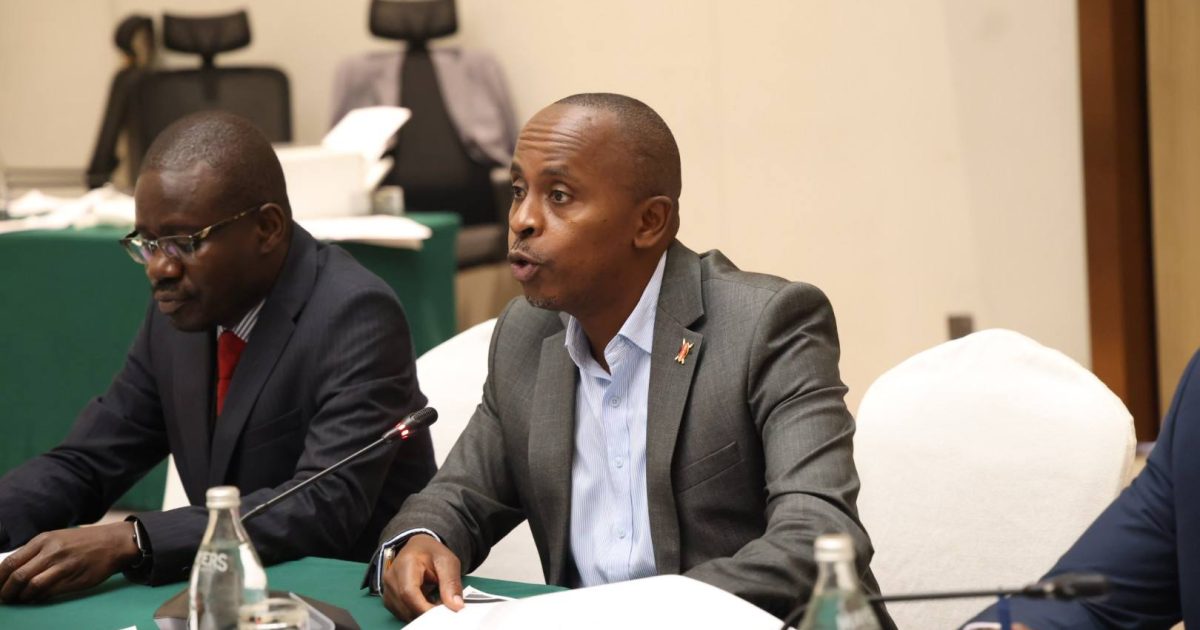
The National Assembly Budget and Appropriations Committee has engaged the Chairpersons of the Sports Committee and the Committee on Communication, Information and Innovation as part of ongoing sectoral budget reviews before finalization of the national estimates.
Members of Parliament called on State agencies to account for the utilization of public funds, implementation of key projects and delivery of services to wananchi.
While presenting submissions before the Budget Committee, Endebess MP Robert Pukose raised concerns over the state of digital hubs across the country, noting that many centres established to expand access to digital services remain non-operational.
“Digital hubs are not active and do not have equipment,” said Pukose, underscoring the need for effective implementation of the government’s digital economy agenda.
Lawmakers also questioned persistent poor network connectivity despite the availability of resources under the Universal Service Fund.
MPs Ali Wario and David Ochieng sought explanations on why several parts of the country continue to experience weak communication signals and unreliable internet services.
“Poor network coverage remains a challenge across the country. What is the Communications Authority doing? The Universal Service Fund has enough money, yet wananchi are still struggling with connectivity,” the members posed.
In response, Chairperson of the National Assembly Departmental Committee on Communication, Information, and Innovation, Dagoretti South MP John Kiarie observed that network challenges stem from multiple factors, including service capacity limitations and inadequate infrastructure in rural areas.
“The network coverage issue has a number of informing factors, including service capacity. We have noted that service quality is dropping, including calls dropping and unstable internet,” said Kiarie.
He added that Parliament would engage service providers and the ICT Committee to improve quality of service and expand installation of communication masts in underserved rural constituencies such as Garsen constituency.
The Communication, Information and Innovation Committee further proposed several reforms aimed at strengthening the ICT and broadcasting sectors. Among the recommendations was a proposal requiring the National Treasury to fully entrench a Zero-Based Budgeting approach beginning July 2026.
The Committee also directed the State Department for ICT and Digital Economy and the State Department for Broadcasting and Telecommunications to develop a collaborative framework on incorporation of Studio Mashinani into digital hubs by September 2026.
Financially, the Committee proposed additional allocations for Konza Technopolis Development Authority, ICT field services and the Media Council of Kenya.
The Committee also highlighted non-funded requests amounting to Sh839 million, including Sh500 million for construction of the Kenya Institute of Mass Communication Eldoret Campus and Sh389 million for hosting the Global Privacy Assembly.
In a separate meeting, the Sports Committee assured Members that Kenya remains on course to successfully host AFCON despite concerns over incomplete sports infrastructure.
On his part, Christopher Aseka sought clarification on the status of stadium projects and the country’s readiness for the continental tournament.
“Are we ready for AFCON? Please share a list of incomplete stadiums,” posed Mr Aseka.
Responding to the concerns, Sports Committee Chairperson Dan Wanyama assured the House that preparations were progressing well.
“We have paid the hosting fee and the stadium renovations are on track. Kenya is ready to host AFCON,” said Wanyama.
The Sports Committee proposed approval of Sh32.2 billion for the State Department for Sports, comprising Sh3.49 billion for recurrent expenditure and Sh28.76 billion for development expenditure.
Additional allocations proposed by the Committee include Sh180 million for the Kenya Academy of Sports, Sh40 million for the Anti-Doping Agency of Kenya and Sh705 million for rehabilitation of stadia and construction of community sports grounds through the Sports, Arts and Social Development Fund.
The Committee also recommended increased support for the creative economy and cultural sector, including Sh60 million for the Kenya Film Classification Board, Sh50 million for the Kenya Film Commission and Sh70 million for the Kenya Film School.
Lawmakers further noted the need to fast-track review of the Sports Act, operationalization of the National Heroes Fund and completion of the Creative Economy Bill 2026 to strengthen governance, commercialization and protection of intellectual property rights within the creative sector.
Trade, Industry and Cooperatives Committee Chair, Mr Bernard Shinali on his part called for increased funding to the State Department for Cooperatives and the State Department for Medium and Small Enterprises.
By Joseph Ng’ang’a